
Reviewed · USA
Salt Lake City Self-Guided Walking Audio Tour
Salt Lake City’s story comes into focus on foot, one monument and grand building at a time. This 2.5-mile audio walk links downtown landmarks with the places that shaped Utah, from Brigham Young and the Mormon pioneers to the state Capitol and modern LDS facilities.
I like the freedom to pause for photos, snacks, or a side trip, and I like the small details, such as the first elevator in the Crandall Building and the crop-saving seagulls of Mormon tradition. The main drawback is navigation. A few transitions can be confusing, especially around the Capitol, and the automatic audio may not trigger if you start away from the marked point or walk too fast.
I especially like these parts:
- A walk through Temple Square: See the Assembly Hall, Tabernacle, Salt Lake Temple, Relief Society Building, and nearby church institutions.
- More than 30 audio stories: The 20 named stops are supported by extra stories for people who want more context.
- A useful mix of history: The route covers religion, immigration, war, women’s political history, architecture, and genealogy.
- Flexible timing: The walk takes about one to two hours at a normal pace, but you can stretch it to nearly three hours with breaks.
- Offline operation: Download the tour on strong Wi-Fi or cellular service, then walk without a live connection.
- A low-cost private outing: At $14.99 per person, your group gets a private, self-guided experience rather than a fixed departure.
What This Salt Lake City Audio Walk Actually Covers
This is a walking tour of central Salt Lake City, not a ride through the wider valley. You begin outside the Visit Salt Lake Center at 90 South West Temple Street and finish near 60 North Temple, by the FamilySearch Library.
The route runs a little more than 2.5 miles and includes over 30 audio stories. The published timing is one to two hours, but the pace is yours. One person stretched the experience to almost three hours by stopping often and listening slowly. That is a useful clue: do not treat the one-hour figure as a race.
The narrator’s name is not provided, but the audio is designed to play automatically as you reach each location. You can pause, skip stories, or listen to extra material. For the smoothest experience, use headphones and keep the phone’s location services active.
Starting at the Crandall Building and Brigham Young
The first stop begins outside the Visit Salt Lake Center. Before you walk, make sure you are physically at the marked starting point. The app uses your location to trigger the stories, and starting elsewhere can create gaps.
The opening story introduces Salt Lake City as Utah’s capital, set at the base of the Wasatch Mountains, with Mormon settlement and Western expansion at the center of its story. Nearby, the Crandall Building provides a quick architectural and social-history lesson.
Built in the 1890s, the Crandall Building was originally home to McCornick Bank and was among the city’s first buildings with an elevator. The story about women in calico dresses accompanying their husbands simply to ride the new machine is a good example of the tour’s tone. You get a memorable human detail, not just a date and building name.
Across the street, the 25-foot bronze statue of Brigham Young shifts the focus to Mormon leadership. The audio explains Young’s upbringing in western New York and his slow path toward joining the Mormon faith after studying the Book of Mormon for two years.
This opening section is short, but it gives you the basic framework for the rest of the walk: a young city, a demanding faith, and a community trying to build a home in difficult surroundings.
More Audio Walking Tours in the USA
- Self Guided Classic Freedom Trail Location Aware (GPS) Walking Audio Tour
★ 4.5 · 258 reviews - Cape Cod & Provincetown Self-Guided Driving & Walking Audio Tour
★ 4.0 · 207 reviews - Santa Fe Historic Downtown Smart Phone Audio App Self Guided GPS Walking Tour
★ 4.5 · 112 reviews
Pioneer Memorials and the Seagull Story
The Handcart Pioneer Monument honors a different group from the first Mormon settlers led by Brigham Young. It commemorates European converts who traveled to the Salt Lake area in 1856, pulling handcarts over long distances.
That distinction matters. It keeps the story from turning every pioneer memorial into one general symbol. You get a clearer sense of the different migration waves that brought people to Utah.
The Seagull Monument follows with one of the tour’s more unusual stories. Mormon tradition says that after the pioneers planted crops in 1848, swarms of crickets attacked the fields. The farmers prayed, and seagulls arrived to eat the insects. The gold seagulls on the monument preserve that story.
You should treat this as a religious tradition rather than a plain agricultural report. That is part of the appeal. The tour shows how communities explain survival, hardship, and good fortune through memorable stories.
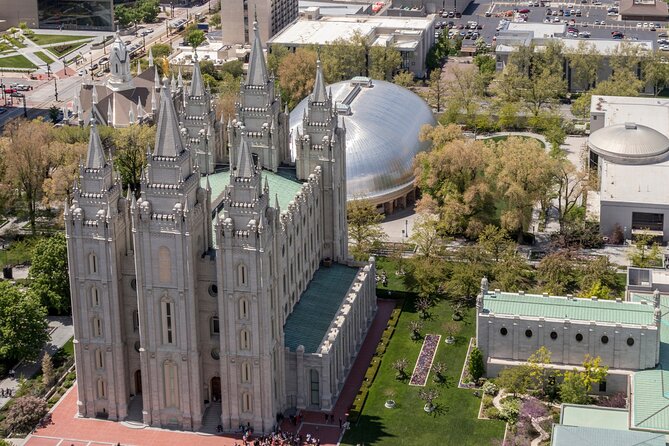
Temple Square: Assembly Hall, Tabernacle, and Temple

The route then reaches the heart of the walk, Temple Square. The square was planned as the center of the Mormon settlement, though the earliest years were marked by hunger and illness rather than monumental buildings.
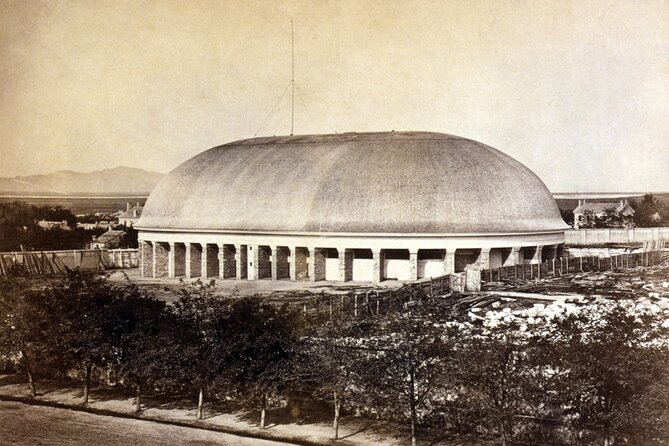
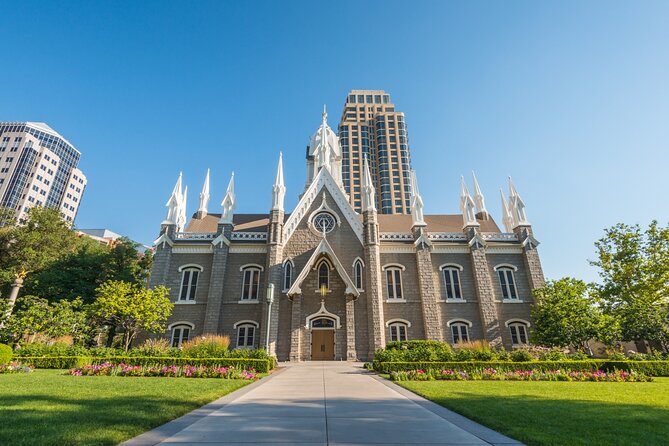
The Assembly Hall, completed in 1882, was a major gathering place. Its scale gives you a sense of how the church grew over the decades. The nearby Salt Lake Tabernacle, built from 1863 to 1867, came first and was designed for large church gatherings and events.
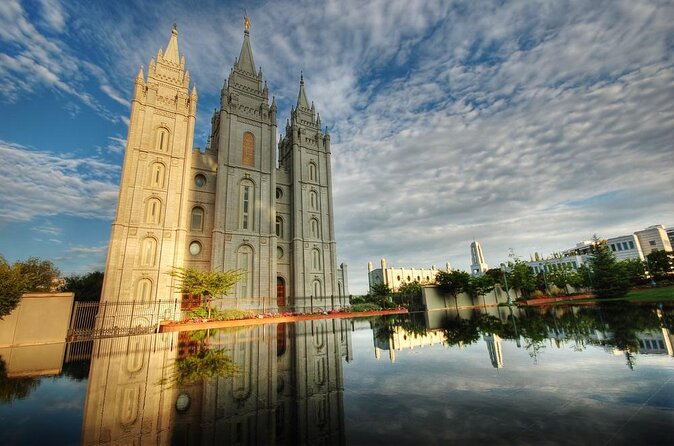
The Salt Lake Temple is the visual centerpiece. Look for its tall spires and the statue of the angel Moroni, whom the audio identifies as the angel associated with Joseph Smith and the golden tablets of the Book of Mormon.
The tour does not include attraction tickets or reservations, so the experience here is primarily an outdoor walk and audio commentary. That is important if you are hoping to enter buildings. The provided information does not promise interior access, and you should plan around the outdoor route unless you separately confirm opening arrangements.
The Relief Society Building adds another angle. The Relief Society began in 1842 as a women’s organization focused on helping the poor. The audio also points to internal struggles around the organization in the early years, giving the story more tension than a simple description of a charitable group.
Brigham Young’s Estate and City Creek Park
At Brigham Young Historic Park, you hear about the land once owned by Young and his family. The original estate extended nearly three blocks and included barns, workshops, and orchards of apples, peaches, and pears.
This is a useful stop because it moves the story away from formal church buildings. You begin to picture daily work, food production, and household life in the growing settlement.
The next stop is City Creek Park. Follow the path with the creek on your left. The pioneers dammed the creek early on, using the water and softened ground to grow produce such as turnips.
The park section is also where the route can feel less obvious. Keep an eye on the app’s map and listen for the next cue. If you stop for photos or wander off the path, the GPS may not trigger the next story until you return to the route.
More Self-Guided Audio Tours in the USA
- Gettysburg Battlefield Self-Guided Driving Audio Tour
★ 4.5 · 910 reviews - Joshua Tree National Park Self-Guided Driving Audio Tour
★ 4.5 · 762 reviews - Ultimate Acadia National Park Self-Guided Driving Audio Tour
★ 4.0 · 521 reviews - Ultimate Lake Tahoe Self-Guided Driving Audio Tour
★ 4.5 · 435 reviews
Council Hall and the Utah State Capitol
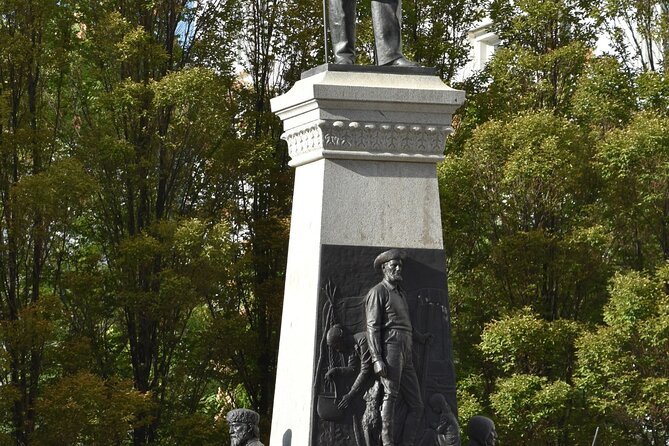
The white Council Hall, topped by a green cupola, once served as Salt Lake City’s Old City Hall. It now houses the Utah Office of Tourism and the Utah Film Commission. The building was not always in its current location, which gives the stop a small lesson in how historic structures can be moved and repurposed.
The route then heads to the Utah State Capitol. This is one of the most important orientation points on the walk, and it is also the section most likely to cause trouble if you rely only on the audio.
The tour explains that Utah operated as a territory from 1850 until 1896. Residents petitioned the federal government seven times before Utah finally became a state. The audio asks why statehood took so long, pointing you toward the political and religious tensions that shaped Utah’s relationship with Washington.
Pay close attention to the walking directions here. The route takes you behind the Capitol building, and that detail is easy to miss if the instruction does not register clearly. If the app seems to lead you in the wrong direction, pause and check the map rather than continuing on instinct.
The Mormon Battalion and Martha Hughes Cannon
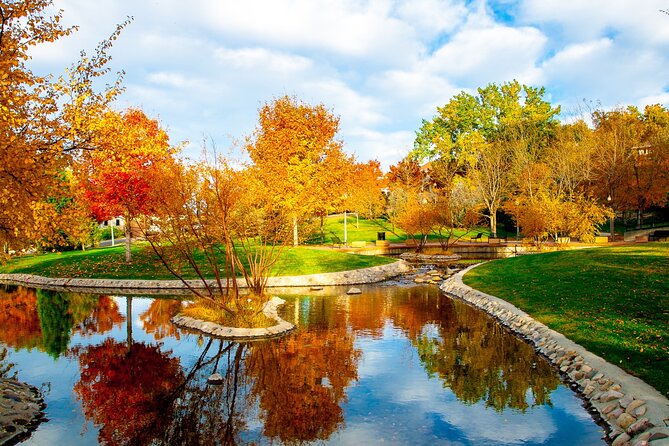
The Mormon Battalion Monument commemorates about 500 Mormon volunteers who joined the U.S. Army during the Mexican-American War. Built in 1927 by Gilbert Riswold, the monument presents different stages of the battalion’s history.
This stop complicates the usual picture of Mormon settlers as isolated from the United States. The volunteers served in a national conflict, even while Mormon communities were dealing with their own struggles and movement west.
Nearby, the Martha Hughes Cannon Statue introduces one of the strongest individual stories on the route. Cannon was the first female state senator in the United States. She immigrated from England, trained as a doctor, worked as a typesetter for a Mormon women’s newspaper, and became known for practical determination.
The detail about her walking to work in men’s boots, with her skirt tucked up to keep it clean, is exactly the kind of small fact that makes a public figure easier to remember. This section also gives the tour a needed focus on women’s work and political influence.
McCune Mansion and Salt Lake’s Wealth
The McCune Mansion is a large brick Victorian home built around the turn of the 20th century. Alfred McCune made his fortune through sections of the Utah Southern Railroad and later moved among wealthy figures such as J.P. Morgan and William Randolph Hearst.
The mansion shows how quickly some Salt Lake City residents moved from pioneer hardship to serious wealth. It also gives the walk visual variety. After monuments, church buildings, and government sites, you get a private residence designed to display status.
The connection to Hearst and Citizen Kane adds a touch of popular culture, but the larger point is economic change. Salt Lake City was no longer only a frontier settlement. Railroads, commerce, and private fortunes were reshaping the city.
The Conference Center, Archives, and Family History
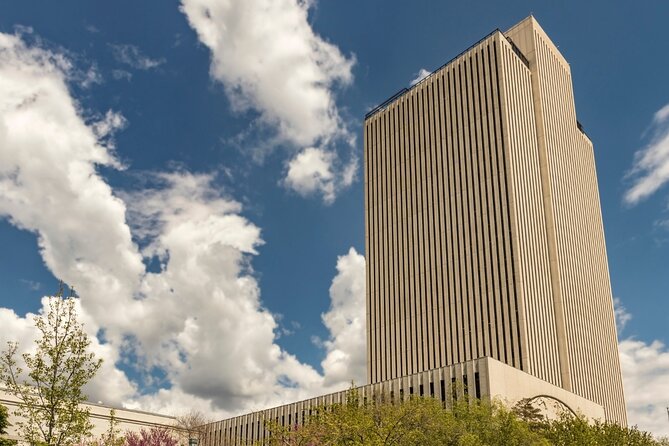
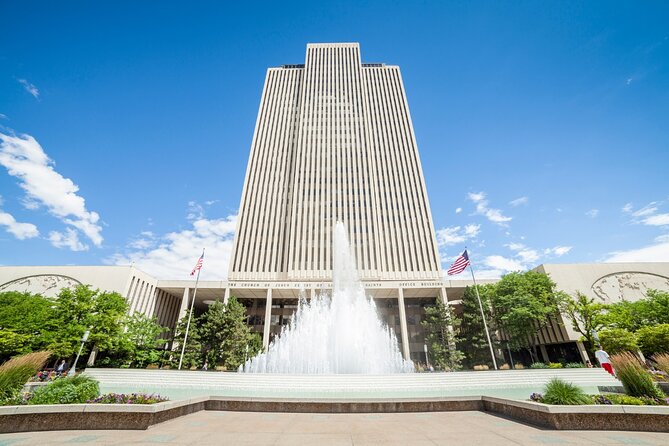
The final group of stops shifts into the modern era. The Conference Center, completed in 2000, hosts the LDS Church’s general conference every April and October. Church members from around the world gather there to hear church leaders.
The Church History Library opened in 2009 and preserves material connected with the Mormon church, including documents dating to the 1820s. If you are interested in Joseph Smith, Brigham Young, or the written record of the church, this stop points you toward a much larger body of material.
The Church History Museum, built in 1984, focuses on exhibits and artifacts from the pioneer journey. The tour presents it as a place to continue the story beyond the outdoor monuments.
The final stop is the FamilySearch Library. Its collection contains names of more than three billion people, held through books, microfilm, and periodicals. Staff can help you begin researching your family background.
This is a strong ending because it connects public history with personal history. You may arrive thinking about Mormon pioneers and leave considering your own family records.
How the App Works in Real Life
After booking, you receive setup instructions and a password by email and text. Search for audio tour if the message is hard to find. Then download the separate Action’s Tour Guide app and download the tour while you have a strong Wi-Fi or cellular connection.
Once the tour is stored on your device, it works offline. That saves mobile data and reduces the chance of losing audio in a weak-signal area.
The tour is private and self-guided. No one meets you at the start. Open the app at the correct starting point, enter the first story’s location, and follow the route. If more than one version appears, choose the one with your intended starting point and direction.
Automatic playback is convenient, but it is not foolproof. One person had trouble getting each stop to start, while another found the route easy to follow. In practical terms, begin exactly where instructed, walk at the suggested pace, and keep the app open enough to check your position.
The tour works on an iPhone with iOS 15 or later, an Android device running version 9 or later, or an iPad or tablet with GPS and cellular connectivity. Couples can share one tour by splitting headphones, though separate devices are more useful if each person wants independent volume control.
Is $14.99 a Good Deal?
At $14.99 per person, this is a reasonable price for a private downtown orientation, especially if you want to walk at a time that suits you. There is no fixed departure and no need to match a guide’s schedule.
The value is strongest if you listen to the extra stories and take your time. The route includes 20 named stops, but the total audio content exceeds that list. You can also reuse the tour on later trips because the access does not expire.
The cost does not include entry tickets, attraction passes, or reservations. That keeps the price simple, but it also means you should not expect an indoor museum visit or a reserved Temple Square experience to be part of the purchase.
Who Should Book This Walk?
I would choose this tour if you like self-guided sightseeing, want a basic introduction to Salt Lake City, or prefer stopping often for photos and food. It suits couples, families with independent walkers, and anyone who dislikes fixed group schedules.
It is also useful for history-minded visitors who want more than famous buildings. The route includes religious history, immigrant journeys, statehood politics, women’s leadership, railroad wealth, military service, and genealogy.
I would be cautious if you need perfectly clear turn-by-turn directions or dislike using a phone while walking. The Capitol section requires care, and GPS-triggered audio can be late or silent if you move too quickly or start in the wrong place.
Cancellation is free up to 24 hours before the scheduled start time. Within 24 hours, the amount paid is not refunded, and last-minute changes are not accepted.
Should You Book the Salt Lake City Audio Tour?
Book it if you want an inexpensive, flexible introduction to central Salt Lake City and are comfortable managing an app. The best parts are the broad subject range, the memorable small stories, and the chance to pause without holding up a group.
Skip it if you want a human guide, guaranteed interior access, or a route that requires no navigation effort. For most independent walkers, though, $14.99 buys a useful first look at the city, with enough extra material to make a second visit worthwhile.
FAQ
How long does the Salt Lake City audio tour take?
The stated duration is about one to two hours. The route is more than 2.5 miles, and you can take longer by pausing for photos, snacks, side trips, or extra audio stories.
Where does the tour start?
It starts outside the Visit Salt Lake Center at 90 South West Temple Street in Salt Lake City.
Where does the tour end?
The route ends at 60 North Temple, Salt Lake City, near the FamilySearch Library.
Is the tour guided in person?
No. This is a private, self-guided activity. No one meets you at the starting point, and the audio plays through the Action’s Tour Guide app.
What language is offered?
The tour is offered in English.
Does the tour work without internet access?
Yes. You must download the tour while connected to strong Wi-Fi or cellular service. After download, the tour works offline.
What device do I need?
The recommended devices are an iPhone running iOS 15 or later, an Android device running version 9 or later, or an iPad or tablet with GPS and cellular connectivity.
Are attraction tickets included?
No. Attraction passes, entry tickets, and reservations are not included in the price.
Can I use the tour more than once?
Yes. The tour provides lifetime access with no expiry, so you can use it on any trip and repeat it as often as you wish.
Latest audio tours in the USA
- Solvang City Personalized Self-Guided App Tour★ 3.0 · 6 reviews
- Essential Downtown SLO: A Self-Guided Audio Tour★ 4.5 · 27 reviews
- Silicon Valley Self-Guided Driving Audio Tour for Tech Lovers★ 4.0 · 24 reviews
- Self-Guided Audio Tour of the Golden Gate Bridge★ 3.5 · 3 reviews
- The Ghosts of San Francisco Haunted Audio App Walking Tour★ 5.0 · 2 reviews
- Point Reyes National Seashore Self Guided Driving Audio Tour★ 4.0 · 9 reviews
- San Francisco Self-Guided Audio Drive: Explore at Your Own Pace★ 4.0 · 9 reviews
- Explore Coronado Island on a Self Guided Audio Tour★ 5.0 · 2 reviews
Audio Walking Tours, compared.
City Monuments Guided Walking Tour with Audio Guide
Read our review →
Self Guided Classic Freedom Trail Location Aware (GPS) Walking Audio Tour
Read our review →
Self-Guided Historical Walking Tour (Audio Guide)
Read our review →
Cape Cod & Provincetown Self-Guided Driving & Walking Audio Tour
Read our review →
Verona Walking Tour with Audio and Written Guide by a Local
Read our review →
Royal Walking Tour and Buckingham Palace Audio Tour
Read our review →
Bologna Walking Tour with Audio and Written Guide
Read our review →Browse the lists this tour appears in