
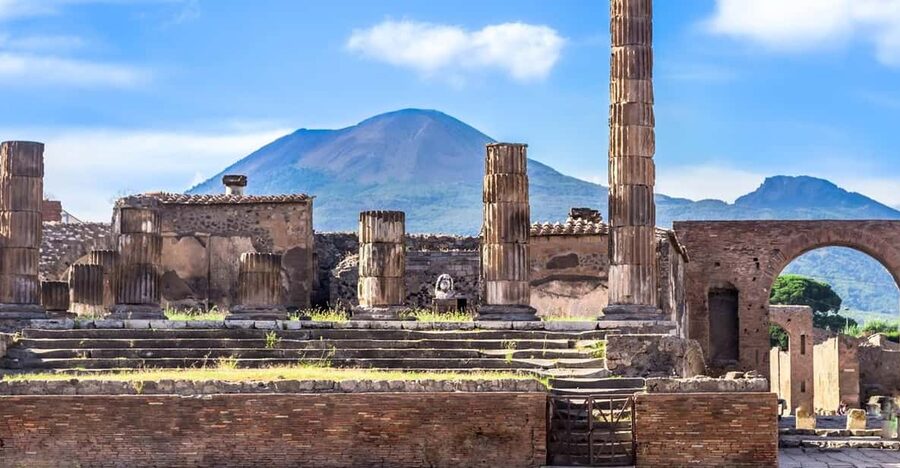
Reviewed · POMPEII
Pompeii Tour_Skip the line ticket + audioguide
Pompeii is not a quick photo stop. It is a full ancient city spread across about 66 hectares, with streets, homes, shops, temples, theaters, baths, and an amphitheater waiting behind the entrance. This skip-the-line ticket and audio guide package gives you the freedom to set your own pace instead of following a fixed group.
I like two things here: fast entry can save precious time at one of Italy’s busiest archaeological sites, and the updated map helps you make sense of a place large enough to overwhelm first-time visitors. The audio guide adds useful structure without tying you to a live guide.
The tradeoff is the depth of the commentary. Do not expect a detailed lecture at every stop. One French-language user found the audio guide far too brief, so travelers who want extensive historical explanation may prefer a tour with a live guide.
Key points to know
- Pompeii covers about 66 hectares: Plan for a serious walk, not a short visit.
- Skip-the-line entry is the main convenience: You avoid the ticket queue and enter with less fuss.
- The visit is self-guided: You receive an audio guide and updated map, but no live guide accompanies you.
- The site mixes daily life with grand monuments: See homes, baths, temples, shops, thermopolia, theaters, brothels, and an amphitheater.
- The meeting point is beside Bar De Vivo: Look for the host or greeter there before entering.
- The audio guide comes in nine languages: Choices include English, French, German, Italian, Hebrew, Chinese, Russian, Spanish, and Portuguese.
Why Pompeii Needs More Than a Quick Hour
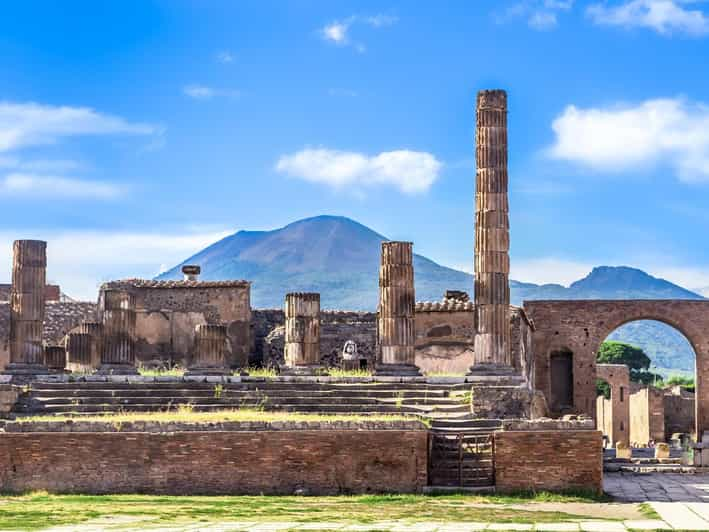
Pompeii is famous because the eruption preserved an entire Roman town in place. That makes the visit different from seeing isolated statues or a single temple. You walk along ancient streets and move from private houses to public buildings, shops, religious spaces, and entertainment venues.
I find that scale both thrilling and tiring. The site is large, and the most interesting areas are spread out. A map matters because you can easily spend too much time in the first few streets and miss major buildings farther inside.
The experience is best treated as an independent day visit. You are not being rushed from one landmark to the next. You can pause at a frescoed house, listen to the audio guide, study a street layout, and then continue when you are ready.
At $44 per person, the package is priced above a basic admission ticket, but the value depends on what you need. If skipping the ticket queue and having a map and commentary saves you time and confusion, the added cost can make sense. If you already know Pompeii well or plan to read about it in advance, the audio guide may add less value.
More Audio Tours in Pompei Campania
- Pompeii: Skip-the-line Entry Ticket with Audio Guide & Map
★ 3.9 · 3,153 reviews - Pompeii: Skip-the-Line Entry Ticket with Digital Guide App
★ 4.1 · 770 reviews - Pompeii: Skip-the-Line Entry & Audioguide
★ 3.8 · 225 reviews
Meeting Beside Bar De Vivo
The meeting point is directly beside Bar De Vivo. This detail is simple but important. Do not arrive at the archaeological entrance and assume the host will find you there. Go first to the stated meeting point and look for the host or greeter.
Assistance is available in English, Italian, Spanish, and French. The host or greeter is there to help with the entry process, but this is not a guided walking tour. Once you receive your ticket and audio guide, you explore on your own.
That arrangement suits independent visitors. You avoid the stop-and-start rhythm of a large group and can choose how much time to give each area. It also means you need to pay attention to the map and keep track of your own route.
The meeting point beside a café may be convenient for a final drink or meeting nearby, but food and beverages are not included. Keep that separate from the ticket price when planning your day.
Entering Pompeii Without the Ticket Queue
The skip-the-line feature is the strongest practical reason to book this option. Pompeii draws roughly 3 million people each year, so the entrance can be busy. Skipping the ticket line does not turn the site into a private visit, but it removes one of the least rewarding parts of the day.
You still need to meet the host or greeter and collect the materials. Bring your passport or ID card, as identification is listed among the required items. Comfortable shoes and comfortable clothes are also essential because the site is extensive and the visit involves plenty of walking.
There is no transfer included. You must make your own way to the meeting point in Campania, so this package works best for people who have already arranged transportation to Pompeii. It is not a hotel pickup or a complete day excursion from Naples or another city.
The ticket is valid for one day. That gives you flexibility to spend the whole day inside, but you should check the available starting times when booking. No fixed itinerary or exact visit duration is provided, so your pace is largely up to you.
Using the Map and Audio Guide
The updated map is more important than it may first appear. Pompeii is not a compact monument with one obvious route. Its streets and buildings spread across a broad area, and a first-time visitor could easily wander without seeing the places that matter most.
Use the map before you begin. Mark the major areas you most want to see, then use the audio guide to add context as you move between them. This approach is better than simply walking until you are tired.
The audio guide is available in English, French, German, Italian, Hebrew, Chinese, Russian, Spanish, and Portuguese. That broad language choice is useful for couples or families who prefer to listen in their own language.
Keep your expectations measured. The guide is described as an aid for independent exploration, not as a full academic program. In at least one French-language experience, the commentary was considered very brief. If you want long explanations about Roman society, architecture, and the eruption, you may find the audio material lacking.
I would treat it as a navigation and orientation tool first, then as a source of basic information. Read the descriptions, listen at the main stops, and give yourself time to look closely rather than racing from one audio point to another.
Another self-paced route in Pompei Campania:
- Pompeii: Skip-the-Line Ticket with Audio Guide and Map
★ 4.0 · 117 reviews - From Pompeii: Vesuvius Entry with Transfer and Audioguide
★ 4.2 · 74 reviews - Pompeii & Herculaneum: Skip-the-line & Digital Guide App
★ 4.0 · 35 reviews - Herculaneum and Pompeii in one day: Audioguides + Tkts (art)
★ 3.7 · 22 reviews
Frescoed Homes and Roman Domestic Life
The houses, or domus, are among Pompeii’s most absorbing stops. They show how wealthy Roman households arranged rooms around interior spaces and decorated walls with painted scenes and patterns.
The appeal is not only artistic. These homes let you see where private life took place, how rooms connected, and how decoration signaled status. A fresco can be beautiful, but the house around it explains how the artwork functioned in daily life.
Some homes may be open while others are closed at a given time. The supplied information does not promise access to every building, so use the map and follow the areas available during your visit.
This is also where a short audio guide can feel limited. You may want more explanation about the difference between public and private rooms, the purpose of wall paintings, and the people who lived in the houses. Take your time, and let the architecture supply part of the story.
Baths, Temples, and the Public City
Pompeii’s baths and temples show the public side of Roman life. The baths were not simply places to wash. They were social spaces, and the surviving rooms help you picture the systems and routines that supported them.
The temples offer another change of mood. Their remains show how religion shaped the city and how public buildings were placed along its streets. You may find that these areas make more sense after seeing the houses and shops, because they show how domestic, commercial, and religious life fitted together.
The site’s value comes from this mixture. Pompeii is not just a collection of grand monuments. Its streets connect ordinary activities with public ceremony, and the map helps you see those connections.
Because the ruins are spread out, wear shoes with good support. Comfortable clothing is listed as an essential item, and it is sensible advice for a full day on ancient streets and uneven surfaces.
Shops, Thermopolia, and the Street-Level Experience
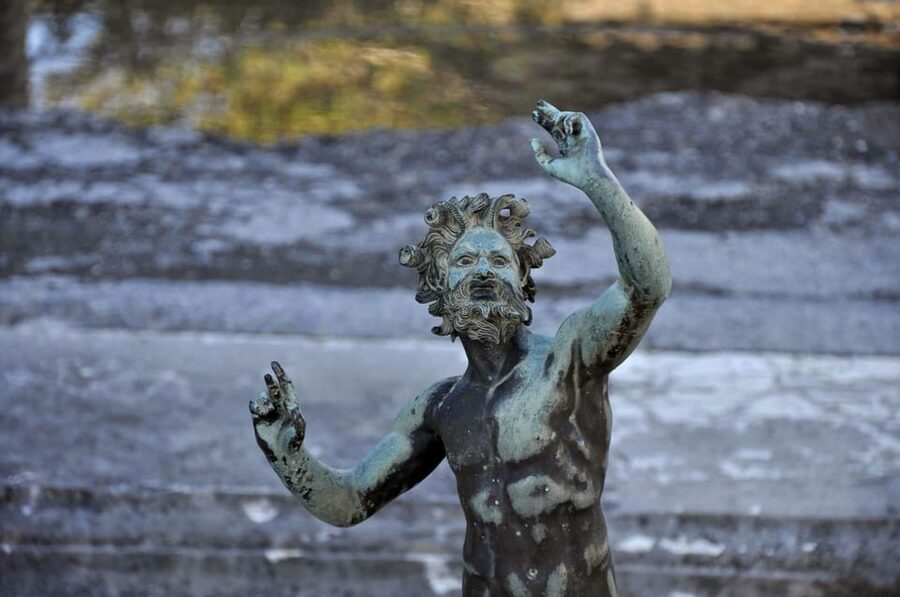
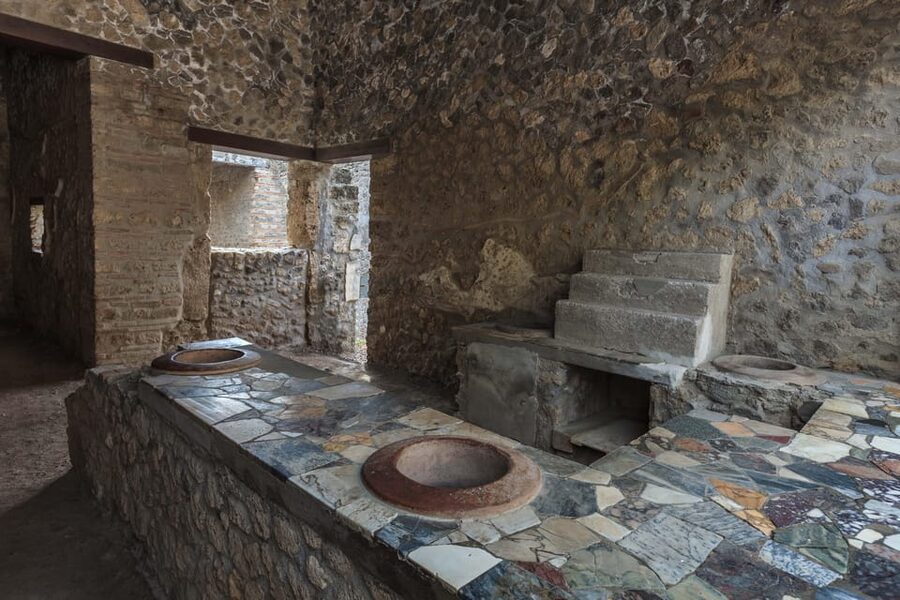
The shops and thermopolia offer some of the clearest links to everyday life. A thermopolium was a Roman food outlet, something like a quick-service counter or café. Seeing these spaces helps you picture how residents bought food and conducted business outside their homes.
These smaller places can be easy to rush past in favor of famous monuments. I would not. The shops show Pompeii as a working city, not only as a place of temples and wealthy houses.
The audio guide should help identify these stops, while the map lets you connect them to the surrounding streets. You may find that the most memorable moments come from noticing how close commercial spaces were to homes and public buildings.
There is no food or beverage included in the experience. Plan accordingly, especially if you intend to spend most of the day at the site. The package is built around access and interpretation, not meals.
Theaters, Brothels, and Pompeii’s Less Polished Side
Pompeii also preserves entertainment spaces and brothels. These places add balance to the usual picture of Roman civilization. The city was not only temples, formal houses, and public ceremonies. It had entertainment, commerce, private behavior, and activities that were more practical than respectable.
The theaters show how people gathered for performances. The brothels offer a glimpse of another part of urban life, presented through the physical layout and surviving decoration.
You may find that these sites are among the most interesting because they challenge a tidy view of the ancient world. They make Pompeii feel like a real town with many kinds of residents and businesses.
Do not assume every building will be open every day. The information provided does not promise access to each named location, so use the route as a guide rather than a guarantee that every room will be available.
Victim Casts and the Amphitheater
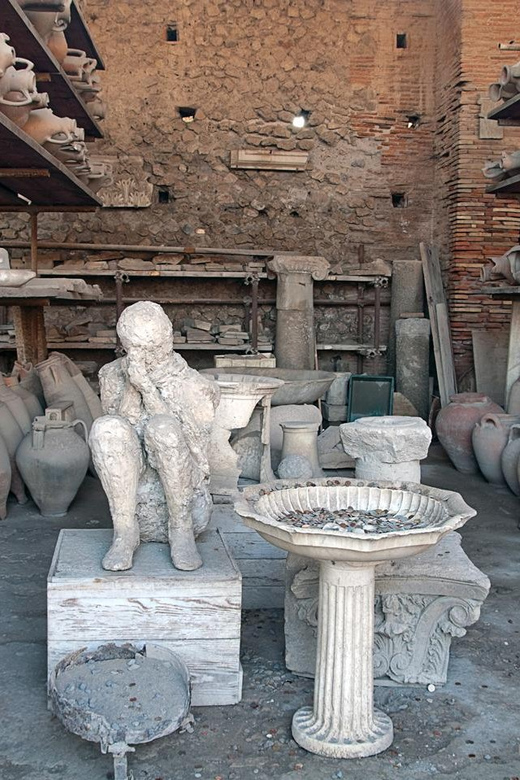
The casts of eruption victims are among Pompeii’s most powerful sights. They bring a human scale to an event that can otherwise seem distant. Approach them thoughtfully. They are not simply dramatic objects for photographs, but evidence of lives interrupted by the eruption.
The preserved amphitheater offers a different experience. It is one of the best-preserved Roman amphitheaters, and its scale helps you understand the place of public entertainment in city life.
Together, the casts and amphitheater create a striking contrast. One shows the sudden destruction of ordinary people. The other shows the organized public life that existed before the disaster.
These are important stops to mark on your map early. Since the archaeological area is large, you do not want to discover their location only after you have spent most of your energy elsewhere.
How the $44 Price Works for You
The $44 price includes entrance to the Pompeii ruins and an audio guide. It does not include transport, a live guide, food, or beverages.
I see the price as reasonable for someone who values convenience and independence. The ticket queue can be a nuisance, and Pompeii is large enough that a map and basic commentary have real practical value. You also get the freedom to choose your own pace instead of joining a set group.
The value is weaker if you want detailed personal explanation. There is no live guide, and the audio content may be concise. A visitor who prefers deep background, questions answered on the spot, and a tightly planned route should compare this with a guided tour before booking.
Free cancellation up to 24 hours before the activity and the option to reserve now and pay later make the booking less rigid. The activity is valid for one day, with starting times shown through availability. Those are useful protections when your Campania plans are still changing.
Who Will Get the Most From This Visit
I would choose this experience if you want to explore independently, dislike waiting in ticket lines, and are comfortable managing a large archaeological site with a map.
It suits:
- First-time Pompeii visitors who want basic direction without a full group tour
- Independent travelers who prefer choosing their own stops
- Visitors who need audio commentary in one of the nine listed languages
- People with a full day available for a large outdoor site
- Anyone who wants the convenience of a host or greeter but not a live guide throughout
I would think twice if you want a detailed, story-heavy interpretation at every building. The short audio content may leave you wanting more, especially if Pompeii’s history is the main reason for your visit.
Should You Book This Pompeii Ticket?
Book it if your priority is easy entry, a flexible route, and enough information to explore Pompeii on your own. The skip-the-line ticket and map are the strongest parts, while the wide choice of audio languages makes the package practical for many visitors.
Do not book it expecting a private guide or a full historical seminar. Bring your ID, wear comfortable shoes, arrive beside Bar De Vivo, and plan for a long walk across a very large site. For an independent day at Pompeii, $44 can be good value, provided you are happy to supply some of the deeper background yourself.
FAQ
How much does the Pompeii tour cost?
The price is $44 per person.
How long is the ticket valid?
The ticket is valid for one day.
Is transportation included?
No. Transfers are not included, so you must arrange your own transportation to the meeting point.
Where is the meeting point?
The meeting point is directly beside Bar De Vivo.
Is a live guide included?
No. The package includes a skip-the-line entrance ticket and an audio guide. A host or greeter is available in English, Italian, Spanish, or French.
Which languages are available for the audio guide?
The audio guide is available in English, French, German, Italian, Hebrew, Chinese, Russian, Spanish, and Portuguese.
What should I bring?
Bring your passport or ID card, comfortable shoes, and comfortable clothes.
Are food and beverages included?
No. Food and beverages are not included.
Can I cancel the booking?
Yes. You can cancel up to 24 hours in advance for a full refund. You can also reserve now and pay later.
Latest audio tours in Pompei Campania
- Pompeii: Skip-the-Line Ticket with Audio Guide and Map★ 3.9 · 5 reviews
- Pompeii: Pre-reserved ticket with audio guide★ 3.2 · 15 reviews
- Pompeii: Skip-the-Line Ticket with Audio Guide and Map★ 4.0 · 14 reviews
- Pompeii, skip-the-line ticket with smartphone audio guide on App★ 3.0 · 4 reviews
- Pompeii: Skip the Line Ticket + Audioguide★ 3.3 · 13 reviews
- Pompeii: Skip The Line Entrance Tickets + Audioguides★ 3.2 · 4 reviews
- Pompeii Skip-the-Line Ticket and Audioguide★ 4.2 · 7 reviews
- Pompeii & Herculaneum: Skip-the-line & Digital Guide App★ 4.0 · 35 reviews
Pompeii Audio Tours, compared.

Skip-the-line Entry Ticket with Audio Guide & Map
Read our review →
Skip-the-Line Entry Ticket with Digital Guide App
Read our review →


Pompeii & Herculaneum: Skip-the-line & Digital Guide App
Read our review →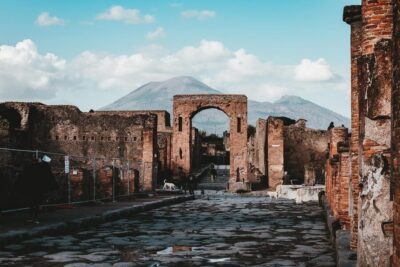
Herculaneum and Pompeii in one day: Audioguides + Tkts (art)
Read our review →Browse the lists this tour appears in