
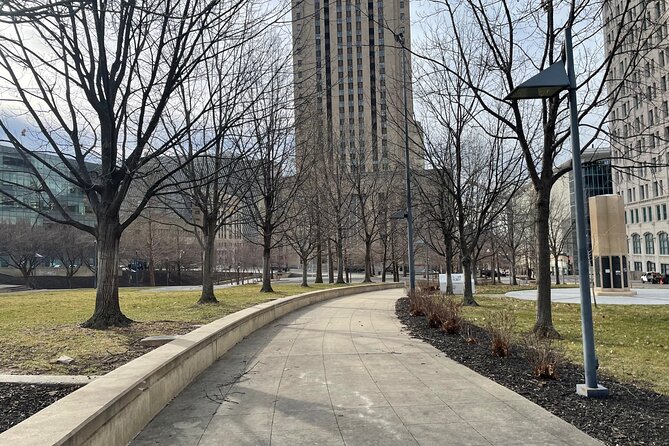
Reviewed · USA
Kansas City Self-Guided Walking Audio Tour
Kansas City’s downtown past comes alive through theater, jazz, politics, and grand old buildings on this self-guided audio walk. In about 1 to 2 hours, you move from Hotel Phillips and the former Gayety district to the Folly Theater, the Garment District, early skyscrapers, and a Civil Rights landmark.
I like the freedom to pause for coffee, photos, or a side trip, then pick up where you left off. I also like the offline maps and location-triggered stories, which let you walk hands-free without watching your phone every few minutes. The main drawback is practical: some information may not match current construction, and setting up the separate app takes a little care.
Key points to know before you go
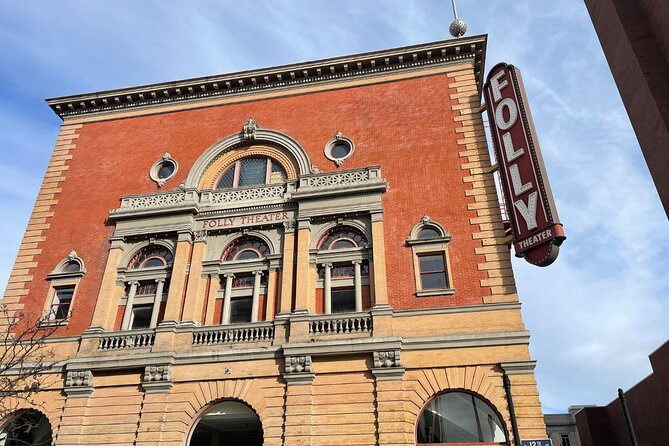
- Kansas City’s theater past: Connect the Folly Theater with the vanished Newman and Gayety theaters on 12th Street.
- A 1.7-mile downtown route: More than 33 audio stories fill a walk that usually takes 1 to 2 hours.
- History with local character: Hear about Harry Truman’s haberdashery, Kansas City jazz, the Garment District, and Bloody Bill Anderson.
- Flexible access: Pause, restart, skip stories, or spread the route over several days with lifetime access.
- No guide or group schedule: You start on your own, using the Action Tour Guide app and your phone’s location.
- A low-cost introduction: At $14.99 per person, it can be good value if you want context without paying for a private guide.
A walking tour built around Kansas City’s downtown story
This is not a tour of every major Kansas City sight. It focuses on a compact downtown area where entertainment, politics, commerce, and architecture overlap.
The route covers more than 1.7 miles and includes at least 33 audio stories. The named stops are the main anchors, but the extra narration gives you more context as you move between them. At $14.99 per person, the price is modest compared with a private walking tour, especially since access does not expire.
You can use the tour once, return to it later in the same trip, or bring it back on another visit. That lifetime access matters most if you prefer to explore in short pieces rather than follow a fixed group schedule.
The route begins at KC Area Credit Union, at 601 E 12th Street, Room G-61, and ends at 1000 Locust Street. No one meets you at the starting point. You arrive, open the app, and let the first story begin when you reach its location.
More Audio Walking Tours in the USA
- Self Guided Classic Freedom Trail Location Aware (GPS) Walking Audio Tour
★ 4.5 · 258 reviews - Cape Cod & Provincetown Self-Guided Driving & Walking Audio Tour
★ 4.0 · 207 reviews - Santa Fe Historic Downtown Smart Phone Audio App Self Guided GPS Walking Tour
★ 4.5 · 112 reviews
How the Action Tour Guide app works
After booking, you receive setup instructions and a password by email and text. Search for audio tour in both places if the instructions do not appear right away.
You must download the separate Action Tour Guide app while you have a strong cellular or Wi-Fi connection. Once the route is downloaded, it works offline. That is useful in a downtown setting, where you do not want to depend on a steady signal while walking.
The audio stories play automatically when you reach the correct points. Follow the spoken directions and move at a normal walking pace for the best results. Bring headphones or earbuds, and keep your phone charged.
If more than one tour version appears in the app, choose the one that matches your starting point and direction. The tour can be opened on as many devices as the number of people booked. For a couple, splitting one set of headphones may reduce the total cost, though separate devices are easier if you want to stop and listen at different speeds.
The setup is not difficult, but it is not as simple as meeting a guide outside a hotel. Download the route before you arrive, test the app, and make sure location services are active. A past version of the route also had some information affected by construction, so use common sense if a sidewalk or building entrance has changed.
Hotel Phillips and the story of Harry Truman
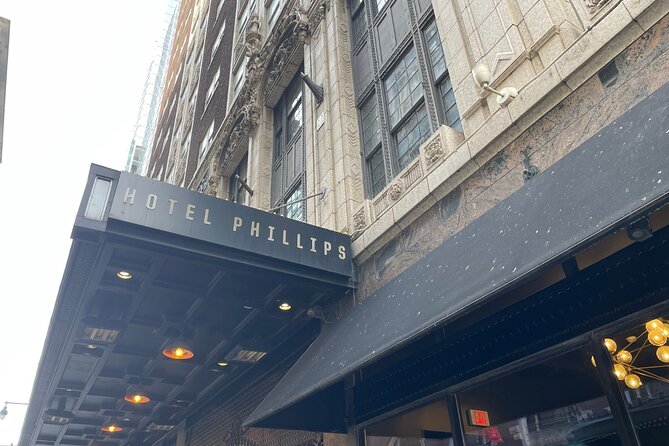
The first named stop is Hotel Phillips Kansas City, Curio Collection by Hilton. The story reaches back to the Glennon Hotel, which once occupied the same corner.
The Glennon had a small haberdashery, an old-fashioned men’s clothing shop. Its most famous owner was Harry Truman, who sold hats and ties before his political career took off. That detail gives the tour an appealing starting point. You are not simply looking at a hotel facade. You are connecting a familiar American president with a small downtown business.
This stop also sets the tone for the route. Kansas City’s past appears through ordinary streets and buildings, not only through formal monuments. Allow about five minutes here.
Jackson County Courthouse and shared civic design
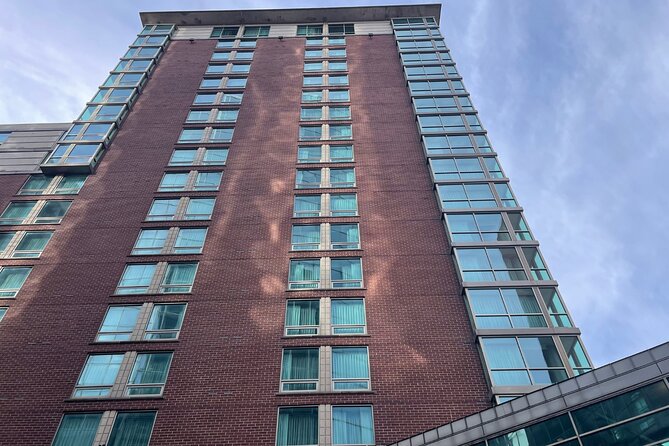
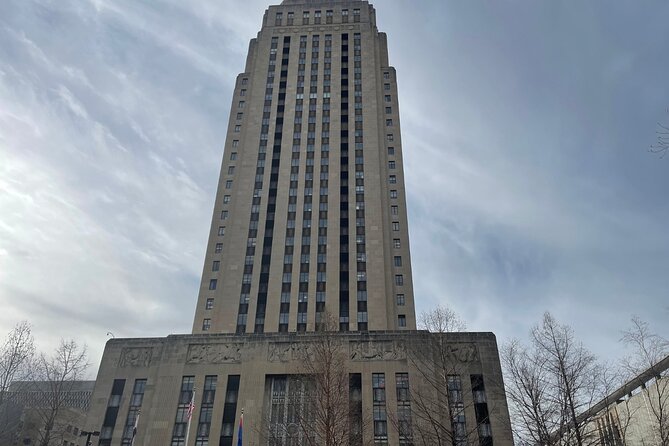
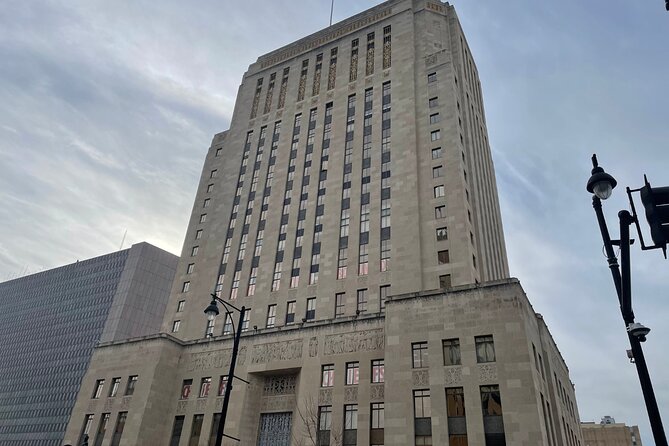
The Jackson County Courthouse dates from 1934. The audio points out its resemblance to City Hall and explains that the same architecture firm designed both buildings.
That comparison is useful because it teaches you to look at the city as a group of related structures. Instead of treating each building as an isolated stop, you begin noticing repeated shapes and design choices.
The courthouse is a quick stop, listed at about five minutes. It works well early in the route because it shifts the subject from private business to public power.
More Self-Guided Audio Tours in the USA
- Gettysburg Battlefield Self-Guided Driving Audio Tour
★ 4.5 · 910 reviews - Joshua Tree National Park Self-Guided Driving Audio Tour
★ 4.5 · 762 reviews - Ultimate Acadia National Park Self-Guided Driving Audio Tour
★ 4.0 · 521 reviews - Ultimate Lake Tahoe Self-Guided Driving Audio Tour
★ 4.5 · 435 reviews
Barney Allis Plaza and the lost Gayety
At Barney Allis Plaza, the story turns to the Gayety, once one of Kansas City’s important jazz clubs. When Allis took over the Gayety to expand his hotel, the city lost one of its leading music venues.
This is one of the route’s most interesting ideas: urban change can erase a cultural center even while creating something new. The plaza may not reveal the full story on its own, so the audio is doing valuable work here.
Jazz mattered greatly to Kansas City, and this stop helps explain why the city’s entertainment history is more than a list of old theaters. It points to the music culture that shaped the identity of downtown.
The Folly Theater and three stages on 12th Street
The Folly Theater is the route’s most tangible theater stop because it still survives. In the early 1900s, people could walk along 12th Street and visit three major venues: the Newman for a movie, the Gayety for jazz, and the Folly for a dramatic production.
The Folly hosted performers including Shirley Booth, Humphrey Bogart, and the Marx Brothers. That mix of theater, comedy, and film gives the building a broad appeal, even if you are not a theater specialist.
Allow about ten minutes here. The audio does more than identify the building. It places the Folly inside a larger entertainment district and helps you picture how a single street once offered several different kinds of evening entertainment.
Mark Twain’s Missouri connection
The Mark Twain Statue honors one of Missouri’s best-known writers. Twain grew up in Hannibal, where his family remained poor, though he later looked back on his childhood with strong nostalgia.
This is a shorter stop, but it adds a literary note to a route otherwise focused on buildings, politics, and commerce. It also connects Kansas City with the wider story of Missouri, rather than keeping the tour limited to downtown streets.
The statue is listed as a ten-minute stop. Take time to look closely at the monument while listening, since the audio supplies the background that the statue itself cannot.
The Majestic, Quality Hill, and Tom Pendergast
The Majestic began in 1911, when James Fitzpatrick decided that the Quality Hill neighborhood needed a place to have a drink. The business connection to Tom Pendergast adds a political edge to what might otherwise seem like a simple bar story.
Pendergast is an important name in Kansas City’s political past, and this stop shows how nightlife, business, and political influence could overlap. The story gives you a reason to look at The Majestic as more than a restaurant or bar.
The audio allows about ten minutes here. It is a good example of the tour’s style: begin with a building, then follow the people and power connected to it.
The Garment District and Kansas City’s clothing trade
The Garment District once ranked among the largest in the United States, second only to New York. In the 1930s, nearly a quarter of the nation’s clothing came from Kansas City.
That figure changes how you see downtown. Streets that now appear quiet or architectural once supported factories, workers, deliveries, and a major clothing trade. The route asks you to picture the work behind the buildings rather than admiring only their exteriors.
This is one of the more useful stops for understanding the city’s economic past. It also gives the walk a practical, working-city feel. You are hearing about shirts, pants, and dresses made here, not just famous people and grand monuments.
21c Museum Hotel and Harry Truman’s lunch
At 21c Museum Hotel Kansas City, the story returns to the Savoy Hotel, once one of the city’s fanciest steakhouses.
Harry Truman walked there from the Glennon Hotel after working at his haberdashery. He always sat in Booth No. 4 and ordered a well-done steak with light vegetables. Small details like this make a historical figure easier to picture. Truman is no longer only a president in a textbook. He is also a local shopkeeper with a regular lunch spot.
The stop is scheduled for about ten minutes. It is a good place to pause and consider how close together these locations are. The walk links Truman’s working life, dining habits, and downtown routine in a compact area.
The New England Building and changing city heights
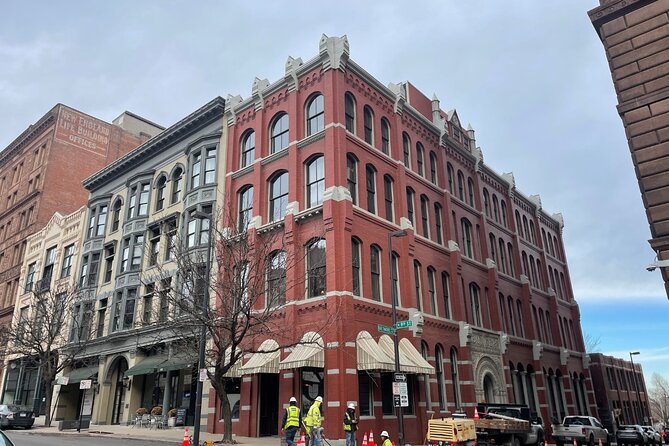
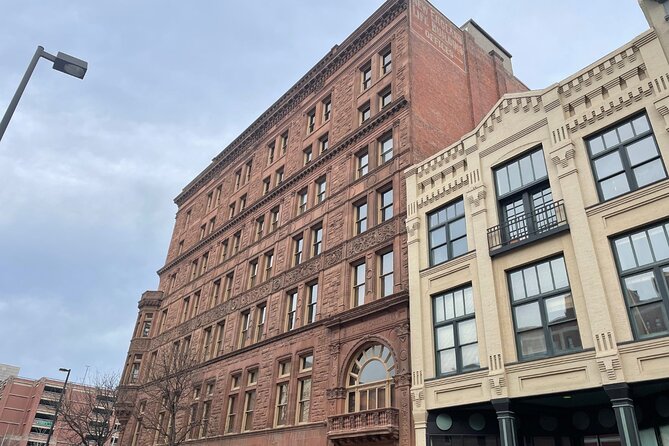
The New England Building is a brownstone apartment building that was once the tallest building in Kansas City.
That fact is a useful reminder that city skylines are temporary. A building that now feels modest beside newer towers once represented the height of modern Kansas City. The stop also adds residential architecture to the route, balancing the theaters, hotels, offices, and public buildings.
You can spend about ten minutes here. Look at the building as an apartment structure, not only as an old facade. Its former height tells you something about the city’s growth and changing sense of scale.
The New York Life Building, Kansas City’s first skyscraper
Construction on the New York Life Building finished in 1890, making it Kansas City’s first skyscraper. The brick and brownstone exterior gives the building a solid, early urban character.
This is one of the clearest architecture stops on the route. The audio explains why the building mattered at the time, while an optional Learn More feature provides extra information about its construction.
If you enjoy architecture, this section may be worth slowing down for. You can pause the route, inspect details, and listen to additional material instead of rushing to the next point.
The Muse of the Missouri fountain
The Muse of the Missouri is a statue and fountain commissioned by Kansas City banker James Kemper in 1962. Kemper created it in memory of his son, who was killed in action fighting the Nazis during World War II.
The statue shows one of the Greek Muses carrying a fishing net. Like many Kansas City statues, it also functions as a fountain.
This stop adds a personal memorial story to the route. It is not only about public history on a grand scale. It is also about one family’s loss and the way that loss was marked in the city.
1000 Walnut Street and the Civil War figure Bloody Bill
At 1000 Walnut Street, you hear about Kansas City’s second-oldest skyscraper and then turn to William Anderson, known as Bloody Bill, a Confederate bushwhacker in Missouri.
This section introduces a darker chapter. Missouri’s Civil War past was marked by conflict between neighbors, irregular fighters, and divided loyalties. The audio’s placement of that story beside an early skyscraper shows how several layers of history occupy the same downtown blocks.
The stop is listed at about ten minutes. If you want the route’s most serious historical material, pay close attention here. It is a sharp change from the lighter stories about restaurants, theaters, and shopping.
Ilus W. Davis Park and the Civil Rights era
The final named stop is Ilus W. Davis Park, connected with Mayor Ilus Davis. He first won election in 1963, during the Civil Rights Movement.
One of his major challenges came on April 9, 1968, only five days after Martin Luther King Jr. was murdered in Memphis. This section brings the tour into modern American history and shows how national events affected Kansas City’s city government and public life.
The story gives the walk a serious ending. You finish not with another old building, but with questions about leadership, race, grief, and civic responsibility.
Who will get the most from this tour?
I would choose this experience if you like history but do not want to join a scheduled group. It suits independent visitors, couples, families with older children, and anyone who prefers stopping often for photos or food.
It is also a good choice if you are visiting Kansas City more than once. Since the access does not expire, you can complete half the route one day and return later. You can also replay stories you found especially interesting.
The tour may be less satisfying if you want a live guide, a question-and-answer format, or a strong focus on present-day Kansas City. Most of its material looks backward, and one direct drawback is that construction can make some directions or descriptions less current.
Timing, cost, and practical planning
The listed operating window is 9 a.m. to 7 p.m., Monday through Sunday. The route itself takes about 1 to 2 hours, but you should allow extra time for photographs, food, shopping, or pauses.
The $14.99 price is fair for a self-guided route with offline maps, automatic audio, extra stories, and lifetime access. A couple can potentially share one tour by splitting headphones, though the booking instructions allow the same password to be used on each device for the number of people booked.
Free cancellation is available if you cancel at least 24 hours before the start time. Changes or cancellations made inside that period are not refunded.
Should you book the Kansas City audio walk?
Book it if you want a flexible downtown introduction built around theater, jazz, architecture, Harry Truman, the Garment District, Civil War history, and Civil Rights history. The strongest feature is the ability to explore at your own pace while still receiving a clear narrative.
Skip it if you need a live person to handle directions or if current-day culture matters more to you than historical context. For most independent visitors, the low price, offline access, and lifetime use make this a practical way to get oriented without giving up control of your day.
FAQ
How long is the Kansas City Self-Guided Walking Audio Tour?
The route is more than 1.7 miles long and usually takes about 1 to 2 hours.
How many audio stories are included?
The tour includes more than 33 audio stories, with extra material available through the app.
What language is the tour offered in?
The tour is offered in English.
Where does the tour begin?
It begins at KC Area Credit Union, 601 E 12th Street, Room G-61, Kansas City, Missouri 64106.
Where does the tour end?
The tour ends at 1000 Locust Street, Kansas City, Missouri 64106.
Do I need cellular service during the walk?
You need strong Wi-Fi or cellular service to download the tour before starting. After downloading, the audio and maps work offline.
Does a guide meet me at the starting point?
No. This is a private, self-guided activity. You go to the starting point, open the Action Tour Guide app, and begin when the first story activates.
Can I use the tour more than once?
Yes. The tour has lifetime access with no expiry, so you can use it on different days, future trips, or multiple visits to Kansas City.
Latest audio tours in the USA
- Sequoia National Park Self-Guided Audio Tour★ 4.5 · 9 reviews
- Sequoia and Kings Canyon Audio Tour Self Guide National Park Tour★ 5.0 · 3 reviews
- Kings Canyon National Park Self-Guided Audio Tour★ 4.0 · 4 reviews
- Sedona, Arizona Self-Guided Audio Tour★ 4.0 · 36 reviews
- Sedona & Red Rock State Park Self-Guided Driving Audio Tour★ 3.0 · 30 reviews
- Haunted Savannah Self-Guided Walking Audio Tour★ 4.5 · 3 reviews
- Downtown Seattle Self-Guided Walking Audio Tour★ 4.5 · 6 reviews
- Uncover Seattle: Self-Guided Audio Tour★ 3.5 · 7 reviews
Audio Walking Tours, compared.
City Monuments Guided Walking Tour with Audio Guide
Read our review →
Self Guided Classic Freedom Trail Location Aware (GPS) Walking Audio Tour
Read our review →
Self-Guided Historical Walking Tour (Audio Guide)
Read our review →
Cape Cod & Provincetown Self-Guided Driving & Walking Audio Tour
Read our review →
Verona Walking Tour with Audio and Written Guide by a Local
Read our review →
Royal Walking Tour and Buckingham Palace Audio Tour
Read our review →
Bologna Walking Tour with Audio and Written Guide
Read our review →Browse the lists this tour appears in