Reviewed · BOSTON
Boston: City History and Highlights Audio App Walking Tour
Boston’s Revolution-era story unfolds best on foot, and this two-hour GPS audio walk links graves, churches, markets, monuments, and old streets into one useful route. You begin at Copp’s Hill Burying Ground and finish at the George Washington Statue in the Boston Public Garden, passing through the North End, the Rose Kennedy Greenway, downtown, and Boston Common.
I like the freedom to pause and resume, especially if you want cannoli, coffee, or a closer look at Quincy Market. I also like the odd, memorable facts, from the Boston Massacre trial to the 1919 molasses flood. The main caution is technical: the app failed for one booking, and the tour is English only, so you need a charged phone, headphones, and a little patience.
Key points to know
- Copp’s Hill to the Public Garden: The route crosses several of Boston’s most important historic areas in about two hours.
- Big Al’s lively narration: One positive review specifically praised Big Al for being entertaining and informative.
- GPS-guided audio: Tracks begin at the right location, so you should not need to stare at your phone for every turn.
- A strong mix of famous and unusual stories: Hear about Paul Revere, Samuel Adams, the Irish Famine, the Big Dig, and the Great Molasses Flood.
- English only: No French, Italian, or other language option is provided.
- Walking is the whole experience: Transportation and a live guide are not included, and the tour is not suitable for people with mobility impairments.
A self-guided route through Boston’s founding story
This is not a museum tour with a guide waiting under an umbrella. It is a walking route that uses your smartphone and GPS-triggered audio to give Boston’s streets a running commentary.
At $7 per person, the price is modest. You are paying for a prepared route and narration rather than a group experience, personal questions, or entrance to historic interiors. That makes it good value if you already enjoy walking and want some structure without committing to a fixed departure time.
The route takes about two hours, though you should allow more time if you stop for food, browse Quincy Market, enter an open site, or linger in the burying grounds. One family found the walk took much longer than expected and still enjoyed it. That is a useful warning: the stated time is a guide, not a stopwatch.
The audio is in English. The tour does not include a live guide, transportation, or admission fees. You will need headphones and a charged smartphone, and you should open the VoiceMap app before reaching the starting point.
More Audio Walking Tours in the USA
- Self Guided Classic Freedom Trail Location Aware (GPS) Walking Audio Tour
★ 4.5 · 258 reviews - Cape Cod & Provincetown Self-Guided Driving & Walking Audio Tour
★ 4.0 · 207 reviews - Santa Fe Historic Downtown Smart Phone Audio App Self Guided GPS Walking Tour
★ 4.5 · 112 reviews
Starting among the gravestones at Copp’s Hill
The tour begins at the entrance to Copp’s Hill Burying Ground, one of Boston’s oldest burial grounds. This is a fitting starting point because the route immediately places you in the city’s colonial past, before it moves into the better-known Revolution stories.
The audio takes you back to 1692 and the grave of Cotton Mather, the minister linked to the Salem Witch Trials. That detail gives the opening some bite. Boston’s past was not only about heroic speeches and clever military signals. It also included fear, religious pressure, and public accusations that harmed real people.
A burying ground is also a practical place to begin an audio tour. You can move slowly, look at old markers, and let the narration set the scene without needing to keep up with a group. The downside is that outdoor historic sites can be harder to appreciate in poor weather, and uneven ground may be tiring if you have mobility problems.
The Old North Church and Paul Revere’s North End
From Copp’s Hill, the route leads toward the Old North Church. This is one of Boston’s essential Revolution stops, and the audio explains the tense years before the fighting began.
You hear about Paul Revere and the midnight riders who warned the Minutemen that British troops were approaching. The church’s famous signal is treated as part of a larger story, not just a single dramatic moment. The route also asks who sent the signal from the steeple, giving you a little historical puzzle to carry along.
The Old North Church is closed on Mondays, so your visit on that day is limited to the exterior. That matters if you hoped to see the inside. The audio can still explain the site, but it cannot replace walking through a building when the interior is open.
The North End adds a modern layer to the old story. As you walk toward the Paul Revere House, you pass restaurants and bakeries associated with Boston’s Little Italy. The contrast is one of the route’s pleasures: colonial houses and Revolutionary-era names sit beside places selling pastries and Italian food.
The tour does not turn the North End into a food tasting. You will need to pay for any food yourself and make your own stops. Still, this is a good place to pause the audio, eat something, and resume when you are ready.
Paul Revere House and the man after midnight
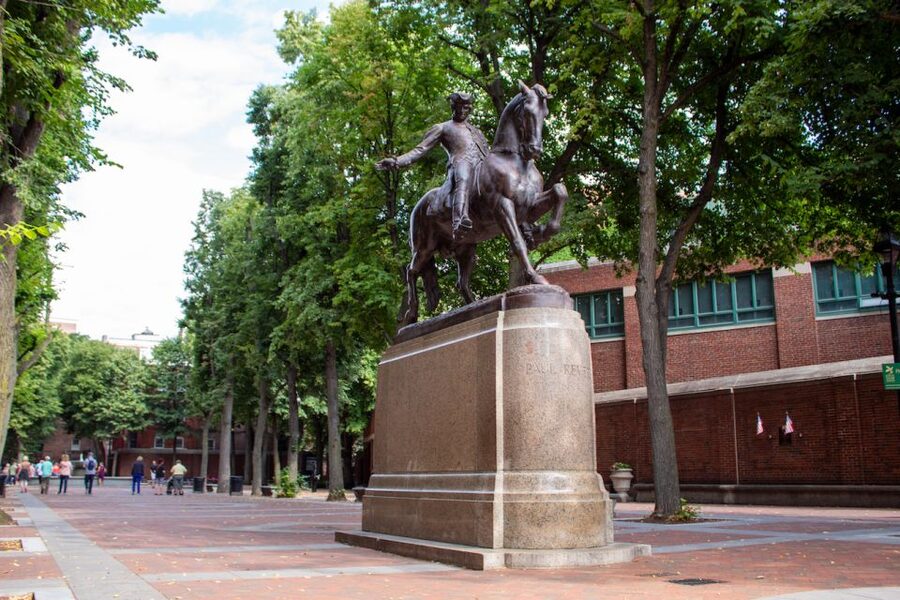
The Paul Revere House is one of the route’s most recognizable stops. The audio puts Revere’s ride into context, then goes beyond the familiar midnight image to discuss what he did after the Revolution.
That extra angle is useful. Boston’s historic figures often get reduced to one famous scene. Revere was more than the rider in a schoolbook story, and the narration gives you a reason to think about his longer life and work.
The tour is self-guided, so you can decide how long to spend outside the house. The provided information does not promise admission or an interior visit, so treat this as an exterior stop unless you separately arrange entry.
This part of the walk can be busy, especially around the North End’s popular food streets. GPS audio is helpful here because you can keep moving while listening, but you should still watch your footing and surroundings rather than follow your phone screen every second.
More History Audio Tours in the USA
- Savannah’s Historical District: A Self-Guided Audio Tour
★ 4.5 · 69 reviews - Salida History Audio Tour l A Self-Guided Wild West Experience
★ 5.0 · 41 reviews - Historic Bar Harbor Self-Guided Walking Audio Tour Guide
★ 4.5 · 38 reviews - Key West’s Old Town Treasures: A Self-Guided Audio Tour
★ 4.5 · 29 reviews
The Rose Kennedy Greenway and the Big Dig
The route then leaves the tight streets of the North End and reaches the Rose Kennedy Greenway. Here the subject changes from colonial Boston to the modern reshaping of the city.
You hear about the Big Dig, the huge highway project that changed the center of Boston. The Greenway gives that story a physical setting. Instead of treating the project as an abstract piece of construction history, the audio connects it to the open public space you are walking through.
This is one of the tour’s better changes of pace. You move from graveyards and old brick buildings into a more open urban corridor, then continue toward Quincy Market and Faneuil Hall.
The Greenway can also be a sensible place to pause. The experience is not tied to a group schedule, so you can stop for a rest and restart the next track when you are ready. That flexibility is one of the clearest reasons to choose an audio walk over a conventional tour.
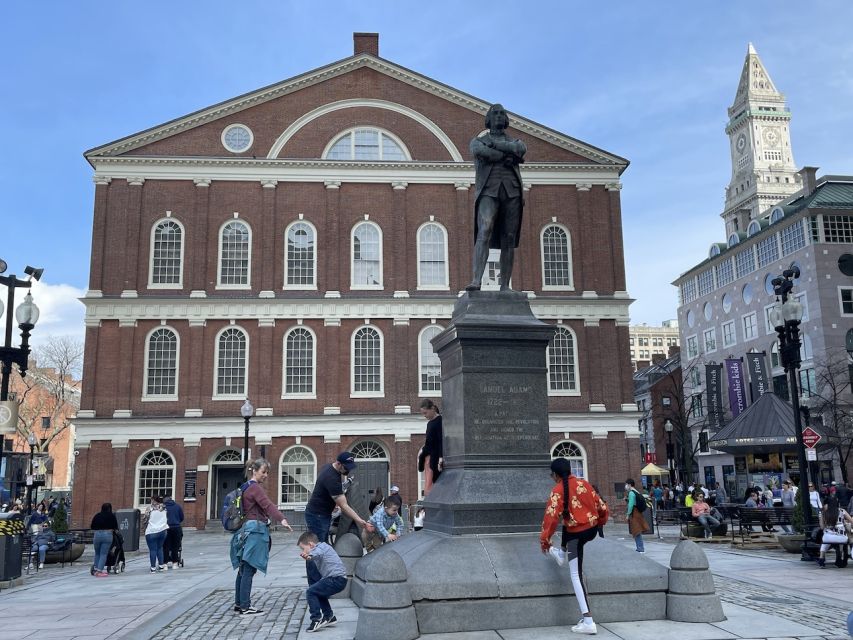
Quincy Market, Faneuil Hall, and Samuel Adams

Quincy Market brings food stalls, shopping, and regular street performers into the route. You hear about Faneuil Hall and Samuel Adams, one of the strongest colonial voices for liberty.
This part works well because it shows how Boston’s public life developed in places that were practical as well as political. Markets and meeting halls were not just decorative backdrops. They were places where people gathered, argued, traded, and spread ideas.
The audio also tackles a question many visitors have: did Samuel Adams really brew beer? That kind of factoid keeps the narration from becoming a parade of dates and names. It gives you a small detail to remember after the larger political story has blurred.
Quincy Market is a natural place to buy lunch or a snack, though doing so will extend the walk beyond two hours. If you want the full route and a relaxed meal, plan on roughly half a day rather than squeezing it into a tight morning.
Street performers can add energy, but they can also make it harder to hear. Headphones are important here. If you use a single earbud, you can keep aware of traffic and people while following the narration.
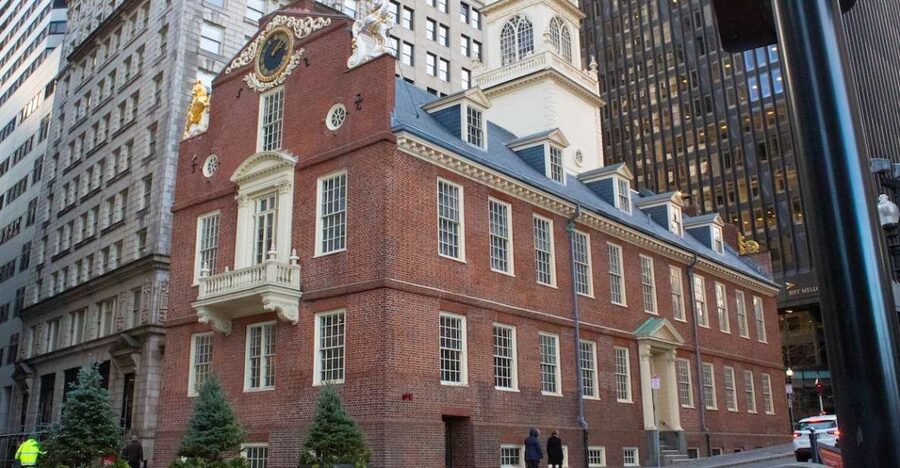
The Old State House and the Boston Massacre
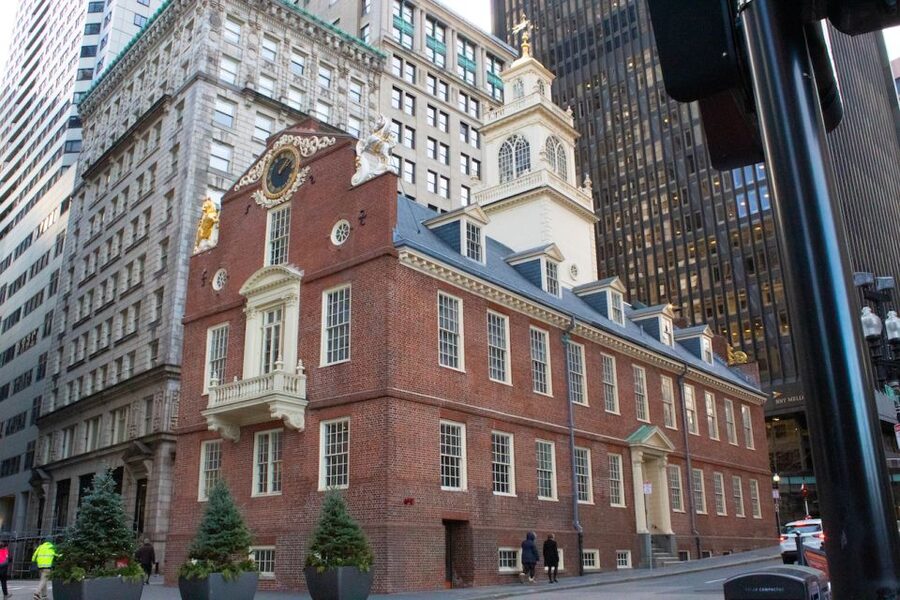
The walk continues to the Old State House, where the audio tells the story of John Adams defending the soldiers involved in the Boston Massacre.
This is a strong stop because it complicates the usual patriot tale. Adams was a future president and a major advocate for independence, yet he defended the accused soldiers in court. The story shows that the push toward Revolution included arguments about law, evidence, and the rights of defendants, not only anger at Britain.
The Old State House is also a good visual marker in the center of Boston. You can look up from the street and see how the old building is surrounded by the modern city. The route uses that contrast to keep the past connected to the place you are standing.
Again, the audio experience does not include a live guide or guaranteed admission. If you want to tour the interior, check separately and allow extra time. The walking route itself is designed around seeing the exterior landmarks and hearing their stories as you go.
The Irish Famine Memorial and Boston’s immigrant story

One of the tour’s useful choices is that it does not stop with the Founding Fathers. At the Boston Irish Famine Memorial, the narration turns to the choices Irish families faced in the 1800s.
This widens the story of Boston. The city was shaped not only by the people whose names appear in Revolutionary textbooks, but also by later arrivals who faced hunger, hard work, and difficult decisions about where to build a new life.
The route promises discussion of how multiple waves of immigration shaped Boston’s neighborhoods. That gives you a better way to read the city as you walk. The North End, downtown streets, and nearby districts are not frozen colonial displays. They reflect different groups arriving, settling, worshipping, working, and changing the city over time.
This section may be especially useful if you have already seen Boston’s patriotic landmarks and want more than a Founding Fathers greatest-hits tour. It is still a short walking experience, so it cannot cover every community in detail, but it does point your attention beyond the Revolution.
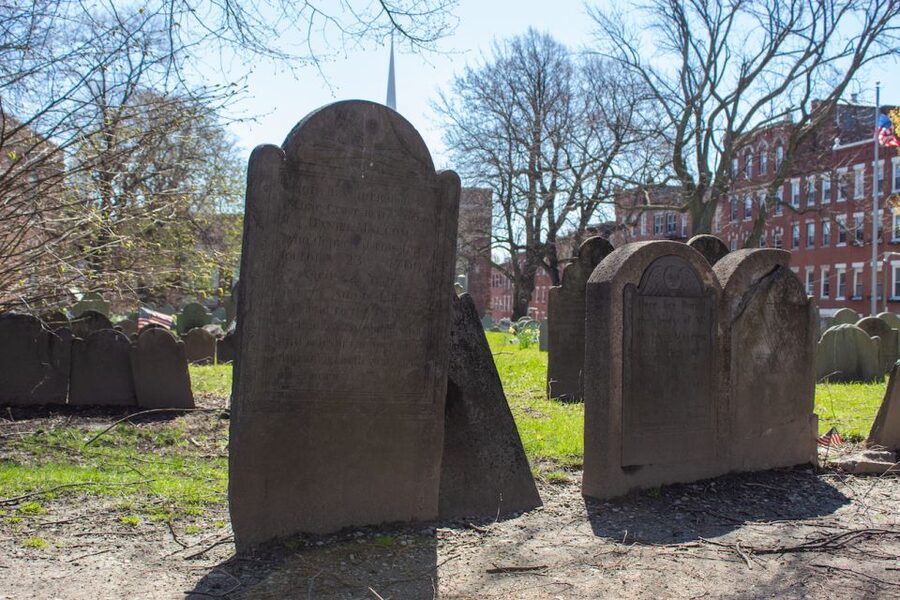
Granary Burying Ground and Boston’s famous names
Granary Burying Ground is another major stop. Here you can see the graves of John Adams, John Hancock, and Paul Revere.
The site brings several of the tour’s earlier stories together. You have heard about Revere’s ride and later life, Adams’s legal defense in the Boston Massacre case, and Hancock’s place in the independence movement. Seeing their burial places gives the route a physical close to the revolutionary cast.
The audio also returns to local questions, including who sent the signal from the Old North Church and what Revere did after the Revolution. That repetition can help you keep track of a complicated story, especially if you are walking with children or family members who are hearing the names for the first time.
Burying grounds are quiet places, but they are still in the middle of a working city. Take your time looking at markers, yet keep expectations realistic. You are not getting a private historical site or an expert standing beside you to answer every question.
From molasses to Boston Common
The route includes one of Boston’s strangest disasters: in 1919, two million gallons of molasses congealed in the North End.
It is an odd story, but that is why it works. A city tour needs a few details that are not easily confused with another destination, and the molasses flood is one of Boston’s unforgettable local episodes. The narration uses it to show that the city’s past includes industrial accidents and ordinary urban dangers, not only grand speeches.
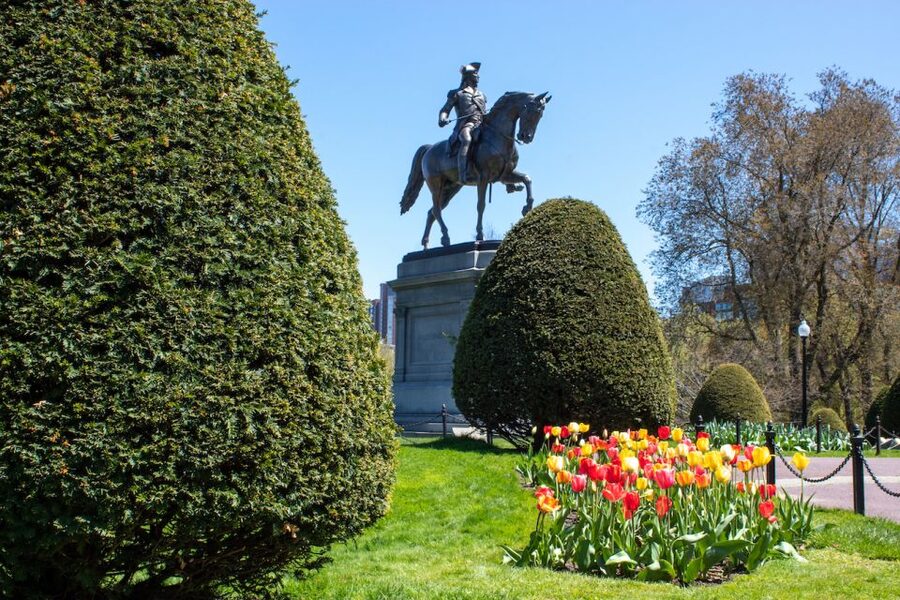
The final section brings you to Boston Common and the George Washington Statue in the Boston Public Garden. The audio explains what led to the creation of America’s first public park, then ends at the Washington monument.
Boston Common gives the walk a calmer finish after the tight streets of the North End and the commercial activity around Quincy Market. The endpoint is also practical. You finish near one of the city’s best-known public spaces, with a clear sense of how colonial Boston, Revolutionary Boston, immigrant Boston, and modern Boston fit together.
How the app works in real use
The GPS system is designed to start each audio track at the right place, with turn-by-turn directions. In theory, that lets you look around instead of checking your phone at every corner.
You should still set yourself up carefully. Charge your phone, download or open the VoiceMap app, connect your headphones, and begin at the Copp’s Hill entrance. The audio is supposed to start automatically once you reach the starting point.
The technical record is mixed. One booking could not get the tour working at all, while another person found it easy to use and well done. That means the app is a real part of the experience, not a minor detail. If the technology fails, you are left with a route through town but without the commentary that gives the landmarks meaning.
Keep your phone charged and carry a backup way to check the route if possible. Do not assume a live guide will appear at Copp’s Hill. No guide meets you there.
The narration style also matters. Big Al was specifically praised as entertaining and informative, which suggests a warmer, more conversational delivery than a dry museum recording. Still, the tour is available in English only. If you need another language, this is not the right booking.
Who gets the best value for $7
At $7, this is an inexpensive way to organize a first walk through central Boston. I think the value is strongest for independent visitors who want historical context but do not want a group, a fixed departure time, or the cost of a private guide.
It also suits families who like to stop often. You can pause for lunch, browse Quincy Market, examine gravestones, or let children take a break without holding up other people.
The price is less useful if you want entrance tickets, a personal historian, or a detailed answer to every question. Those are not included. You are buying a route and narration, not a full guided visit to Boston’s interiors.
The overall rating is 3.7 from 12 reviews, which fits the experience: some people find it entertaining and easy to use, while others have had technical trouble or struggled with the English-only format. The low cost reduces the risk, but it does not remove the need to prepare your phone properly.
The tour is not suitable for people with mobility impairments. It is a walking route through old parts of the city, and the provided information does not promise accessible conditions.
Should you book this Boston audio walk?
Book it if you want a low-cost, flexible introduction to Boston’s colonial and Revolutionary core, and you are comfortable using an app in English. The route covers a satisfying spread of places, from Copp’s Hill and the Old North Church to Faneuil Hall, Granary Burying Ground, Boston Common, and the Public Garden.
I would choose it for a first morning in Boston when you want basic orientation plus memorable stories. I would also choose it if you value stopping for food and photographs more than following a guide’s schedule.
Skip it if you need another language, dependable human help, or guaranteed access to historic interiors. Monday visitors should also note that the Old North Church is exterior-only that day. For everyone else, $7 buys a useful route, provided your phone is charged and the app behaves.
FAQ
Where does the Boston audio tour begin?
It begins at the entrance of Copp’s Hill Burying Ground in Boston’s North End.
Where does the tour finish?
The route finishes at the George Washington Statue in the Boston Public Garden.
How long does the walking tour take?
The stated duration is two hours. Stops for food, shopping, photographs, or longer visits can make the experience take more time.
Is there a live guide?
No. This is a self-guided audio tour through the VoiceMap app, and no live guide meets you at the starting point.
What language is the audio tour in?
The audio guide is available in English only.
Do I need headphones?
Yes. Headphones are listed as something to bring, along with a charged smartphone.
Does the tour include transportation?
No. You walk the route yourself, and transportation is not included.
Can I pause the tour?
Yes. You can pause and resume the audio tour at any time, which lets you stop for food, shopping, or additional sightseeing.
Is the Old North Church open during the tour?
The Old North Church is closed on Mondays, so on Monday you can see only the exterior.
More Smartphone Audio Tours in the USA
- Self-Guided GPS Audio E-Bike Tour Hawaii Volcanoes National Park
★ 4.5 · 131 reviews - Ultimate Portland Self-Guided Driving GPS Audio Tour
★ 4.0 · 56 reviews - Birmingham Civil Rights Walk of Freedom Smartphone Audio App Tour
★ 5.0 · 40 reviews - Self Guided GPS Audio Driving Tour Acadia NP From Hulls Cove VC
★ 4.0 · 25 reviews
Latest audio tours in the USA
- Solvang City Personalized Self-Guided App Tour★ 3.0 · 6 reviews
- Essential Downtown SLO: A Self-Guided Audio Tour★ 4.5 · 27 reviews
- Silicon Valley Self-Guided Driving Audio Tour for Tech Lovers★ 4.0 · 24 reviews
- The Ghosts of San Francisco Haunted Audio App Walking Tour★ 5.0 · 2 reviews
- Self-Guided Audio Tour of the Golden Gate Bridge★ 3.5 · 3 reviews
- Point Reyes National Seashore Self Guided Driving Audio Tour★ 4.0 · 9 reviews
- San Francisco Self-Guided Audio Drive: Explore at Your Own Pace★ 4.0 · 9 reviews
- Explore Coronado Island on a Self Guided Audio Tour★ 5.0 · 2 reviews
Audio Walking Tours, compared.

City Monuments Guided Walking Tour with Audio Guide
Read our review →

Self Guided Classic Freedom Trail Location Aware (GPS) Walking Audio Tour
Read our review →
Self-Guided Historical Walking Tour (Audio Guide)
Read our review →
Cape Cod & Provincetown Self-Guided Driving & Walking Audio Tour
Read our review →
Verona Walking Tour with Audio and Written Guide by a Local
Read our review →
Royal Walking Tour and Buckingham Palace Audio Tour
Read our review →