
Reviewed · ATHENS
Athens: Hadrian’s Library Entry Ticket and Audio Guide
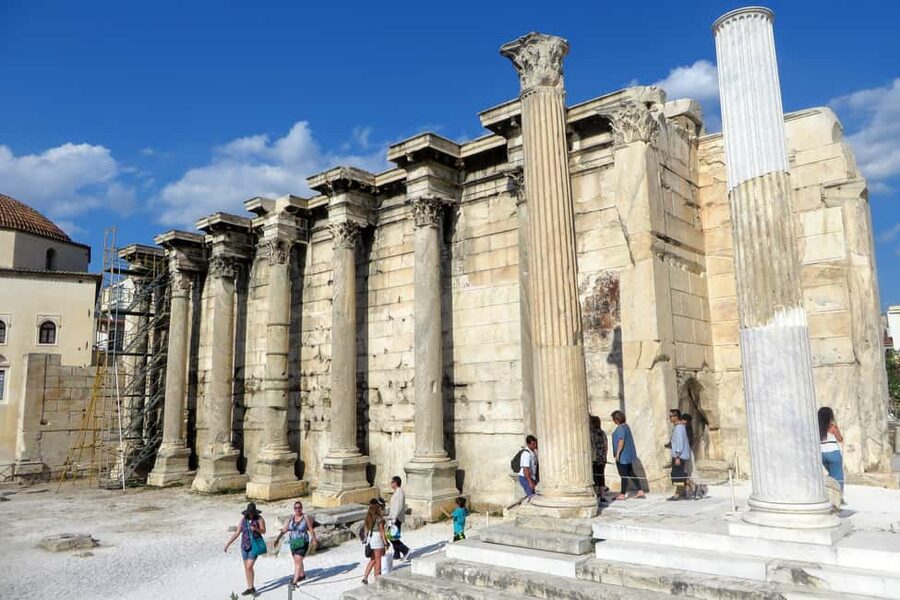
Hadrian’s Library is more than a row of old stones. Built by Emperor Hadrian in 132 AD, it was a place for books, teaching, public debate, gardens, and later Christian worship. The story-led audio guide helps you picture the people who once studied and talked here, rather than leaving you to guess at a field of ruins.
I like two things in particular: the grand Corinthian entrance, which gives the site an instant sense of scale, and the way the tour follows the building’s changing purpose from Roman cultural center to Christian sacred space. The audio commentary is told as a series of scenes and stories, making it easier to see past the broken walls.
The main drawback is practical: this is not a live tour, and the web app needs an internet connection at the site. You must bring your own headphones and a charged smartphone, and the $28 price is reasonable mainly if you value guided context as much as the entrance itself.
Key points to know before you go
- A Roman library with several later lives: Hadrian’s complex became a Christian worship site, an Ottoman administrative area, and now an archaeological monument.
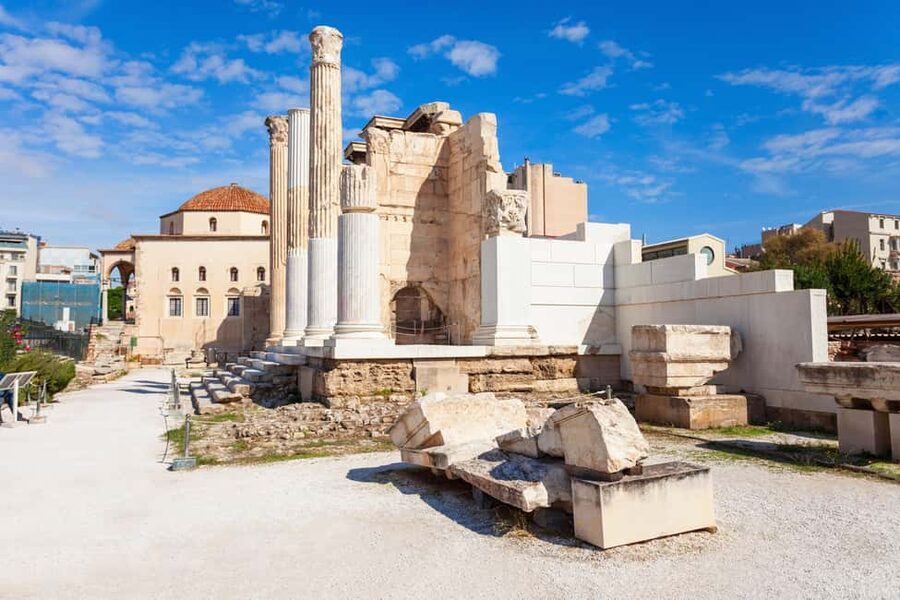
- The Propylon makes the first impression: Four tall purple marble columns once contrasted with bright white Pentelic marble at the monumental entrance.
- The courtyard was a social place: Students, teachers, philosophers, and officials once read, taught, walked, and argued around its gardens and pool.
- The audio guide is available in seven languages: Choose English, French, German, Italian, Spanish, Dutch, or Chinese.
- Monastiraki Station is only a two-minute walk away: The Blue metro line makes this one of the easiest archaeological stops in central Athens.
- Plan for a phone-based visit: Download the material in advance, carry headphones, and keep mobile internet available on site.
Hadrian’s Library: a Roman center for books, teaching, and public life
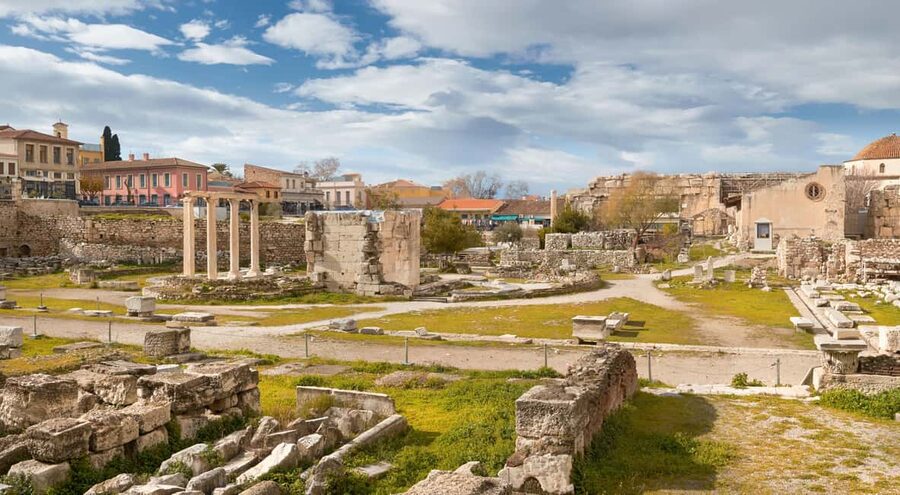
Hadrian’s Library was built in 132 AD by Emperor Hadrian, a Roman ruler with a strong affection for Greece. His aim was not simply to store books. He wanted Athens to remain a major center for culture, study, and public life.
That wider purpose matters when you visit. The name library can make you picture quiet shelves and people reading in silence. This complex was livelier. It included spaces for teaching, discussion, walking, and official business, with a garden and colonnaded paths that gave people room to meet.
The one-hour audio tour works best when you let it rebuild that larger picture. The commentary does not treat the site as a list of dates. It uses stories to help you imagine the building when its marble was bright, its statues were intact, and the courtyard was full of voices.
You should not expect a fully restored building. Much of what you see is architectural remains, open ground, columns, walls, and traces of later construction. The value comes from understanding how these pieces fitted together and why the site mattered for so long.
More Audio Tours in Athens
- Athens: Cape Sounio & Poseidon Temple Trip with Audio Guide
★ 4.4 · 4,521 reviews - Athens: Acropolis Ticket with Audio Guide
★ 4.0 · 3,575 reviews - From Athens: Delphi Full Day V.R. Audio Guided Tour
★ 4.6 · 3,028 reviews
The Propylon: Athens enters through a grand Roman doorway
Your visit begins at the Propylon, the monumental entrance facing the Roman Agora. In ancient Athens, this was the first clear signal that you were entering a special place.
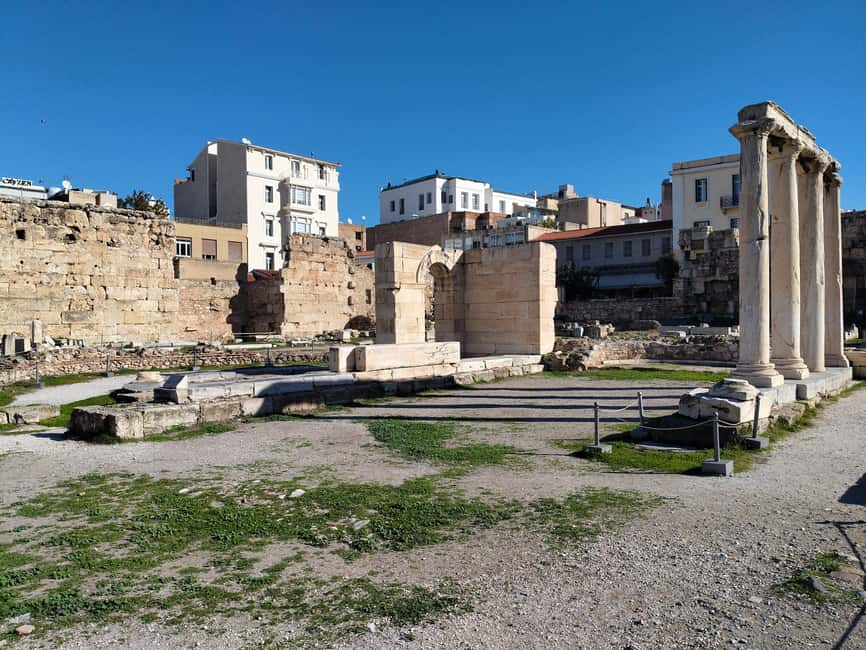
The entrance once had four tall columns made from purple marble. White Pentelic marble added a sharp contrast, creating a bright and formal front in the Greek sun. The materials were not chosen only for practical reasons. They sent a message about power, wealth, learning, and Roman respect for Athens.
Today, the entrance gives you a useful sense of scale before you explore the rest of the site. Look closely at the surviving masonry and columns, then picture the doorway as part of a complete architectural design rather than an isolated ruin.
The location also tells you something about ancient city life. The library faced the Roman Agora, so it was connected to a busy public area. Once you passed through the gate, you moved from the noise and activity of the marketplace into a more controlled setting for study and conversation.
The audio guide helps explain this change in mood. You are not just looking at a gate. You are following the route taken by people who came to read, teach, meet, or carry out official work.
The central courtyard: marble, gardens, and a long reflecting pool
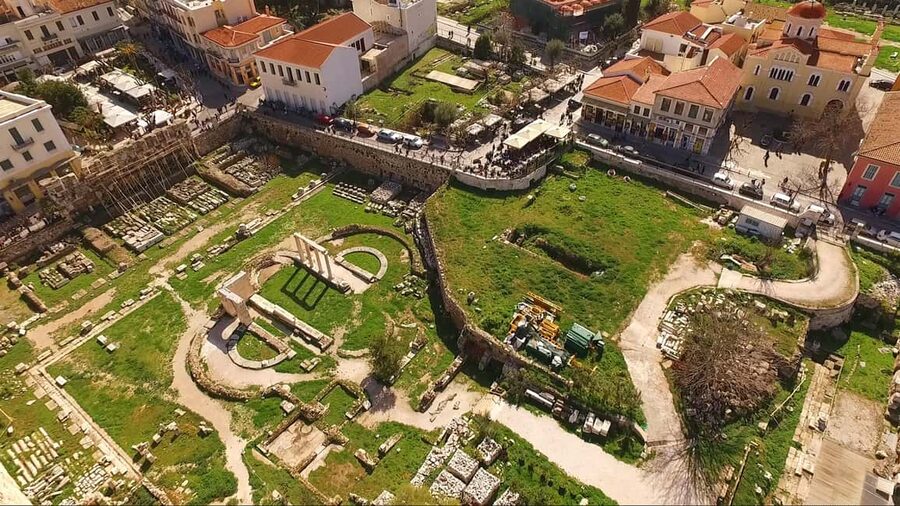
Beyond the entrance, the Central Courtyard formed the heart of the complex. It was a large open space surrounded by columns, with marble surfaces, statues, gardens, and a long pool at its center.
This is where the building’s public character becomes easiest to understand. The courtyard was not a storage area for scrolls alone. It was a place to walk, talk, pause, and exchange ideas. Students could read beneath the colonnades, teachers could speak with pupils, and philosophers could debate in the open air.
The pool and gardens also changed the feel of the site. Water and planting offered shade and coolness in a hot city. They made the courtyard more pleasant, but they also gave it a sense of order and beauty suited to a major cultural institution.
You will mainly see the remains rather than a complete garden or functioning pool. That can make the audio guide especially useful here. As you look across the open center, the narration gives you a better idea of how statues, plants, water, and columns once worked together.
Take your time in this section. The one-hour schedule is enough for a steady visit, but rushing through the courtyard would miss the point. Pause to look at the relationship between the entrance, the open center, and the rooms around the edges.
Christian churches: the courtyard changes purpose
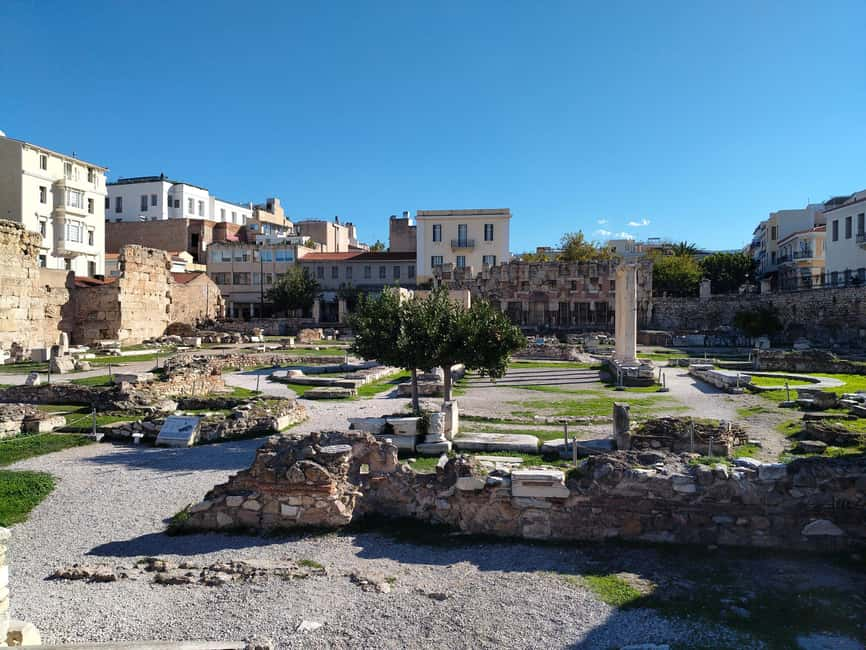
One of the most interesting parts of Hadrian’s Library is the change that came in the 5th century AD. The center of the courtyard was no longer used as the heart of a Roman cultural complex. It became a Christian area of worship.
Three churches occupied the site over time: the Tetraconch Church, a large basilica, and later the Church of the Megali Panagia. Their presence shows how the site adapted as Athens changed.
This section adds depth to the visit because it prevents you from seeing the library as a single-period monument. The building did not simply rise, serve one purpose, and fall into silence. It was reshaped for new religious and community needs.
The Tetraconch Church is described as an elegant structure, while the later basilica was larger. The Church of the Megali Panagia represents another stage in the site’s long use. Even if the remains require some imagination, the sequence gives you a clear way to read the ruins.
I find this historical change more useful than a long list of rulers and dates. It explains why parts of the site may not look like a library at all. The stones record different communities making practical use of an important place.
Another self-paced route in Athens:
- Athens: Acropolis Museum Ticket with optional Audio Guide
★ 4.4 · 2,652 reviews - Athens: Peloponnese Highlights Day Trip and V.R. Audio Guide
★ 4.5 · 1,425 reviews - Athens: Acropolis Museum Ticket with Audio Guide
★ 4.1 · 835 reviews - Athens: National Archaeological Museum Ticket w/ Opt. Audio
★ 4.4 · 713 reviews
The eastern library halls: where books and teaching once filled the rooms
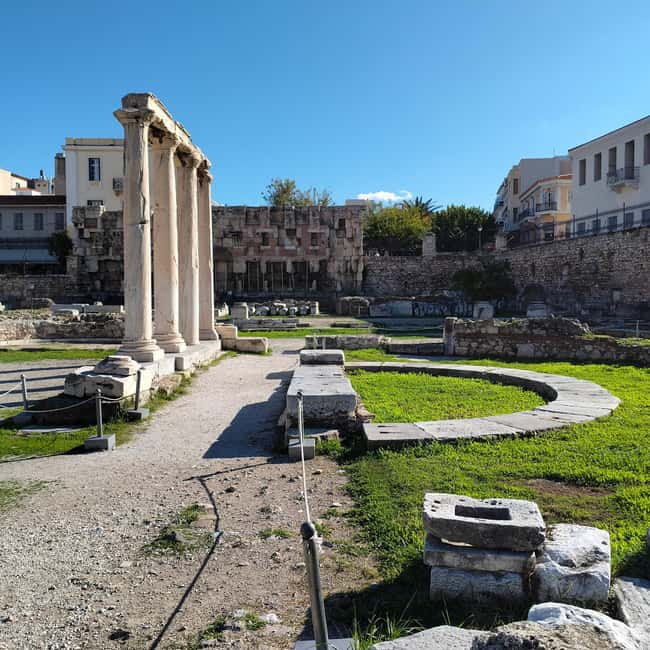
On the eastern side of the courtyard were the Library Halls. These rooms held papyrus scrolls and parchment books in wooden cupboards set into wall niches.
The collection may have contained between 17,000 and 20,000 works. That figure gives you a sense of the library’s scale, though it is best understood as an estimate rather than a precise count. The rooms also served as reading areas, lecture rooms, and teaching spaces.
This was not a silent modern library. Students, philosophers, teachers, and officials used the rooms for study and debate. The audio guide makes that distinction clear, helping you picture a place where ideas were spoken aloud and discussed rather than merely stored.
As you examine the eastern wing, look for the practical relationship between the rooms and the courtyard. The library halls were part of a wider complex, connected to covered walkways and shared public spaces. A person could move from reading to conversation, from a lecture to a stroll, without leaving the building.
The remains do not provide a complete view of the original interior. You will not see rows of intact shelves filled with ancient books. What you get instead is the plan of the place and a sense of how architecture supported learning.
The peristyle and side chambers: a covered path through the complex
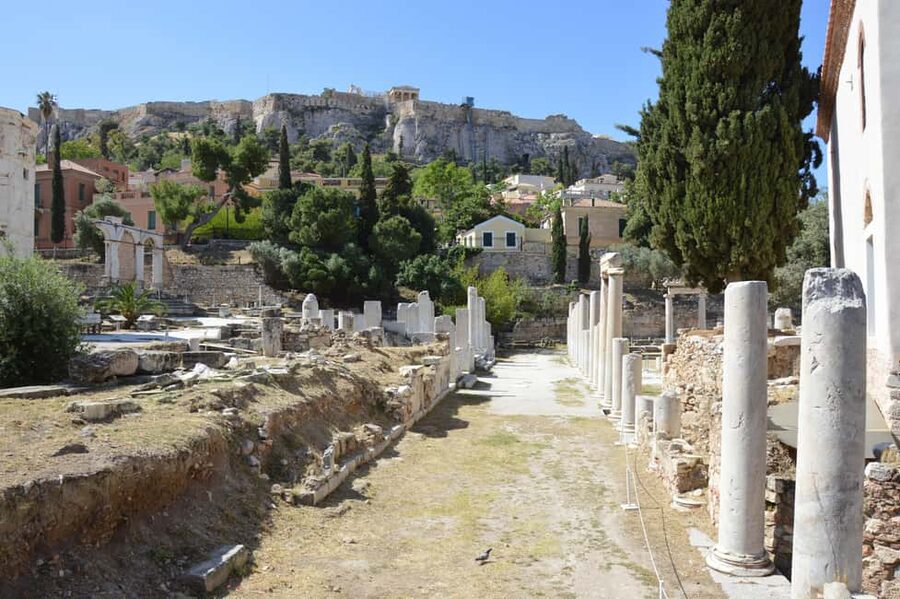
A long peristyle ran around the courtyard. It had 100 marble columns and a covered walkway that protected people from strong sun and rain.
This was likely one of the most useful parts of the building in daily life. People could walk, talk, and move between rooms without crossing the exposed courtyard. The side chambers behind the colonnade were used for lectures, small meetings, reading, and official tasks.
The peristyle also helps tie the whole visit together. The Propylon brought you into the complex. The courtyard gave the building its open center. The library halls provided rooms for books and study. The peristyle connected all of these elements.
Today, the columns are not all standing in their original form, and the side chambers are archaeological remains. Still, the layout is easy to follow when the audio guide explains how the spaces functioned.
This is a good place to slow down near the end of the visit. Instead of treating the peristyle as the final item on a checklist, use it to picture the movement of daily life: a teacher crossing toward a lecture, a student reading in the shade, or an official stepping into a side room.
What the audio guide adds, and where it falls short
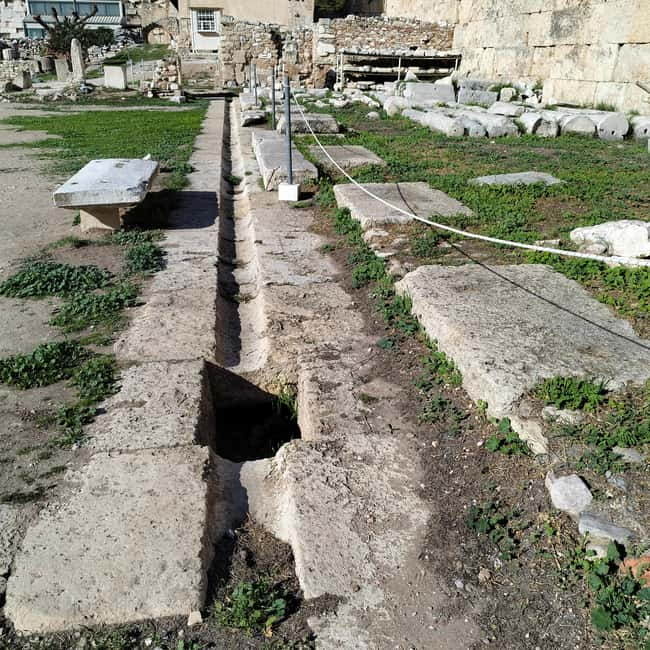
The strongest feature of the audio guide is its use of narrative. It gives you scenes rather than only facts, helping you picture the library as a working place filled with people and ideas. That approach was specifically praised by Nicola of Italy, who found that the stories helped him see beyond the ruins and grasp the character of the site.
You should expect a digital, self-guided experience rather than a conversation with a guide. You control the pace, stop when you wish, and can spend more time at the courtyard or churches if those sections interest you most.
That freedom is useful, but it also puts more responsibility on you. There is no live guide to answer a question, adjust the explanation, or point out something you missed. The experience depends on your phone, the web app, mobile internet, and your own headphones.
The audio guide is offered in English, French, German, Italian, Spanish, Dutch, and Chinese. The broad language choice makes the tour practical for many people, but remember that headphones are not included.
Is $28 a fair price for one hour?
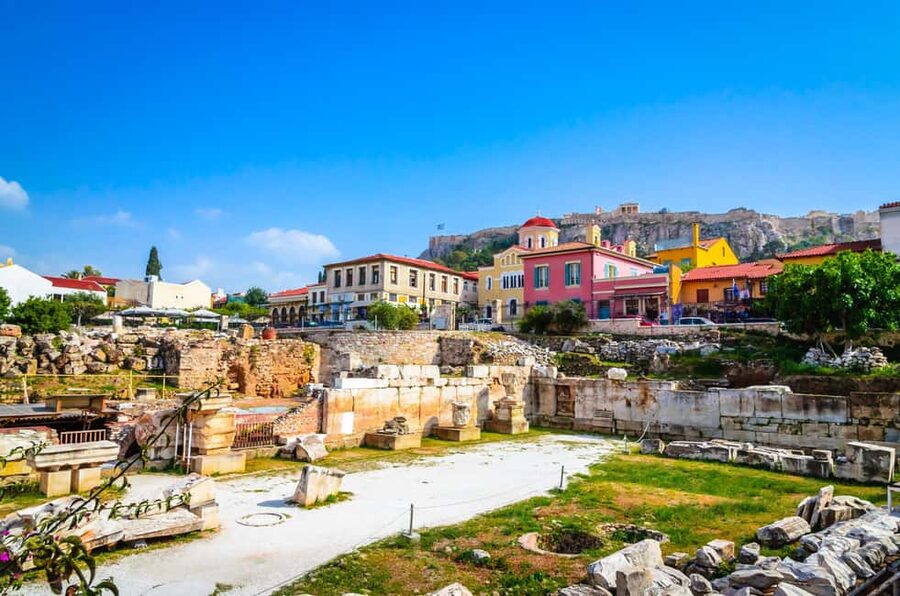
At $28 per person, this is not the cheapest archaeological stop in Athens. You are paying for the entrance ticket plus a prepared audio experience, not for a live guide or a long tour.
The price makes the most sense if you want structure and context but prefer to explore alone. Hadrian’s Library is compact enough for a one-hour visit, and the narration helps turn architectural fragments into a readable story. If you already know the site well or prefer to walk around without commentary, the value will be lower.
The location improves the calculation. The entrance is next to Monastiraki Square, and Monastiraki Station is about a two-minute walk away on the Blue metro line. You can fit the visit into a central Athens sightseeing day without arranging transport or meeting a group at a distant starting point.
The ticket is non-refundable, so check your plans before buying. You receive the digital ticket and instructions by email from Athenian Tours, and you should check your spam folder if the message does not appear.
Practical advice for a smooth visit
Download the audio content before you arrive, even though you still need internet access at the site because the web app does not work offline. Keep your phone fully charged, and carry your own earphones or headphones.
Wear comfortable shoes. The visit involves moving around an archaeological site, and the one-hour duration works better when you can walk and pause without discomfort.
Athens can be hot and bright, so bring water, sunscreen, and a sun hat. An umbrella is also listed as useful, which can help with sun as well as sudden rain.
The tour has no meeting point. Go directly to Hadrian’s Library, easiest from Monastiraki Station. Since the experience is self-guided, you can arrive at an available starting time rather than waiting for a named guide or group.
Who should book Hadrian’s Library?
I would choose this experience if you want a short cultural stop with a clear story and no group schedule. It suits independent visitors who like to set their own pace, families with older children who can follow an audio tour, and anyone already exploring Monastiraki.
It is also a good choice if you want to understand how one site changed from Roman institution to Christian worship center. That shift gives the visit more substance than a quick look at columns and walls.
I would hesitate if you strongly prefer live guiding, do not want to rely on a smartphone, or have limited mobile internet. The ticket also requires more preparation than a standard paper entry, since you need the email, working phone, headphones, and enough battery.
Should you book this Athens audio tour?
Book it if you want a focused one-hour visit that explains what Hadrian’s Library was used for across several centuries. The monumental entrance, central courtyard, Christian churches, eastern library halls, and 100-column peristyle give you a clear route, while the story-based audio guide helps you picture life beyond the surviving stones.
Skip it if you only want a quick photograph from outside or if a live guide is essential. For independent visitors who value context and can manage the phone requirements, $28 is a fair price for an easy-to-reach archaeological stop in central Athens.
FAQ
Where is Hadrian’s Library?
Hadrian’s Library is in central Athens, right next to Monastiraki Square.
How do I reach Hadrian’s Library?
Take the Blue metro line to Monastiraki Station. The entrance is about a two-minute walk from the station.
How long does the visit take?
The experience lasts about one hour.
Is there a live tour guide?
No. This is a self-guided digital tour with an audio guide.
Which languages are available for the audio guide?
The audio guide is available in English, French, German, Italian, Spanish, Dutch, and Chinese.
Are headphones included?
No. You need to bring your own headphones or earphones.
Do I need internet access during the visit?
Yes. The web app does not work offline, so you need internet access at the site.
What should I bring?
Bring comfortable shoes, a sun hat, an umbrella, sunscreen, water, headphones, and a fully charged smartphone.
How do I receive the ticket and audio guide instructions?
Athenian Tours sends the ticket and instructions by email. Check your spam folder if you do not see the message.
Latest audio tours in Athens
- Athens Ticket Pass: Acropolis & 6 Sites with 5 Audio Guides★ 3.5 · 84 reviews
- Temple of Olympian Zeus: Self-Guided Audio Tour on your Phone (without ticket)★ 4.0 · 8 reviews
- Ancient Agora of Athens: A Self-Guided Audio Tour★ 3.5 · 3 reviews
- Self Guided Tour In Athens With 100 Captivating Audio Stories★ 4.0 · 4 reviews
- E-ticket for Kerameikos with Audio Tour on Your Phone★ 5.0 · 4 reviews
- Private Audio Guided Walking Tour in Athens★ 3.5 · 2 reviews
- Audioguided tour of Athens’ alternative neighbourhood of Exarchia★ 5.0 · 2 reviews
- Athens Hop-On Hop Off w/ Acropolis & Acr.Museum tickets & 3 audio★ 3.0 · 5 reviews
Athens Audio Tours, compared.

Cape Sounio & Poseidon Temple Trip with Audio Guide
Read our review →
Acropolis Museum Ticket with optional Audio Guide
Read our review →
Peloponnese Highlights Day Trip and V.R. Audio Guide
Read our review →
National Archaeological Museum Ticket w/ Opt. Audio
Read our review →
Acropolis & Parthenon Entrance Ticket w/optional SG Audio Tours
Read our review →Browse the lists this tour appears in