
Reviewed · UK
A Guide to the City of Dreaming Spires: A Self-Guided Audio Tour of Oxford
Oxford’s spires, college courtyards, bells, libraries, and old lanes make a fine walking tour, but you do not need to join a group to enjoy them. This self-guided audio tour leads you from Carfax Tower through the historic centre, ending at the Martyrs’ Memorial on Magdalen Street.
I like the freedom to start when you choose and pause whenever a college gate, cafe, or photograph deserves more time. I also like the price: $14.99 buys lifetime access, offline maps, and repeat use instead of a single timed outing.
The main drawback is simple: you are relying on your phone, headphones, and recorded commentary rather than a guide who can answer questions. Also, the tour passes Oxford’s famous buildings but does not include entry fees, so you will need a separate ticket for attractions you want to visit inside.
Key points to know before you walk

- Great Tom rings 101 times at 9.05pm: Hear the reason behind Christ Church’s unusual bell tradition.
- The route links Oxford’s major sights: Walk from Carfax Tower past Radcliffe Camera, the Bodleian Library, the Bridge of Sighs, and Magdalen College.
- Ian Grover provides the commentary: The producer is a licensed tour guide with several VoiceMap tours.
- The walk takes about 90 minutes to two hours: You can move briskly or pause at stops and nearby sights.
- The audio works offline: Download the app, maps, and commentary before setting out.
- It costs $14.99 per person: That is good value if you want structure without paying for a private guide.
Starting at Carfax Tower in the heart of Oxford
The walk begins at Carfax Tower on Queen Street, a useful central point where Oxford’s old city centre comes together. From here, the route takes you around the area where many of the university colleges are gathered, finishing near the Martyrs’ Memorial at 13 Magdalen Street.
This is a smart route for a first look at Oxford because it connects several major sights without requiring public transport. You can get a sense of the city’s layout as you move between college gates, busy streets, grand squares, and quieter stretches.
The audio uses GPS playback, so the commentary begins as you reach the relevant places. The app also supplies turn-by-turn directions. You do not need to keep checking a printed route, though you should still watch where you are walking in a busy city centre.
The stated walking time is 90 minutes to two hours. I would treat that as a guide, not a deadline. The shorter time suits you if you want a compact introduction. Allow more time if you stop for photographs, look at college entrances, or pause the recording for coffee.
More Self-Guided Audio Tours in the UK
- Bristol: Self-Guided Sightseeing Audio Tour
★ 4.4 · 151 reviews - Essential Whitby: Discover the town’s legends on a self-guided audio tour
★ 5.0 · 47 reviews - Harry Potter’s Edinburgh: A Self-Guided Audio Tour
★ 4.5 · 42 reviews
Oxford time, student rules, and city traditions
Early commentary explains why Oxford time is five minutes behind the rest of the country. That small detail gives you an immediate sense of how the university’s customs have shaped ordinary life in the city.
You also hear why students are forbidden from jumping into the River Cherwell. It is the sort of local rule that makes a walking tour more memorable than a string of dates and architectural labels. Oxford has plenty of grand buildings, but its everyday traditions help explain how the university works as a living place.
The audio format is useful here because the stories arrive while you are looking at the city itself. You are not just reading a sign after the fact. You hear a detail, then continue walking with the surrounding streets and college walls in view.
Alice’s Shop and Oxford’s literary connection
The route passes Alice’s Shop, an Alice in Wonderland themed store. The commentary explains how the shop developed and why Lewis Carroll’s story is so closely tied to Oxford.
This stop adds a welcome change of mood. Oxford can sometimes feel like a procession of stone institutions, so the Alice connection brings in the city’s literary and commercial character. You can pause outside the shop if the theme interests you, but the tour does not include purchases or entry to attractions.
The audio is especially helpful if you know the story but not its connection to Oxford. You get a local link rather than a general explanation of the book, and the stop fits naturally into the walk toward the university buildings.
Christ Church and the 101 chimes of Great Tom

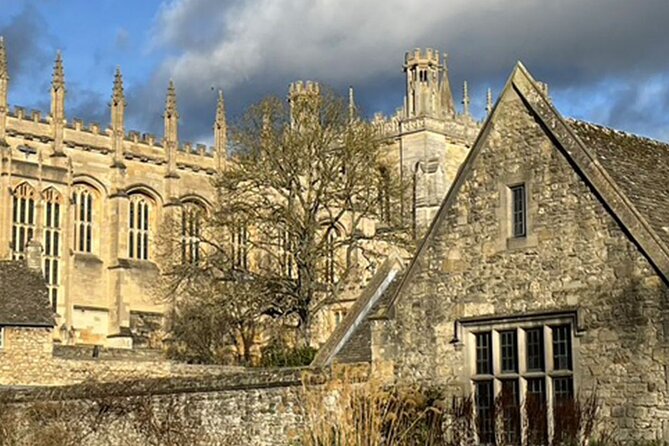
As you pass Christ Church College, you hear about Great Tom, the bell above the entrance. It chimes 101 times at 9.05pm, a detail that is easy to miss if you simply photograph the gateway and move on.
The story gives the college a more human scale. Instead of seeing Christ Church only as a grand facade, you learn about a sound that has marked university life for generations.
Keep in mind that passing a college is not the same as visiting it. Entrance fees and attraction tickets are not included, and this route is designed as an outdoor walking experience. If Christ Church is high on your list, check its separate opening arrangements rather than assuming the audio tour provides access.
Another self-paced route in the UK:
- London: Emirates Stadium Entry Ticket and Audio Guide
★ 4.7 · 5,513 reviews - Westminster Abbey Entrance Ticket Including Audio Guide
★ 4.0 · 661 reviews - London: British Museum Audio Tour & Priority Entrance Ticket
★ 4.5 · 631 reviews - Golden Tours York Hop-on Hop-off Open Top Bus Tour with Audio Guide
★ 4.5 · 468 reviews
Magdalen College and the eastern end of the walk
The audio tour continues past Magdalen College, one of Oxford’s best-known institutions. You hear about the college as you walk, with the route carrying you toward Magdalen Street and the final stop.
This section helps prevent the walk from becoming too concentrated around the central squares. You see more of the historic core and get a better sense of how the university colleges are placed around the city.
The spelling in the supplied route sometimes appears as Magdelen, but the college is Magdalen College. That is worth knowing when you use maps or search for nearby information.
Examination Schools and an Oxford tradition

The route passes the Examination Schools, where the commentary introduces a distinctive Oxford tradition. The building is tied to the university’s formal academic life, so this stop gives you a look beyond picturesque towers and famous libraries.
It is a good reminder that Oxford is not only a sightseeing backdrop. Its buildings still serve ceremonies, examinations, teaching, and student life. The audio helps connect the architecture with those uses.
Because this is a recorded tour, the amount of detail is fixed. You can pause and replay a section, but you cannot ask for more explanation about the tradition. That is one of the clear differences between this format and an in-person guide.
The Grand Cafe and England’s first coffee-house story

The route passes the Grand Cafe, identified as the site of the first coffee house in England. The stop adds a social layer to the walk, showing how places for conversation and public debate formed part of Oxford’s story.
The cafe also gives you a natural pause point. Food and drink are not included, but the route passes a place where you might choose to stop. Since the audio can be paused, you do not have to sacrifice the commentary if you take a break.
I like stops such as this because they make the city easier to picture. A library tells you about scholarship, a college tells you about education, and a coffee house suggests where people gathered to talk.
The Bridge of Sighs and Oxford’s most photographed views
You pass the Bridge of Sighs, one of Oxford’s most photographed sights. The bridge is a natural place to stop for a picture, and the audio explains its place within the city.
This is one of the moments when the self-guided format works well. You can step aside, take your time, and return to the route without holding up a group. You can also replay the commentary if you were distracted by the view.
Photography can slow the walk, so do not feel bound to the advertised 90-minute pace. The route is short enough to complete efficiently, but Oxford rewards a slower approach around its best-known buildings.
Radcliffe Square and the Radcliffe Camera
Radcliffe Square is one of the visual highlights of the walk. Here, the commentary turns to the Radcliffe Camera, the round library building that often appears in photographs of Oxford.
The square brings several major university sights together, making it one of the strongest sections for first-time visitors. You can take in the architecture while listening to how the building fits into the university.
The name can confuse some visitors. The Radcliffe Camera is a library, not a camera in the modern sense. The audio gives you the context you need, so the building becomes more than an impressive circular facade.
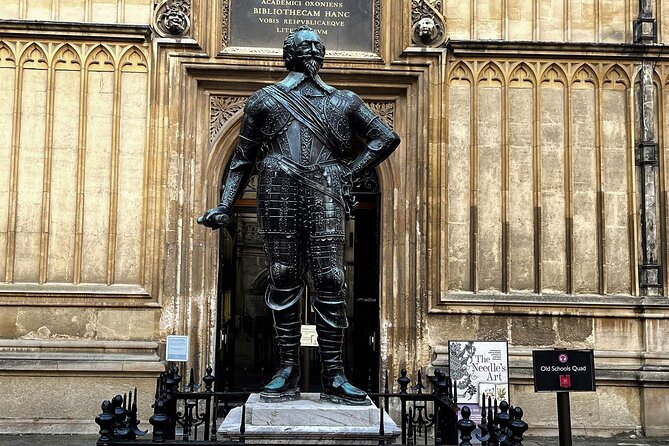
The Bodleian Library and Oxford’s vast collection
The tour passes the Bodleian Library, the main research library for the University of Oxford. The Bodleian libraries hold more than 13 million printed items and form the second-largest library collection in the country after the British Library.
That number gives the stop real weight. You are looking at a working centre of research, not simply an old building that happens to photograph well.
The route does not include a library tour or an entrance ticket. Still, hearing about the Bodleian while standing nearby gives you useful context before you decide if you want to arrange a separate visit.
The Sheldonian Theatre and university ceremonies
Next comes the Sheldonian Theatre, a focal point of the university and its ceremonial hall. It is used for Matriculation Ceremonies, when new students enrol on the university register.
This stop explains why the building matters even if you are not attending an event. Oxford’s academic life includes formal rituals as well as lectures and exams, and the Sheldonian is one of the places where those rituals take place.
The commentary also helps you understand the city’s mixed character. A visitor may see a beautiful theatre, while the university sees a working ceremonial building with an important role in student life.
Balliol College and Oxford’s long academic story
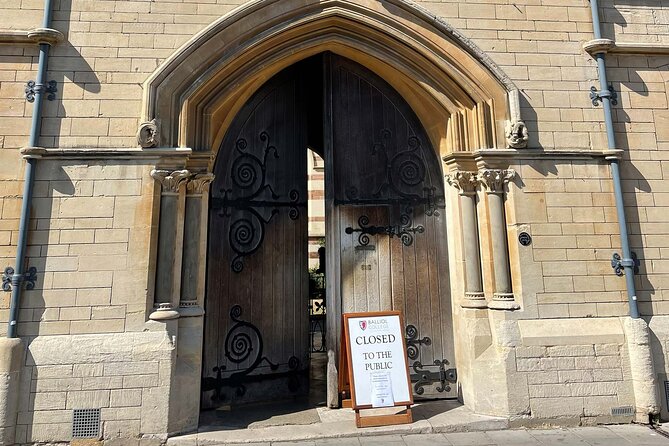
The route passes Balliol College, which began as a community of scholars in 1263. That date places the college within Oxford’s medieval beginnings and shows how long the university has been gathering students and teachers in this part of the city.
You will not enter the college as part of the audio walk, but the outside view still fits the route’s purpose. The tour gives you a connected look at the university rather than asking you to study one college in isolation.
This is also where the recorded format can feel a little thin if you want detailed architectural analysis. The tour is designed as a broad city introduction, not a specialist college history walk.
The Martyrs’ Memorial and the route’s finish
The walk ends at the Martyrs’ Memorial on Magdalen Street. The monument marks the final part of the route and gives you a clear stopping point rather than leaving you somewhere vague in the centre.
Finishing here is practical. You remain close to the city centre, and the route has taken you past many of Oxford’s main sights in one direction without requiring transport back to the start.
The ending also makes the tour easy to pair with another Oxford activity. Since the audio remains available after your booking, you can return to sections you missed or use the virtual tour option from home.
What the VoiceMap system is like to use
After booking, you receive instructions and a unique code under the Before You Go information. Install the VoiceMap app on an Android or iOS phone, enter the code, and follow the directions to Carfax Tower.
When you reach the starting point, put on your headphones and tap start. The app uses automatic GPS playback, so the commentary is linked to your position instead of requiring you to press a new track at every sight.
Offline access is a major practical benefit. Download the audio, maps, and geodata before walking, then you can follow the route without depending on a mobile signal. Bring your own smartphone and headphones, since neither is supplied.
You receive lifetime access to the English tour. You can use it before the booked date, after the booked date, and through the virtual tour option at home. That makes the $14.99 price more useful than a one-time audio file tied to a single afternoon.
Who gets the best value from $14.99
At $14.99 per person, this is a low-cost way to add structure to an Oxford visit. You are paying for a prepared route, recorded commentary, GPS directions, maps, and repeat access, not for a live guide or attraction admission.
I see the strongest value for solo visitors, couples, and small private groups who want to walk together without joining strangers. It also suits anyone who likes to stop for photographs, coffee, or a college visit without asking a guide to wait.
The tour is less suitable if you want a conversation, detailed answers, or access inside the colleges. One published comment names Angelica and describes an escorted visit inside Trinity College, but that account does not match this self-guided audio format. For this experience, Ian Grover is the named producer and licensed tour guide behind the recording.
The tour is listed as a private activity, with only your group participating, but that means private use of the audio rather than a live private guide. You still control the pace and the pauses.
It is usually booked about 15 days ahead. The experience is non-refundable and cannot be changed for any reason, so check your plans carefully before paying.
Should you book this Oxford audio walk?
Book it if you want a flexible first orientation to Oxford at a modest price. The route covers the city’s essential sights, and the stories about Great Tom, Alice’s Shop, Oxford time, student rules, and university ceremonies give the walk more character than a simple map-led stroll.
Skip it if your main goal is going inside several colleges or asking a guide detailed questions. You will need separate admission tickets for attractions, and the recording cannot adapt to your interests.
For most independent visitors, this is a sensible way to get your bearings, hear the stories behind the spires, and keep control of your day. Download the tour before leaving, bring headphones, and allow closer to two hours if you want to enjoy Oxford rather than merely pass through it.
FAQ
Where does the Oxford audio tour start?
The tour starts at Carfax Tower, Queen Street, Oxford OX1 1ET, UK.
Where does the tour finish?
It finishes in front of the Martyrs’ Memorial at 13 Magdalen Street, Oxford OX1 3AE, UK.
How long does the walking tour take?
The tour takes approximately 90 minutes to two hours, depending on your walking pace and how often you pause.
What app is used for the tour?
The tour uses the VoiceMap app, which is available for Android and iOS devices.
Does the audio tour work offline?
Yes. The tour includes offline access to the audio, maps, and geodata.
Who produced the audio commentary?
The commentary was produced by Ian Grover, a licensed tour guide who has produced several VoiceMap tours.
What sights does the route pass?
The route passes Carfax Tower, Alice’s Shop, Christ Church College, Magdalen College, the Examination Schools, the Grand Cafe, the Bridge of Sighs, Radcliffe Square, Radcliffe Camera, the Bodleian Library, the Sheldonian Theatre, Balliol College, and the Martyrs’ Memorial.
Are attraction entrance fees included?
No. Tickets or entrance fees for museums and other attractions along the route are not included.
What do I need to bring?
You need a smartphone and headphones. Transportation, food, and drinks are also not included.
Can I use the tour more than once?
Yes. The tour includes lifetime access in English, and you can use it before or after your booking date. A virtual tour option is also available at home.
Latest audio tours in the UK
- Stonehenge Private Immersive Audio Guide★ 4.5 · 15 reviews
- Discovering Cheltenham: A Self-Guided Audio Tour★ 4.5 · 23 reviews
- Oxford’s literary legends and landmarks: A Self-Guided Audio Tour★ 3.0 · 4 reviews
- Hadrian’s Wall: A Self-Guided Audio Tour along the Ruins★ 3.5 · 4 reviews
- Whitby’s Historic East Side: An audio tour uncovering the east side’s tales★ 5.0 · 2 reviews
- Durham’s Landmarks and Legends: A Self-Guided Audio Tour★ 4.0 · 35 reviews
- Essential Whitby: Discover the town’s legends on a self-guided audio tour★ 5.0 · 47 reviews
- Wicked Whitechapel: Where Now’s Jack The Ripper Audio Tour★ 5.0 · 2 reviews
Self-Guided Audio Tours, compared.

Acropolis Ticket & Optional Self-Guided Audio Tours
Read our review →


Ultimate Acadia National Park Self-Guided Driving Audio Tour
Read our review →


Akrotiri Ticket with Optional Self-Guided Audios
Read our review →
Browse the lists this tour appears in