
Reviewed · POMPEII
Herculaneum and Pompeii in one day: Audioguides + Tkts (art)
Pompeii and Herculaneum tell the same volcanic story in very different ways. Pompeii gives you streets, forums, villas, and a huge urban footprint, while Herculaneum offers more intimate houses, mosaics, frescoes, and preserved wooden details. This package lets you see both with an audioguide and without joining a fixed group.
I like the freedom to choose which site comes first, and I like that the audio devices are authorized for the archaeological parks rather than being a generic phone app. The main catch is the ticket and device pickup: the promised fast entry may still involve exchanging vouchers, and that process has cost some visitors valuable time.
Key points to know before booking
- Two archaeological parks in one day: Pompeii and Herculaneum require stamina, sensible timing, and comfortable shoes.
- Start where you prefer: You can visit Herculaneum or Pompeii first, then travel between them by Circumvesuviana train.
- Authorized audio devices: Explanations are selected using numbered stops, with English, Italian, French, Spanish, and German available.
- Pompeii pickup takes planning: Exchange your voucher at Tempio Travel on the first floor of the EAV station before walking to Porta Marina Inferiore.
- Audio quality is useful but not perfect: Explanations can be technical, and changing conservation barriers may make some directions outdated.
- $88 buys convenience, not a private guide: The package is best for independent visitors who value flexibility and two admissions in one booking.
Why Pompeii and Herculaneum belong in the same day
If you visit only Pompeii, you see the remains of a major Roman town spread across a large archaeological park. If you visit only Herculaneum, you get a smaller site with strikingly preserved domestic spaces. Seeing both gives you a better sense of how the eruption affected different parts of the region.
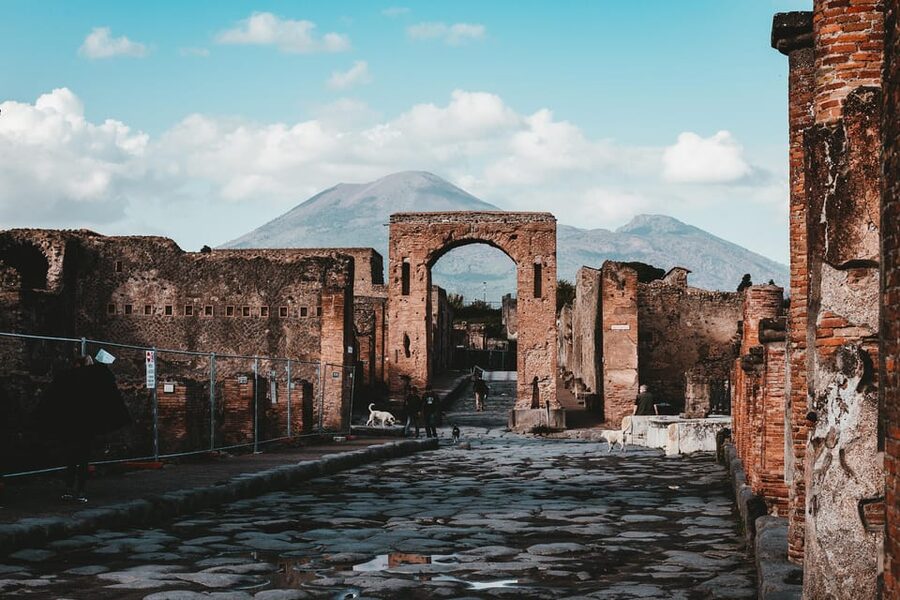
Pompeii is the place for scale. You walk along ancient streets, pass public buildings, enter villas, and look across open spaces that once served as the city’s main centers. It takes effort to understand the site because distances are long and the ruins do not unfold in a neat museum sequence.
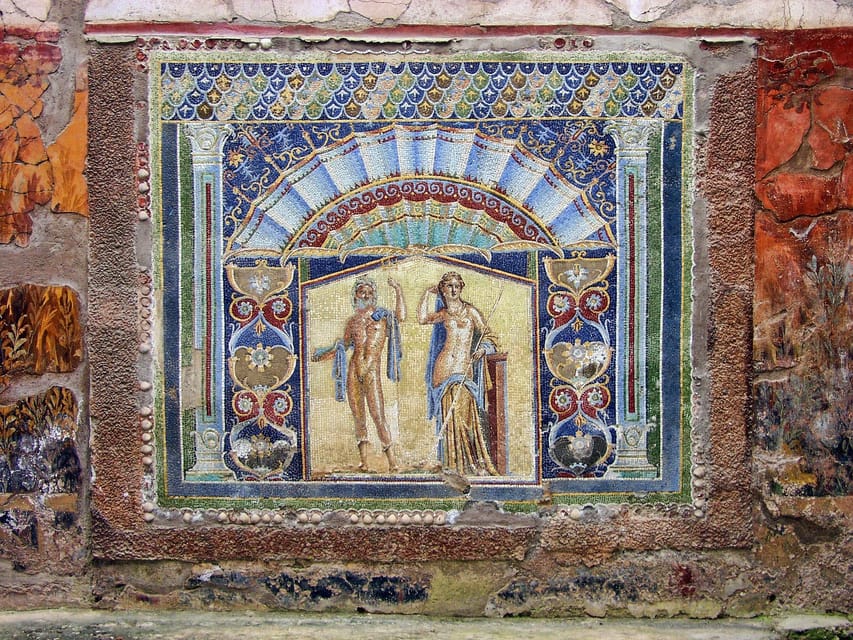
Herculaneum is easier to read at close range. Its houses, mosaics, frescoes, and wooden structures can make daily Roman life feel more immediate. Volcanic material buried the town differently from Pompeii, preserving details that help you notice doors, interiors, and household design.
The contrast is the real reason to do both. Pompeii shows a city in its full civic setting. Herculaneum gives you a more concentrated look at private life. The day is tiring, but the two sites support each other.
More one-day trips in Pompei Campania
- From Paris: Giverny Day Trip with Audio Guide or Live Guide
★ 4.3 · 2,372 reviews - Athens: Peloponnese Highlights Day Trip and V.R. Audio Guide
★ 4.5 · 1,425 reviews - Giverny and Monet’s House Half Day Trip from Paris Guide or Audio
★ 4.0 · 1,319 reviews
Starting at Pompeii: the ticket pickup matters
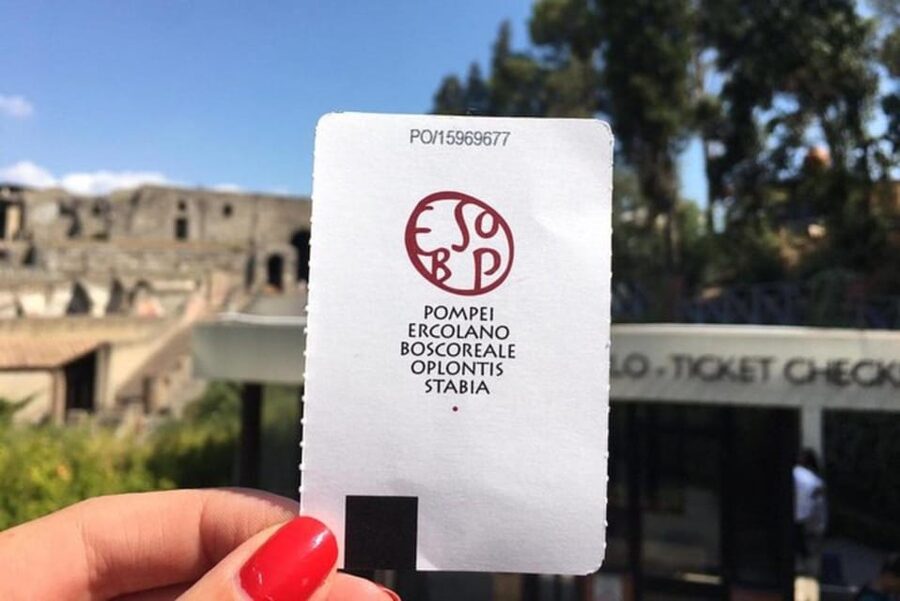
At Pompeii, begin at the Tempio Travel office on the first floor of the Circumvesuviana station at Via Villa dei Misteri 1. The station is called Pompei Scavi, Villa dei Misteri. You exchange your voucher there and collect the audioguide device.
This is the part that needs the clearest planning. The office is not the archaeological entrance itself. After collecting the device, you walk several hundred meters to the dedicated access line at Porta Marina Inferiore, in Piazza Esedra.
That extra step can be easy to miss, especially if you arrive eager to enter the ruins. Build in time for the office, the walk, and any queue at the exchange point. A dedicated entrance can help, but it does not always mean you walk straight into the park with no waiting. One reported problem involved having to queue again to exchange tickets, making the supposed fast access less useful.
I recommend downloading or saving the voucher before you arrive and keeping your identification ready. You need a valid passport or ID card as a deposit for the audioguide. The device must be returned before the office closes, according to the park schedule.
Once inside, the map becomes important. Pompeii is large, and the audio stops use numbered references. The device can be used hands-free, or with standard headphones using a jack connection. Personal headphones are not included, so bring your own if you prefer not to hold the unit.
Herculaneum: a shorter site with closer details
At Herculaneum, go directly to the entrance of the Archaeological Park and find the Audioguide Desk. Staff should have the reservation connected to your booking confirmation. This pickup is more direct than the Pompeii arrangement.
Herculaneum rewards slow looking. The compact site makes it easier to move from one building to another without the same sense of scale you get at Pompeii. You can focus on the remains of houses, decorative surfaces, mosaics, frescoes, and wooden elements that survived beneath volcanic material.
The audioguide helps explain what you are seeing, especially if Roman building terms are unfamiliar. Still, the commentary is not written as a basic introduction for every listener. Technical words such as atrium may appear without enough explanation, so keep your site map nearby and pause when a term or building plan is unclear.
The audio directions may also refer to barriers or markers that have changed because of conservation work. If a direction does not match what you see, trust the numbered site information and ask staff rather than wasting time searching for an old reference point.
Choosing the order of the two parks
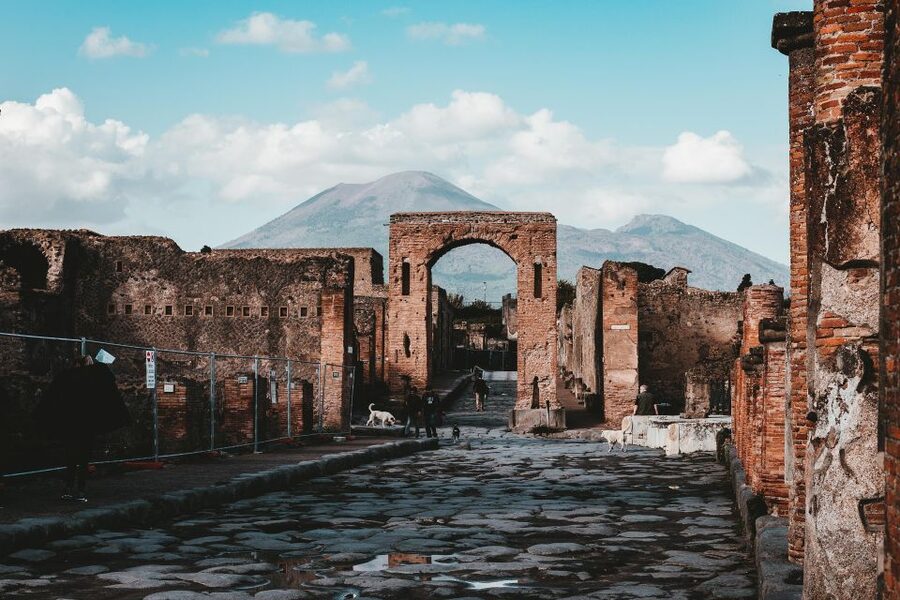
You can begin at either Pompeii or Herculaneum. This flexibility is useful if you are arriving from Naples, Sorrento, or another base and already know which train connection fits your morning.
Starting at Herculaneum can make sense if you want a smaller site first. You may find it easier to learn how the audioguide works there before facing Pompeii’s larger distances. Starting at Pompeii can work better if you want to tackle the biggest site while your energy is highest.
The opening hours change by season:
- From October 15 to March 15, both parks are generally open from 9:00 to 17:00, with last entry at 15:30.
- In the longer summer schedule, the parks are generally open from 9:00 to 19:00, with last entry at 17:30.
The Pompeii information lists the extended period as March 16 to October 15. Herculaneum lists it as March 16 to October 14. Since seasonal hours can affect your train and return plans, check availability and the operating schedule for your date before setting the order.
Six hours sounds workable, but it leaves little room for a relaxed meal, a long delay, or a failed pickup. Treat the day as a focused archaeological visit rather than a leisurely outing.
More Audio Tours in Pompei Campania
- Pompeii: Skip-the-line Entry Ticket with Audio Guide & Map
★ 3.9 · 3,153 reviews - Pompeii: Skip-the-Line Entry Ticket with Digital Guide App
★ 4.1 · 770 reviews - Pompeii: Skip-the-Line Entry & Audioguide
★ 3.8 · 225 reviews - Pompeii: Skip-the-Line Ticket with Audio Guide and Map
★ 4.0 · 117 reviews
Getting between Pompeii and Herculaneum
Transportation between the parks is not included. The practical option is the local Circumvesuviana train between Pompei Scavi, Villa dei Misteri, and Ercolano Scavi, usually with a change at Torre Annunziata.
You buy the train tickets separately. Give yourself time to find the platform and manage the change, particularly if you are carrying bags or trying to stay within the audioguide return schedule. The train connection makes the two-site plan possible, but it is still public transport, not a reserved transfer.
Private transfers are available on request, though they are not part of the $88 package. If you choose this option, factor the additional price into your comparison. For many people, the train is the sensible budget choice. For anyone with a tight timetable, a private vehicle may reduce stress, but the package itself does not cover it.
What the audioguide adds, and where it falls short
The biggest advantage of the audio device is independence. You are not tied to a guide’s pace or to a group moving from stop to stop. You can pause, replay, skip sections, or linger in a room that interests you.
The devices offer English, Italian, French, Spanish, and German. They use the numbers displayed around the parks, giving you a straightforward way to select explanations. The content is described as accurate and current for the archaeological parks, and the authorized format is a useful alternative to unverified audio apps.
Still, an audioguide is not a live guide. It cannot answer a question about a confusing wall, suggest a better route, or explain why a restoration area is closed. Some commentary uses architectural terms without defining them. If you like plain-language storytelling or want help connecting the ruins to the wider Roman world, a guided tour may suit you better.
Bring standard headphones if you have them. The devices work hands-free, but shared equipment is easier to manage with your own earphones. Remember that the ID deposit is not optional, and you are responsible for damage, loss, or theft.
Is $88 a fair price?
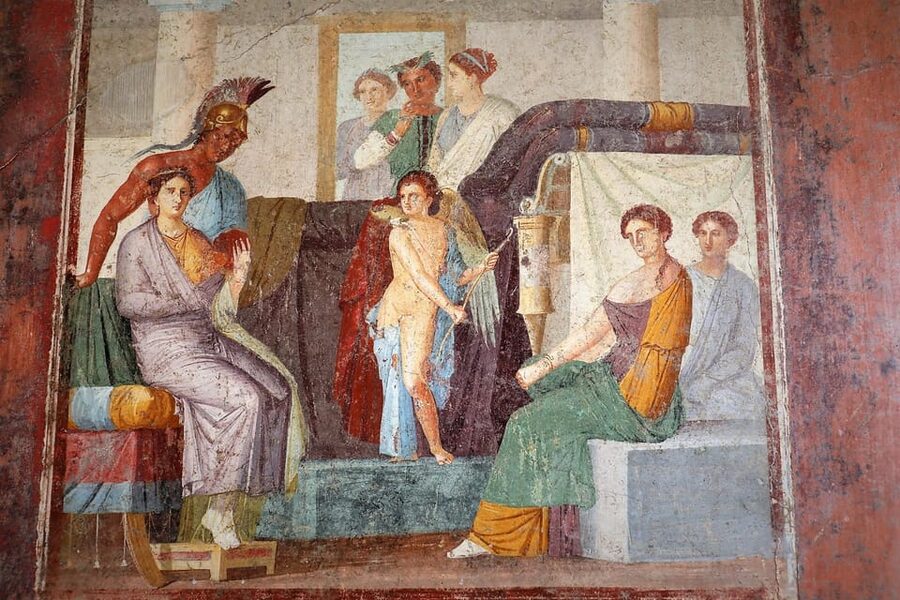
At $88 per person, the package is not the cheapest way to enter these sites. Its value depends on how much you want the two tickets, official audio devices, flexible starting point, and local assistance bundled together.
The price makes more sense if you would otherwise buy both admissions and two separate audio rentals. It also has practical value for someone who wants to avoid arranging each site independently. Multilingual support at the Pompeii office and the site map add useful help on a complicated day.
The value drops if the ticket exchange creates a second queue or if the audioguide malfunctions. One poor experience involved devices that did not work and fast-track tickets that still required a line. Another visitor lost about half an hour dealing with the handling process at each site. Those are not minor issues when the itinerary allows only six hours.
A guided Pompeii upgrade was considered worthwhile by one person after an independent Herculaneum visit. That points to a sensible compromise: use the self-guided format if flexibility matters, but choose a live guide if Pompeii’s size and technical commentary feel daunting.
Timing, comfort, and practical preparation
Wear comfortable shoes. The archaeological surfaces can be uneven, and you will be walking for much of the day. Comfortable clothes matter too, especially during the longer opening season.
Bring your passport or ID card, your voucher, water, and headphones. Food and drinks are not included. You should also keep an eye on closing times because the devices must be returned before the office closes.
The package information gives conflicting accessibility details. It lists the activity as wheelchair accessible, but also says it is not suitable for wheelchair users. Treat that as a serious point to clarify with Tempio Travel before booking, since the two statements cannot both guide your planning.
Free, ungated parking may be available from April 1 at Osteria Nonna Cherubina on Via Andolfi 46 in Pompei, but it is dependent on the location being open and spaces being available. Do not build your arrival plan around guaranteed parking.
Free cancellation up to 24 hours before the activity and reserve-now, pay-later booking provide useful flexibility. They do not solve the day’s main risk, which is the time needed for pickup, transport, and device return.
Who should choose this experience?
I would choose this package if you want both archaeological parks, prefer to set your own pace, and are comfortable handling trains, maps, and a self-guided device. It suits independent visitors who already have some patience for logistics and who want more context than a basic entry ticket provides.
It is less suitable if you want door-to-door transport, a personal guide, or a perfectly simple fast-track process. It may also frustrate anyone who needs accessible facilities without uncertainty, dislikes technical explanations, or has only a narrow window before a train or flight.
The strongest feature is the combination of two very different sites in one flexible plan. The weakest feature is the risk that voucher exchange and equipment problems eat into that flexibility.
Should you book it?
Book it if Pompeii and Herculaneum are both priorities and you value independence over a polished, guided day. The authorized audio devices, site map, multilingual options, and choice of starting point give you a useful framework for exploring on your own.
Skip it and arrange a live guided tour or separate tickets if you want help with complicated architecture, guaranteed personal explanations, or less handling at the entrances. If you do book, start early, confirm the pickup points, bring headphones and ID, and allow extra time for the Pompeii exchange and the train connection. That preparation makes the $88 package far more likely to deliver what you want.
FAQ
Can I visit Pompeii and Herculaneum on the same day?
Yes. The package includes two full entrance tickets and audioguide devices for both archaeological parks. The stated duration is six hours, so you need to plan the order and transport carefully.
Can I choose which site I visit first?
Yes. You can begin at Pompeii or Herculaneum, depending on your schedule and transport plans.
Is transportation between Pompeii and Herculaneum included?
No. The local Circumvesuviana train is recommended, usually with a change at Torre Annunziata. Train tickets are separate, and private transfers can be requested at an additional cost.
Where do I collect the audioguide in Pompeii?
Collect it at the Tempio Travel office on the first floor of the EAV station at Via Villa dei Misteri 1. Afterward, walk several hundred meters to the dedicated entrance at Porta Marina Inferiore in Piazza Esedra.
Which languages are available on the audioguide?
The devices are available in English, Italian, French, Spanish, and German. You may use them hands-free or with standard jack headphones, which you need to bring yourself.
Do I need identification for the audioguide?
Yes. A valid passport or ID card is required as a deposit for each device. You must return the device before the office closes, and you are responsible for loss, theft, or damage.
Latest audio tours in Pompei Campania
- Pompeii: Skip-the-Line Ticket with Audio Guide and Map★ 3.9 · 5 reviews
- Pompeii: Pre-reserved ticket with audio guide★ 3.2 · 15 reviews
- Pompeii: Skip-the-Line Ticket with Audio Guide and Map★ 4.0 · 14 reviews
- Pompeii Tour_Skip the line ticket + audioguide★ 4.7 · 17 reviews
- Pompeii, skip-the-line ticket with smartphone audio guide on App★ 3.0 · 4 reviews
- Pompeii: Skip The Line Entrance Tickets + Audioguides★ 3.2 · 4 reviews
- Pompeii Skip-the-Line Ticket and Audioguide★ 4.2 · 7 reviews
- Pompeii: Skip the Line Ticket + Audioguide★ 3.3 · 13 reviews
1-Day Tours, compared.

Giverny Day Trip with Audio Guide or Live Guide
Read our review →
Peloponnese Highlights Day Trip and V.R. Audio Guide
Read our review →
Giverny and Monet’s House Half Day Trip from Paris Guide or Audio
Read our review →

Albi and Cordes/Ciel Day Trip with Audio Guides
Read our review →
Meteora Day Trip with Central Pickup & Audio Guide
Read our review →
Rethymno: Full or Half-Day Trip to Chania with Audio Guide
Read our review →
Sorrento & Pompeii Day Trip from Rome Audio Guide Tour
Read our review →Browse the lists this tour appears in