
Reviewed · PHILADELPHIA
Philadelphia Historic Sites Self-Guided Walking Tour
Philadelphia’s past comes alive in the space between the Liberty Bell, Independence Hall, Christ Church, and Elfreth’s Alley. This self-guided walk gives you a useful thread through that story, from colonial protest to the founding documents and the unfinished promise of American liberty.
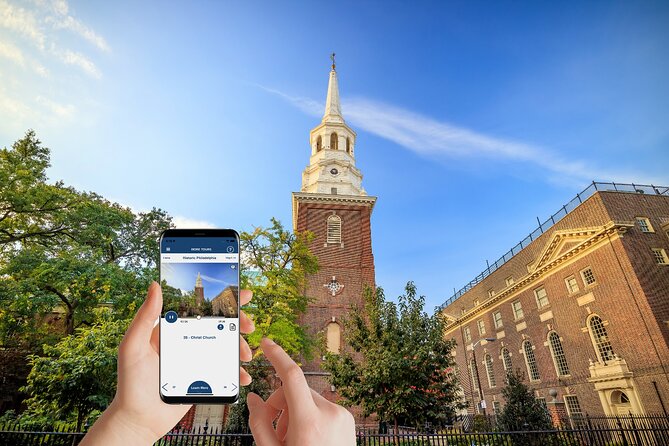
I love the freedom to stop and start, and I like that the GPS audio begins as you reach each point. The offline map is another real plus. You can download everything on Wi-Fi, then walk without burning through cellular data. The main drawback is the app setup. A few people have had trouble entering the password or getting the audio to behave, so download and test it before you reach the historic district.
What makes this Philadelphia walk useful
- More than 30 audio stories: The route covers the headline sights plus smaller stops connected to Franklin, African American history, money, religion, and early city life.
- A flexible 1.5-mile-plus route: Plan on one to two hours at a brisk pace, or about two and a half hours if you pause for photos, side visits, and extra audio.
- Automatic GPS playback: Stories begin when you reach the correct location, helping you keep your phone in your pocket.
- No attraction tickets included: You see many places from outside, but museum admission, reservations, and paid house visits cost extra.
- Lifetime access: You can return to the tour on another Philadelphia visit and use it as many times as you like.
- A good $14.99 value: The cost is modest for a private experience, especially if two people share headphones.
Starting near City Hall and finding your bearings
The official starting point is Philadelphia City Hall at 1400 John F. Kennedy Boulevard, with the route ending near the Museum of the American Revolution at 101 South 3rd Street. No guide meets you, and that is both the appeal and the challenge. You arrive when you want, open the Action Tour Guide app, and let your phone lead you.
Before heading out, download the separate app and the tour while you have strong Wi-Fi or cellular service. Search your email and text messages for the audio tour instructions and password. The password works on the same number of devices as the number of people booked, so use the same password on each device.
I would also bring earbuds, a charged phone, and a small power bank. One person ran out of battery before finishing, which is an easy problem to avoid. If the app offers more than one version, choose the route with your intended starting point and direction.
The app uses GPS rather than a live guide. As you approach a stop, the next story should play automatically. If you walk too quickly, the next clip may begin before the previous one ends. Pause the audio when you want to finish a story, especially if you have opened one of the bonus segments.
More Audio Walking Tours in the USA
- Self Guided Classic Freedom Trail Location Aware (GPS) Walking Audio Tour
★ 4.5 · 258 reviews - Cape Cod & Provincetown Self-Guided Driving & Walking Audio Tour
★ 4.0 · 207 reviews - Santa Fe Historic Downtown Smart Phone Audio App Self Guided GPS Walking Tour
★ 4.5 · 112 reviews
The Liberty Bell and the meaning of freedom
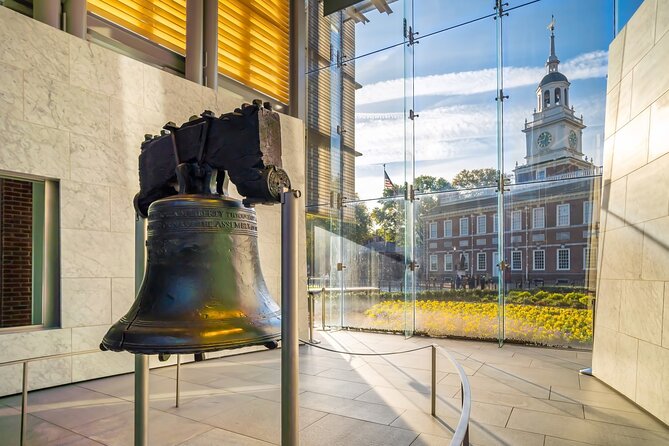
The Liberty Bell is the natural star of this walk. The audio explains its famous crack, why bells can split, and how the object became a powerful symbol long after its colonial use.
The better part of this stop is the broader question of what liberty has meant over time. The story connects the bell with later struggles over slavery, voting rights, and equal freedom. That gives the stop more weight than a simple account of an old bell and its inscription.
Admission to the Liberty Bell Center is free. You should still allow extra time if you want to visit the interior rather than simply listen outside. The tour itself allots about 10 minutes to the stop, which is enough for the audio but not necessarily for a long visit.
Betsy Ross, Christ Church, and the flag story
The walk then turns to Betsy Ross House, one of Philadelphia’s most recognizable colonial addresses. The audio presents the familiar story of the flag’s beginnings and Betsy Ross’s reported meeting with George Washington during Sunday service at Christ Church.
You should treat this as a story about national memory as much as a simple biography. The Declaration of Independence and Constitution tend to receive the largest share of attention, but the flag became the everyday symbol most Americans could see and carry.
Admission to Betsy Ross House is not included. If you want to enter, plan that as an optional side visit and expect the walk to take longer than the basic one to two hours.
City Hall and the road to revolution

Philadelphia City Hall is listed as a major point in the tour and gives the route a link between present-day Philadelphia and the 1700s. Here the narration turns to George Washington, Benjamin Franklin, and the political pressure that led to revolt.
The story includes the Tea Tax as a catalyst. That helps place the Revolution in a chain of arguments over money, representation, and control, rather than presenting it as a sudden burst of fighting.
The city blocks around City Hall are not the quietest setting for listening. I would begin with the phone and app ready before you set out, then keep the volume at a level that lets you hear traffic and people around you.
More History Audio Tours in the USA
- Savannah’s Historical District: A Self-Guided Audio Tour
★ 4.5 · 69 reviews - Self-Guided Walking Audio Tour of Historic Santa Fe
★ 4.5 · 43 reviews - Salida History Audio Tour l A Self-Guided Wild West Experience
★ 5.0 · 41 reviews - Historic Bar Harbor Self-Guided Walking Audio Tour Guide
★ 4.5 · 38 reviews
Independence Square and the making of a nation
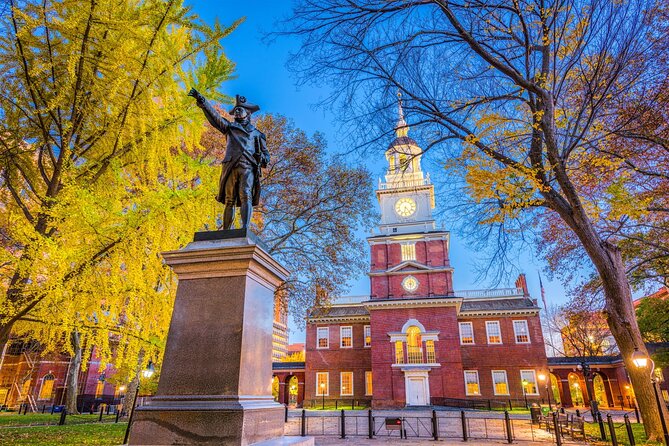
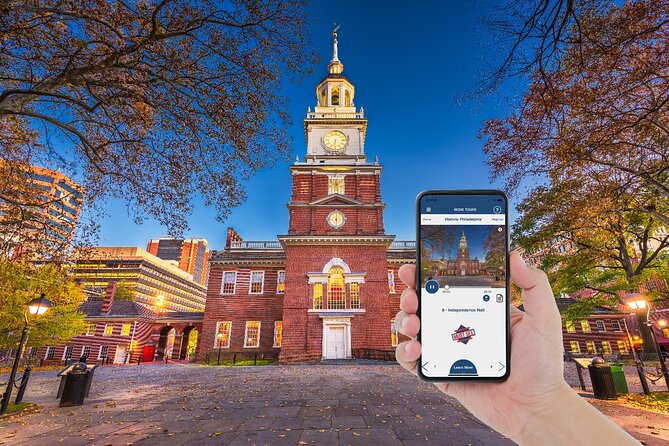
Independence Square is the heart of the experience. This is the setting for the First Continental Congress, the Second Continental Congress, military planning, and the debates that led to the Declaration of Independence.
The narration introduces John Hancock, Patrick Henry, John Adams, and George Washington while explaining why Independence Hall mattered to colonists and why it still matters now. That broader framing is useful because the building is more than a famous backdrop. It represents a debate over who could speak for the colonies and what a new country should become.
The route allows about five minutes here, but that is only enough for the audio. Entry to Independence Hall is not included, and a separate ticket or reservation may be needed. If this is your first Philadelphia visit, check the hall’s entry requirements before booking the walking tour so you can coordinate both activities.
West Washington Square adds another piece of the political story. The audio points out the site connected with the First Continental Congress and explains what followed that meeting. This is a brief stop, but it helps connect the park and surrounding streets with the decisions made nearby.
Benjamin Franklin, Benedict Arnold, and the city’s complicated founders
The Benjamin Franklin Museum is one of the strongest optional stops. The narration presents Franklin as a statesman, writer, inventor, and curious thinker, rather than reducing him to one famous experiment.
You also hear about Benedict Arnold, Franklin’s opposite in the story, and his plans to betray the American cause. That contrast gives the walk some drama and reminds you that the Revolution was not a clean story of united heroes.
Museum admission is separate. If you enter, you will need more time than the short audio segment allows. If you skip the museum, the exterior stop still gives you useful context before the route moves on.
Franklin Square offers a natural pause. It is tied to Franklin’s books, ideas, experiments, and public work. The square is also a practical place to stop the audio, rest, and catch up if the earlier stories have begun to pile up.
Nearby, the Bolt of Lightning Memorial focuses on Franklin’s work with electricity. The audio explains what he was trying to learn, why he pursued the experiment, and how he planned to carry it out. This is a compact stop, but it adds a vivid scientific chapter to a walk otherwise filled with politics and war.
The President’s House and the limits of liberty
The President’s House site recalls the first executive residence used by George Washington and John Adams. The audio gives you a sense of presidential life during the colonial and early national period.
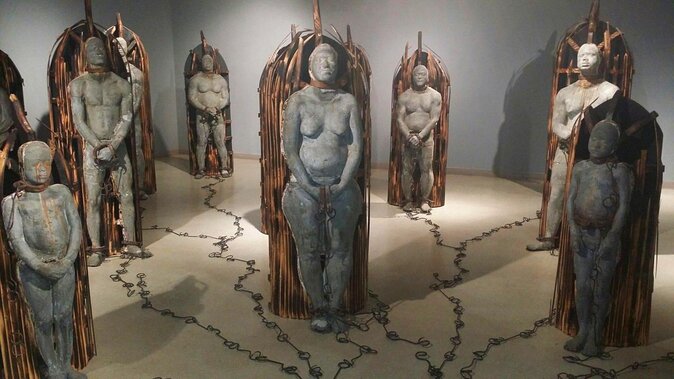
This stop also fits the larger theme of the tour. The new nation spoke of freedom while slavery remained part of American life. That tension becomes clearer as the walk moves toward the African American Museum in Philadelphia.
The African American Museum is an optional paid visit. From the outside, the tour introduces slavery and the contributions of African Americans such as Crispus Attucks. If you want more than a short introduction, the museum deserves its own block of time and separate admission.
That is one area where expectations matter. The route touches many major subjects, but the audio cannot give each one the depth of a full museum visit. Think of it as a well-organized introduction that helps you decide where to spend more time.
Jefferson’s Declaration House and the writing of independence

Declaration House, also known as the Graff House, is connected with Thomas Jefferson’s writing of the Declaration of Independence. The audio also brings in Franklin’s role in editing the document.
This stop works best when you remember that the Declaration was written by people working together, arguing over language, and trying to make a political case to the world. The story gives you a little more of Jefferson’s background and his place in the independence movement.
Admission is not included. The route gives you the historical setting, but an interior visit requires additional planning.
The Constitution, the Mint, and Franklin’s grave
At the National Constitution Center, the tour shifts from independence to government. The audio explains how the colonies gathered to create a lasting union and how the Constitution set out basic rights and the structure of the United States.
This is an important change of subject. The Declaration explains why independence was claimed. The Constitution deals with how the new country would operate. You may want to visit the center itself if that question interests you, since entry is separate.
The United States Mint adds an everyday economic angle. The audio covers early gold and silver coins, then connects them with the copper, nickel, and paper money used today. It is a short stop, but it shows how the new country had to build practical systems, not just issue grand statements.
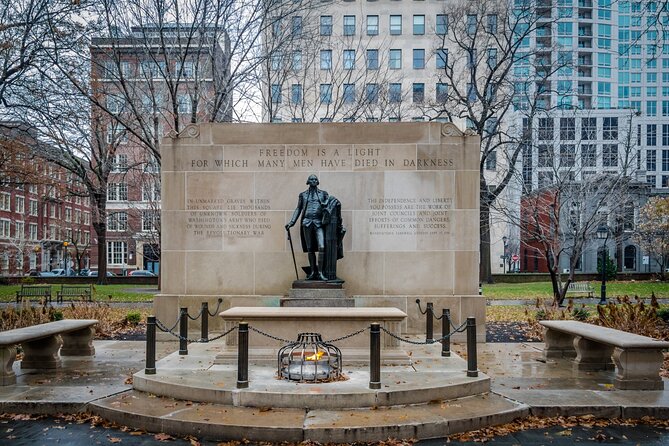
At Benjamin Franklin’s grave, the focus turns to his educational legacy and the University of Pennsylvania. The story explains how Franklin’s ideas for educating the next generation shaped the young nation and continued to influence Philadelphia.
The grave stop is brief, and the admission information indicates that entry is not included. It works well as a final Franklin chapter after the museum, square, and lightning memorial.
Elfreth’s Alley and Christ Church
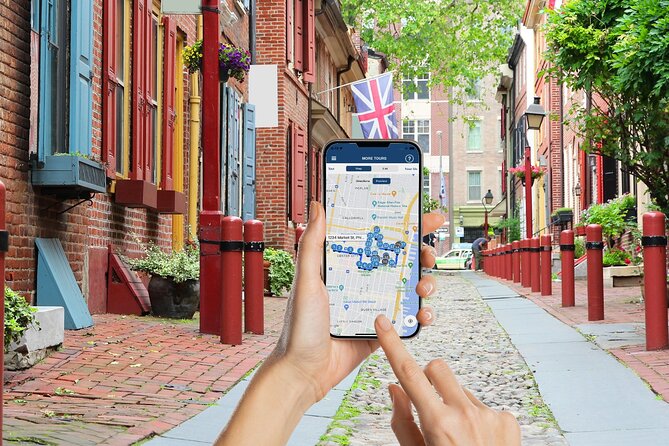
Elfreth’s Alley gives you one of the most atmospheric stretches of the walk. It is known today as an excellent photo stop, but its importance goes beyond appearances. The lane reflects Philadelphia’s early residential life and the city’s first downtown area.
This is a place where you should slow down. The audio may take only about 10 minutes, but the narrow street and colonial buildings reward a careful look. The houses are historic residences, so be respectful and avoid treating the lane as a film set.
Christ Church adds another strong connection to the Revolution. George Washington, Betsy Ross, and other figures associated with the period worshipped here. The audio points out the church’s importance and its architecture, tying the religious life of the city to the political story.
The stop is free to view from outside, while the tour does not include paid admissions. If you want to go inside, check the church’s current arrangements separately.
Finishing near the Museum of the American Revolution
The route ends near the Museum of the American Revolution. That is a sensible finish because the museum can extend the story you have just heard, with exhibits and objects that need more time than a walking audio clip can provide.
The advertised walk is more than 1.5 miles with over 30 stories. In practice, your timing depends on how often you pause, how quickly the GPS advances, and how many optional places you enter. A brisk run through the audio may take close to one hour. A relaxed walk with photos and side visits can take two to two and a half hours.
One person tried to follow the tour by car during rain and found Philadelphia’s one-way streets awkward. I would not use this as a driving tour. The route is designed for walking, and the short city blocks make much more sense on foot.
What $14.99 gets you
At $14.99 per person, the tour is priced well for a private audio walk. You are not paying for a live guide, attraction admissions, or reservations. You are paying for the route, narration, GPS prompts, offline maps, and the ability to use the tour again.
That last point matters. The access is described as lifetime, with no expiration, so you can pause for lunch, return on another day, or finish the route on a future Philadelphia trip. Couples can also share one tour by splitting headphones, though each booked person may use the password on a separate device.
The value is strongest if you want a broad introduction without joining a fixed group. It is weaker if you expect long, detailed lectures at every stop. The audio moves quickly across a lot of history, and some people may want more information for the amount of walking involved.
App setup, pace, and practical concerns
The greatest advantage is control. You can start at any time during the stated operating period, pause for snacks, explore a side street, skip a story, or return to a stop later. You do not have to keep up with a group or wait for anyone else.
The main risk is technical. Download the tour before leaving reliable service, enter the password carefully, and open the app at the starting point. If a clip begins too early, pause it instead of walking on and letting the next story interrupt.
The tour is offered in English. It is near public transportation, and the information says most people can participate. Since you control the pace, you can make the walk easier by taking breaks, though the route still covers a fair amount of ground.
Free cancellation is available if you cancel at least 24 hours before the local start time. Within 24 hours, the price is not refunded.
Who should choose this tour?
I would choose this walk if you have one to three hours, want the main historic district in one organized route, and prefer your own schedule. It suits families who need flexibility, couples who want to stop for photos, and solo visitors who like having directions without joining a group.
It is also useful on a return visit. The lifetime access lets you use the audio as a refresher, then spend more time inside the Liberty Bell Center, Independence Hall, the Franklin Museum, or the Museum of the American Revolution.
I would choose a live guide or a museum visit instead if you want detailed discussion, questions answered on the spot, or a deep look at one subject. I would also skip it if you do not want to download an app or depend on GPS.
Should you book the Philadelphia Historic Sites Self-Guided Walking Tour?
Book it if you value freedom, simple directions, and a low price. The best features are the automatic audio, offline access, broad route, and lifetime use. You can see the major landmarks while also hearing about Franklin’s science, African American history, early money, religion, and the limits of American freedom.
Just prepare the app before you go, bring headphones, charge your phone, and treat the route as a walking introduction rather than a full museum experience. With those expectations, $14.99 buys a practical and flexible way to get oriented in historic Philadelphia.
FAQ
How long does the Philadelphia Historic Sites Self-Guided Walking Tour take?
The tour takes about one to two hours, depending on your pace. Stops for photos, food, optional attractions, or extra audio can extend it to about two and a half hours.
How far is the walking route?
The route is more than 1.5 miles long and includes over 30 audio stories.
Where does the tour start?
The stated starting point is Philadelphia City Hall at 1400 John F. Kennedy Boulevard, Philadelphia, Pennsylvania 19107.
Where does the tour end?
The tour ends near the Museum of the American Revolution at 101 South 3rd Street, Philadelphia, Pennsylvania 19106.
Is a live guide included?
No. This is a private, self-guided activity. No one meets you at the starting point, and the Action Tour Guide app provides the narration and directions.
Does the tour work without internet service?
Yes. You must download the tour while you have strong Wi-Fi or cellular service. After downloading, the audio and maps work offline.
Are attraction tickets included?
No. Entry tickets, attraction passes, and reservations are not included. Paid stops include places such as Betsy Ross House, the Benjamin Franklin Museum, Declaration House, the African American Museum, the National Constitution Center, and the Museum of the American Revolution.
In what language is the tour offered?
The tour is offered in English.
Can I pause the tour or use it on another day?
Yes. You can pause the tour, take breaks, explore side stops, and continue later. The access is described as lifetime with no expiration, so you can use it again on another trip.
What device do I need?
An iPhone running iOS 15 or later, an Android device running version 9 or later, or an iPad or tablet with GPS and cellular connectivity is recommended. Headphones or earbuds are also recommended.
More Self-Guided Audio Tours in the USA
- Gettysburg Battlefield Self-Guided Driving Audio Tour
★ 4.5 · 910 reviews - Joshua Tree National Park Self-Guided Driving Audio Tour
★ 4.5 · 762 reviews - Ultimate Acadia National Park Self-Guided Driving Audio Tour
★ 4.0 · 521 reviews - Ultimate Lake Tahoe Self-Guided Driving Audio Tour
★ 4.5 · 435 reviews
Latest audio tours in the USA
- Sequoia National Park Self-Guided Audio Tour★ 4.5 · 9 reviews
- Sequoia and Kings Canyon Audio Tour Self Guide National Park Tour★ 5.0 · 3 reviews
- Kings Canyon National Park Self-Guided Audio Tour★ 4.0 · 4 reviews
- Sedona, Arizona Self-Guided Audio Tour★ 4.0 · 36 reviews
- Sedona & Red Rock State Park Self-Guided Driving Audio Tour★ 3.0 · 30 reviews
- Haunted Savannah Self-Guided Walking Audio Tour★ 4.5 · 3 reviews
- Downtown Seattle Self-Guided Walking Audio Tour★ 4.5 · 6 reviews
- Uncover Seattle: Self-Guided Audio Tour★ 3.5 · 7 reviews
Audio Walking Tours, compared.

City Monuments Guided Walking Tour with Audio Guide
Read our review →
Self Guided Classic Freedom Trail Location Aware (GPS) Walking Audio Tour
Read our review →
Self-Guided Historical Walking Tour (Audio Guide)
Read our review →
Cape Cod & Provincetown Self-Guided Driving & Walking Audio Tour
Read our review →
Verona Walking Tour with Audio and Written Guide by a Local
Read our review →
Royal Walking Tour and Buckingham Palace Audio Tour
Read our review →
Bologna Walking Tour with Audio and Written Guide
Read our review →Browse the lists this tour appears in