
Reviewed · OAHU
Honolulu Historic District a Smartphone Audio Walking Tour
Honolulu’s historic center is easy to miss if you spend all your time on Waikiki Beach. This self-guided audio walk brings you into the city’s royal, civic, religious, and cultural core, beginning at Aliʻiolani Hale and circling back through nearly 30 points of interest. You’ll hear about Hawaiian monarchs, public buildings, churches, theaters, statues, and a few odd pieces of art that make more sense once the narration explains them.
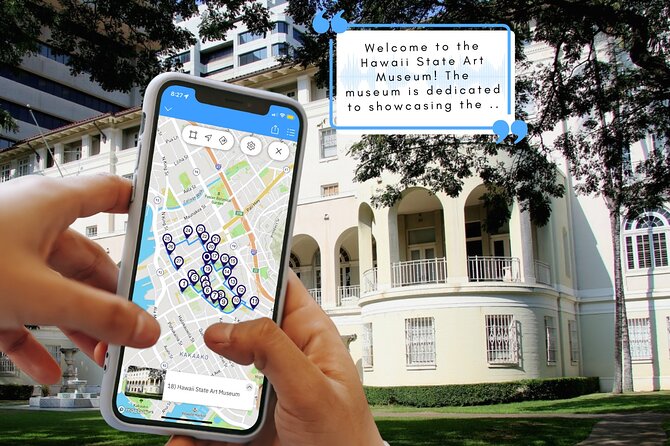
I like the freedom here. The GPS map shows your route and location, while the commentary plays automatically as you reach each stop. I also like the price: at $10.99 per person, it costs less than many guided city walks and remains yours to use at any time after downloading.
The main limitation is just as clear: this is an outdoor audio tour, not a ticketed palace or museum visit. Some stops are more compelling than others, and quiet narration can be hard to hear from a phone speaker, so earbuds are a smart addition.
Key points to know before you walk

- Aliʻiolani Hale is the starting point: Begin at 417 S King Street, in front of the building known as the House of the Heavenly Kings.
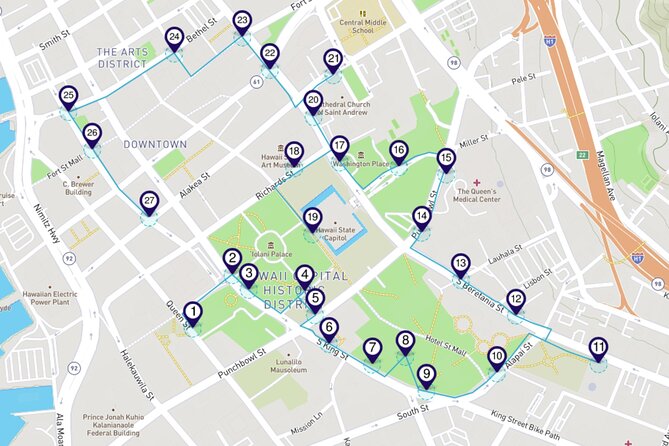
- Nearly 30 historic stops: The route covers royal statues, churches, government buildings, museums, theaters, memorials, and public art.
- GPS-triggered commentary: Audio starts automatically at points of interest, and a live map helps you follow the route.
- No signal is needed during the walk: Download the tour over Wi-Fi before leaving.
- Outdoor access only: Attraction admission, including entry to any palace or museum, is not included.
- Plan for sun and sound: The walk may take longer than two hours, and early morning helps reduce heat. Earbuds improve the audio.
Begin with Hawaii’s royal past at Aliʻiolani Hale
The tour opens at Aliʻiolani Hale, a grand government building whose name means House of the Heavenly Kings. It was built in 1879 for King Kalakaua, a useful first stop because it places you in the era when Hawaii was still an independent kingdom.
From here, the route introduces King Kamehameha I at his famous statue. The narration includes folklore about Hawaii’s celebrated unifier, giving the statue more meaning than a quick photograph can provide. You can pause here, take in the setting, and let the story play before moving along.
This beginning works well for first-time visitors because the tour starts with people, not just buildings. You learn why the monarchy matters before moving into the civic spaces that shaped modern Honolulu.
The route then reaches the Kanaina Building, a Victorian structure listed on the National Register of Historic Places in 1978. The building is a good reminder that Honolulu’s older architecture is not limited to royal residences. Look closely at its design while the audio explains its place in Hawaii’s built heritage.
More Audio Walking Tours in the USA
- Self Guided Classic Freedom Trail Location Aware (GPS) Walking Audio Tour
★ 4.5 · 258 reviews - Cape Cod & Provincetown Self-Guided Driving & Walking Audio Tour
★ 4.0 · 207 reviews - Santa Fe Historic Downtown Smart Phone Audio App Self Guided GPS Walking Tour
★ 4.5 · 112 reviews
Statues, libraries, and Honolulu’s oldest church
One stop focuses on Patsy Mink, including her accomplishments and the reason a statue honors her. The audio gives this part a human scale, moving beyond kings and queens to an important public figure whose work also belongs in Honolulu’s story.
The route continues to the library. This book-lined haven began as a simple reading room in 1879, created partly to keep unruly sailors out of mischief. That small detail makes the stop memorable. It also shows how civic institutions often begin with very practical local needs.
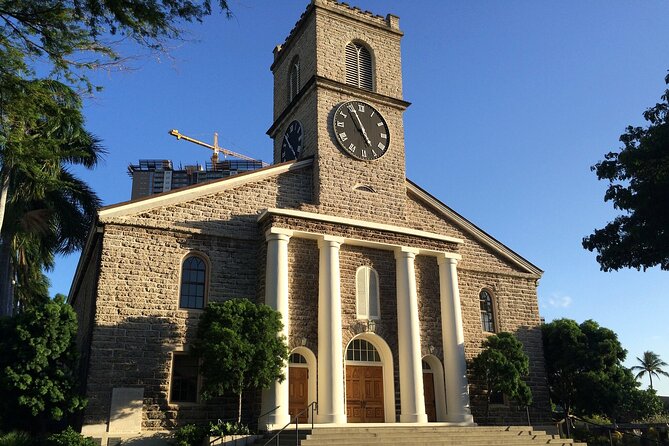
You’ll then hear about Hawaii’s oldest church. The tour does not treat the building as decoration alone. It explains its place in the city and connects it to the monarchy and the changing role of religion in Honolulu.
At another church, the story turns to King Lunalilo. He refused burial in the Royal Mausoleum and instead rests here. That decision gives the stop a personal and political edge, especially after the earlier discussion of Hawaii’s royal family.
I like this section because it offers several kinds of history close together: architecture, education, public service, faith, and royal tradition. The drawback is that the tour’s many short stops can feel uneven. A major church may deserve more time than a brief audio segment allows, so use the pause function and look around instead of rushing from one GPS point to the next.
Civic Honolulu, from city hall to the state capitol
The route moves into Honolulu’s government district, beginning with the city hall building. You’ll hear about its construction and some of its impressive features. This is the kind of place you might pass without a second glance, but the audio gives you reasons to study the facade.
Another building raises a small mystery: why do the dates 1820 and 1915 appear on the front if the building itself was constructed in 1921? The tour supplies the explanation, turning a detail above the doorway into a short history lesson.
You’ll also encounter an unusual sculpture tied to a natural phenomenon. Its strange appearance makes more sense once you know the story behind it. This is one of the route’s lighter moments and a useful reminder that public art can be puzzling on purpose.
The Frank F. Fasi Building, Honolulu’s municipal building since 2006, comes next. Its design is intentionally distinctive, and the narration explains why. Nearby, relaxed-looking stone figures sit on the grounds of Seagull Schools, an early childhood education center. These sculptures add a playful pause to an otherwise formal government district.
The Honolulu Police Department receives its own stop, with attention to something unique about the department. The route then reaches the Bell of Nagasaki, a symbol of peace and friendship between the United States and Japan. This sequence broadens the walk beyond Hawaiian monarchy and local government, bringing in international memory and public service.
At the Queen’s Conference Center, the audio introduces another historic and cultural landmark. The name hints at the continuing royal influence in the area, even as the route moves through modern civic life.
Queen Emma’s vision and Hawaii’s state government
One of the most meaningful parts of the walk concerns the complex created through the vision of Queen Emma and King Kamehameha IV. The narration explains what they hoped to build for Hawaii. This is an important counterpoint to the grand royal stories because it focuses on care, public purpose, and the future of the islands.
The tour then reaches the building that became the Hawaii State Capitol in 1969. The audio supplies details about the structure and its role. You can compare the state government building with the older royal-era sites from the start of the tour, seeing how Hawaii’s political identity changed over time.
Another stop brings you to a regal manor built in 1842 by a clipper ship captain for his wife and young son. Its story adds a domestic note to the route. Not every historic building is tied to a king or a government office, and this home offers a different picture of life in nineteenth-century Honolulu.
The route also visits a museum devoted to Hawaiian art and culture. The tour explains why it matters, but remember that the activity does not include attraction tickets. You can view the exterior as part of the walk, then decide separately if you want to return and go inside.
That distinction matters. One low-priced audio tour cannot provide admission to every major site, and this experience is best understood as an orientation to downtown Honolulu. If you want a full museum visit or an indoor palace tour, budget for those separately.
More History Audio Tours in the USA
- Savannah’s Historical District: A Self-Guided Audio Tour
★ 4.5 · 69 reviews - Salida History Audio Tour l A Self-Guided Wild West Experience
★ 5.0 · 41 reviews - Historic Bar Harbor Self-Guided Walking Audio Tour Guide
★ 4.5 · 38 reviews - Key West’s Old Town Treasures: A Self-Guided Audio Tour
★ 4.5 · 29 reviews
Royal voices, churches, and a shared public garden

The audio returns to the monarchy with a passage framed around the words Queen Liliʻuokalani might have spoken as the last surviving member of the Kamehameha dynasty. This is a thoughtful way to connect personal voice with political change.
You’ll also visit a magnificent church tied to a dream shared by King Kamehameha and Queen Emma for Hawaii. The building provides another chance to see how royal ideals became lasting institutions. Take time to appreciate the exterior, since the walking tour does not include admission to attractions.
The route then reaches the small area originally named for Queen Emma. Since 2016, it has also honored James and Abigail Campbell. That change in name reflects the way public spaces can hold several layers of memory at once.
These stops are strongest for anyone interested in Hawaii’s monarchy and the people who shaped the islands’ religious and civic life. If your main goal is shopping or food, this section may feel slower, but the route gives you a clear historical frame before it reaches the more commercial parts of downtown.
Downtown Honolulu’s theater and pedestrian mall

The pedestrian-only street mall was created in the 1960s as part of an effort to revive downtown. Today, it remains a place for shopping, dining, and entertainment. The audio helps you see it as more than a convenient shortcut. It is part of Honolulu’s urban story and an example of how the city tried to bring people back into its center.
The Hawaii Theatre Center opened in 1922, during the age of vaudeville and silent film. That fact gives the building a lively connection to early twentieth-century entertainment. Its ornate presence also provides a change of mood after the government district.
The tour continues to a building donated to Kumu Kahua Theatre Company. The company was formed to produce new works by Hawaii playwrights and pieces reflecting the many cultures and experiences of the islands. This is a valuable stop because it shows Hawaii’s culture as something still being created, not simply preserved in old buildings.
The final subject concerns construction materials. Newcomers needed a substitute for the bricks they had used back home, and the narration explains what they chose instead. It is a small but revealing detail about adapting imported ideas to local conditions.
A useful extension is Chinatown, which is not part of the stated route but can be added on afterward if you want more downtown atmosphere, food, and street life. The official walk ends back at Aliʻiolani Hale, so treat Chinatown as your own add-on rather than part of the paid experience.
How the audio and GPS system work

You download the tour over Wi-Fi before setting out. Once it is on your device, the walk does not require a signal and uses no mobile data during the tour. That is especially helpful if your phone plan has limits or you are visiting from outside the United States.
The live GPS map shows your position and the route. Commentary plays automatically at each point of interest, so you do not need to keep stopping to read instructions. You can also move at your own pace and skip a stop when the building does not catch your interest.
Bring a fully charged smartphone or tablet. Those devices are not supplied, and headphones are optional. The sound can play through your phone’s speaker, but quiet narration may be difficult to hear outdoors. Earbuds are the practical choice, especially near traffic or other city noise.
The experience is private in the simple sense that you explore with your own group. There is no scheduled guide and no fixed departure time. The tour is available every day, all day, within the stated operating period, and you can take as long as you like.
Timing, heat, and the real value of $10.99

The expected duration is one to two hours, but you should not treat that as a strict limit. Pausing for photographs, reading building details, entering any separately ticketed site, or taking a break can stretch the walk.
Early morning is the best practical choice. The route is outdoors, and starting early helps you avoid the strongest heat and sun. You may also prefer a slower pace, since some stops deserve more attention than the automatic narration alone provides.
At $10.99 per person, the tour offers good value if you want structure without paying for a private guide. You receive the audio, GPS route, flexible use, customer support by phone and email, and the ability to keep the tour for later use.
The value drops if you expect entry to a palace, museum, or other attraction. You must pay those admission fees separately. One past booking confusion came from expecting an indoor palace audio tour, but this activity is specifically an outdoor walk through historic Honolulu. Read that distinction carefully before you buy.
Who should choose this Honolulu audio walk?
I would choose it for an independent visitor who wants context while walking but does not want to join a group at a fixed hour. It also suits repeat visitors staying in Waikiki who want to see the capital’s older civic center.
It works well for history-minded visitors, architecture fans, first-time visitors who want a city orientation, and anyone watching the budget. Families may appreciate the freedom to skip stops, although younger children may lose interest during the government-building sections.
You should consider another option if you want a live guide, long indoor visits, or a tightly edited list of only major sights. The route has many stops, and some are more impressive than others. Its strength is breadth and flexibility, not a grand finale at every corner.
Service animals are allowed, the route is near public transportation, and most people can take part. The activity is private to your group, but it is still a walking tour through an active city, so you will need to manage your own pace and comfort.
Is the Honolulu Historic District audio tour worth booking?
Book it if you want an inexpensive, flexible way to understand downtown Honolulu’s royal, civic, religious, and cultural landmarks. Download it first, start early, bring earbuds, and keep your expectations clear: you are buying an outdoor audio walk, not attraction admission.
Skip it if your main goal is to enter a palace or museum, or if you prefer a human guide who can answer questions on the spot. For everyone else, $10.99 buys a useful city route with enough stories to make Honolulu’s older center feel worth a few hours away from the beach.
Free cancellation is available when you cancel at least 24 hours before the scheduled start time. Within 24 hours, the payment is not refundable.
FAQ
Where does the tour start?
It starts at Aliʻiolani Hale, 417 S King Street, Honolulu, Hawaii 96813.
Where does the tour end?
The activity ends back at the starting point.
How long does the walking tour take?
The estimated duration is one to two hours, but there is no time limit. You can take longer if you pause or explore additional areas.
Is the tour guided in person?
No. It is a self-guided smartphone audio tour with commentary that plays automatically at points of interest.
Does the tour include palace or museum admission?
No. Attraction tickets are not included. The experience is an outdoor walking tour.
Do I need mobile data during the walk?
No. Download the tour over Wi-Fi before you begin. No signal or mobile data is required during the tour.
What language is available?
The tour is offered in English.
More Smartphone Audio Tours in the USA
- Self-Guided GPS Audio E-Bike Tour Hawaii Volcanoes National Park
★ 4.5 · 131 reviews - Ultimate Portland Self-Guided Driving GPS Audio Tour
★ 4.0 · 56 reviews - Birmingham Civil Rights Walk of Freedom Smartphone Audio App Tour
★ 5.0 · 40 reviews - Self Guided GPS Audio Driving Tour Acadia NP From Hulls Cove VC
★ 4.0 · 25 reviews
Latest audio tours in the USA
- Solvang City Personalized Self-Guided App Tour★ 3.0 · 6 reviews
- Essential Downtown SLO: A Self-Guided Audio Tour★ 4.5 · 27 reviews
- Silicon Valley Self-Guided Driving Audio Tour for Tech Lovers★ 4.0 · 24 reviews
- Self-Guided Audio Tour of the Golden Gate Bridge★ 3.5 · 3 reviews
- The Ghosts of San Francisco Haunted Audio App Walking Tour★ 5.0 · 2 reviews
- Point Reyes National Seashore Self Guided Driving Audio Tour★ 4.0 · 9 reviews
- San Francisco Self-Guided Audio Drive: Explore at Your Own Pace★ 4.0 · 9 reviews
- Explore Coronado Island on a Self Guided Audio Tour★ 5.0 · 2 reviews
Audio Walking Tours, compared.

City Monuments Guided Walking Tour with Audio Guide
Read our review →

Self Guided Classic Freedom Trail Location Aware (GPS) Walking Audio Tour
Read our review →
Self-Guided Historical Walking Tour (Audio Guide)
Read our review →
Cape Cod & Provincetown Self-Guided Driving & Walking Audio Tour
Read our review →
Verona Walking Tour with Audio and Written Guide by a Local
Read our review →
Royal Walking Tour and Buckingham Palace Audio Tour
Read our review →
Bologna Walking Tour with Audio and Written Guide
Read our review →Browse the lists this tour appears in