
Reviewed · CRETE
Crete: Knossos Palace Entry Ticket with Optional Audio Guide
Knossos is the place to go in Crete if you want to walk through the political center of Europe’s oldest known civilization. The site dates back roughly 3,500 to 4,500 years, and its rooms, stairways, storerooms, and painted fragments give you a real sense of a working palace, not just a pile of stones.
I like the timed phone ticket, which can save you from a long queue, and I like the freedom to set your own pace. The main catch is the optional audio guide. It adds useful background, but its directions can be hard to follow, and some visitors found the computer-generated voice distracting.
Key points to know before you go
- Book a timed entry: Scan your phone at the gate and avoid the ticket-buying line, but arrive only within 15 minutes before or after your selected time.
- Go early or late: The site gets hot and crowded, especially after tour buses arrive around midmorning.
- Bring water and sunscreen: Most of the route is exposed, with only a few shaded areas and benches.
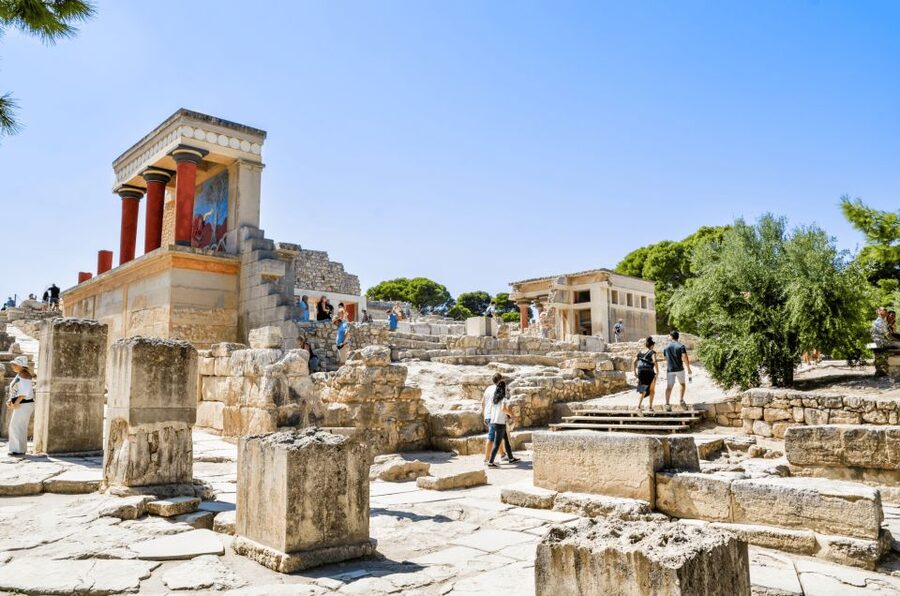
- Expect reconstruction: Arthur Evans’s early 20th-century restorations help you picture the palace, but much of what you see is not original ancient fabric.
- Treat the audio guide as optional: It offers history in four languages, though navigation and pronunciation can be uneven.
- Pair it with Heraklion Museum: The museum’s objects and frescoes help make sense of the rooms you see at Knossos.
Why Knossos matters more than its famous name
Knossos was much more than a mythological backdrop for King Minos and the Minotaur. It was a major center of Minoan government, trade, religion, storage, and daily life. The palace complex began around 2000 B.C., then changed over many centuries before later earthquakes and destruction reshaped it.
You will not see one perfectly preserved ancient building. Instead, you walk through a large archaeological site where foundations, walls, stairways, drainage systems, storage jars, and reconstructed sections reveal how the complex may have worked.
That distinction matters. If you expect the untouched stonework of Pompeii, you may find Knossos less immediately satisfying. If you enjoy piecing together an ancient place from evidence, signs, color, and architecture, the site rewards a slower visit.
The palace also carries the mark of Sir Arthur Evans, the archaeologist who excavated and partly reconstructed Knossos in the early 20th century. His concrete columns, painted surfaces, and rebuilt rooms make the site easier to picture, but they also raise questions about what is ancient and what is modern interpretation.
More Castle and Palace Audio Tours in Greece
- Crete: Palace of Knossos E-Ticket and Audio Guide
★ 3.8 · 1,540 reviews - Crete: Knossos Palace and Museum E-Tickets with Audio Guides
★ 4.0 · 828 reviews - Rhodes: Palace of Grand Master Ticket & Rhodes SG audio tour
★ 4.0 · 324 reviews
Getting in with the timed phone ticket
The practical strength of this experience is simple: you receive an e-ticket for a selected date and time, then scan the QR code from your phone at the entrance. That can save you from a long wait at the ticket office, especially during the busy summer months.
The ticket is for the regular adult price and costs about $30 per person. It is not a reduced admission ticket, so children and young people who qualify for free entry should check the current rules before booking this option. From April 1, 2025, EU citizens under 25 and non-EU citizens under 18 can receive free admission by showing identification at the ticket booth. People with disabilities can also receive free admission with a disability certificate.
Your entry window is strict. You can enter only during the selected time slot, or up to 15 minutes before or after it. The date and entry time cannot be changed, and the booking is non-refundable, so check your plans carefully before paying.
If you arrive without a timed ticket, the ticket office may not have space at your preferred hour. That is especially important when cruise passengers, coach groups, and independent visitors all arrive at once.
Walking through the palace complex
Once inside, you explore independently. There is no live guide included, and the visit is valid for one day, so you do not need to rush through the site as if it were a short timed tour.
Start by looking at the overall scale. The palace is not a single grand block with one obvious route. It is a network of courtyards, rooms, passageways, staircases, and terraces. This layout helps explain why later stories turned Knossos into a maze.
The workrooms and storage spaces are among the most useful areas for understanding everyday life. Large storage jars and stone features suggest a palace that collected, managed, and distributed food, oil, wine, and other goods. These spaces make the Minoan world feel practical and organized rather than purely mythical.
The living quarters show a different side of the complex. You can look for rooms arranged around light wells and courtyards, along with stairways and passages that suggest a multi-level building. Much of the upper structure is gone, so the restored sections help you imagine how vertical and complex the palace once was.
Take your time with the signs. The written information at the site can help orient you, especially if the audio tour sends you in circles. A few people found the audio stops difficult to match with the numbered areas, so do not feel obliged to follow the recording in strict order.
The throne room, murals, and restored architecture
The throne room is one of the most memorable stops. Its stone seat remains in place, and the room gives you a strong sense of the ceremonial side of the palace. You may need to wait to enter or view it properly, especially when large groups are moving through the area.
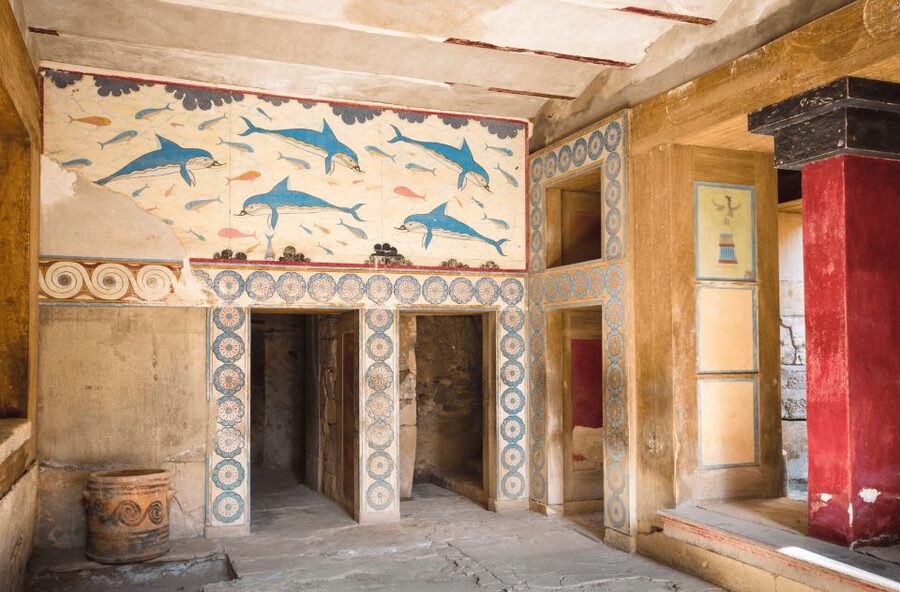
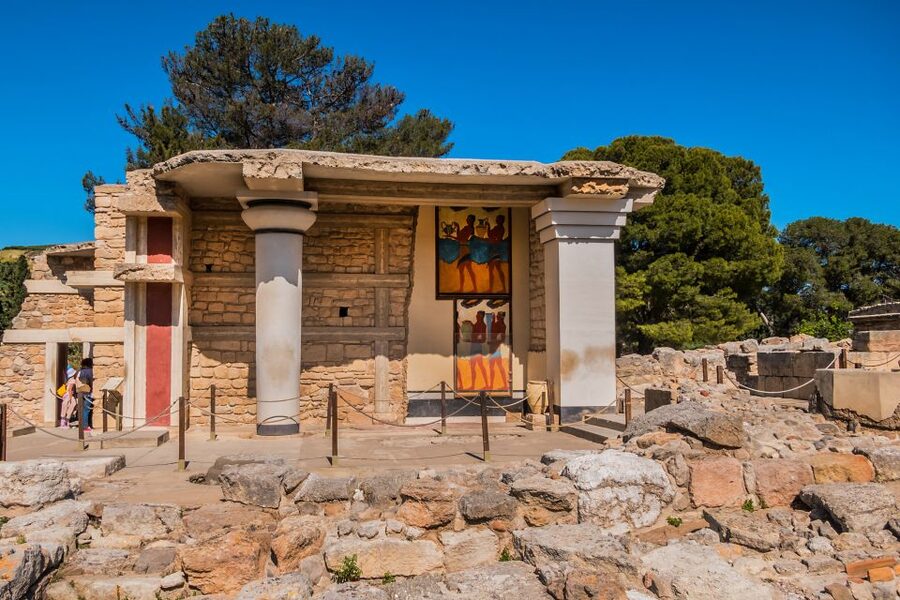
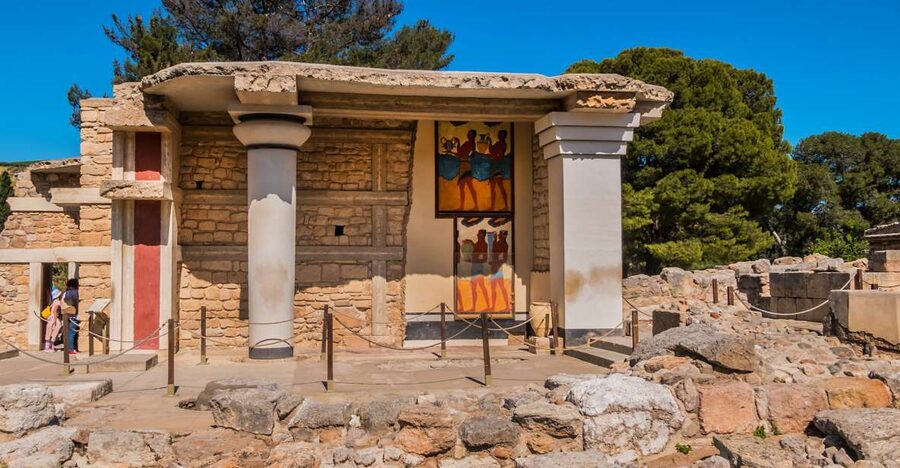
The restored murals add color to an otherwise pale stone and concrete site. They show the decorative style associated with the Minoan period, but it is important to understand that you are seeing a mixture of surviving fragments and modern restoration.
This is where Knossos can divide opinion. I find the reconstructions useful because they give shape to a site that might otherwise be difficult to read. At the same time, concrete columns and heavily rebuilt walls can make it hard to tell what is original.
If authenticity is your top concern, pay close attention to the difference between ancient remains and reconstructed sections. The site is still valuable, but it is best understood as an archaeological place interpreted through several layers of modern work.
The Grand Staircase is another area worth slowing down for. It helps you picture the palace as a substantial multi-level complex rather than a flat field of ruins. The architecture is one of the strongest reasons to visit, even if some parts look more reconstructed than you expected.
Another self-paced route in Greece:
- Athens: Acropolis Ticket with Optional Audio or Live Guide
★ 4.2 · 11,055 reviews - Athens: Cape Sounio & Poseidon Temple Trip with Audio Guide
★ 4.4 · 4,521 reviews - Athens: Acropolis Ticket with Audio Guide
★ 4.0 · 3,575 reviews - From Athens: Delphi Full Day V.R. Audio Guided Tour
★ 4.6 · 3,028 reviews
Is the optional audio guide worth the extra cost?
The audio guide is available in English, Italian, French, and Spanish. It is self-guided, so you listen on your own phone while walking around the site. You need to bring headphones, since no physical audio device or earphones are supplied.
The guide can add useful context about Minoan culture, ancient life, and the purpose of different rooms. Without some explanation, it is easy to walk through Knossos in 15 minutes and leave with only a general impression of walls and pathways. The audio option encourages you to stop and look more closely.
Still, I would not call it an automatic purchase. The main weakness is navigation. The tour does not provide a simple, clear map showing all the stops, and the directions between points can be vague. You may walk past a location, circle back, or struggle to match the audio number with the number at the site.
Some recordings also use a robotic text-to-speech voice, with awkward pronunciation of Greek names and other common words. The information remains usable, but the delivery is not as polished as a good live guide.
If you are comfortable reading signs and using a phone map, the entry ticket alone may be enough. If you want more historical explanation and can tolerate imperfect directions, the audio guide has value. A live guide hired at the entrance may suit you better if interpretation matters more than independence.
Timing your visit around heat and crowds
The most useful advice is to go early. An 8 a.m. to 10 a.m. arrival gives you a better chance of walking through the palace before the largest groups appear. By late morning, the site can become very busy, with queues at popular rooms and more people competing for shade.
Early morning also helps with the heat. Much of the route is in full sun, and there are only a few shaded spots and benches. Bring water, sunscreen, and a hat. The site has a kiosk nearby for drinks and snacks, but you should not depend on finding shade when you need it.
Late afternoon can also work well. One booking at a later time found the site much quieter, with no queue at the entrance. Check the available time slots and local opening hours before relying on this strategy.
Allow roughly a couple of hours if you want to read signs, use the audio guide, and pause at the major rooms. You can walk around faster, but doing so reduces the value of paying for entry to such an important archaeological site.
Reaching Knossos from Heraklion
Knossos is easy to visit from Heraklion without arranging a private transfer. Public bus service from the city takes about 20 minutes, and the fare has been reported at roughly €1.50 to just under €2 each way. Use the transport center and check the current route details before setting out.
If you drive, free parking is available near the palace. Around the entrance, you will find tourist shops, cafes, a kiosk, and places selling drinks and snacks. Toilets are available for a small charge, reported at 50 cents, though lines can grow when a tour group arrives.
The exact meeting point can vary depending on the option you book. Since this is primarily an entry ticket rather than a pickup tour, plan your own route and allow extra time for traffic, bus waits, or finding the parking area.
What the $30 price really buys you
At about $30 per person, this is not a cheap walk through ruins. The price makes more sense if you value the convenience of a timed ticket and the chance to skip a long ticket line during peak season.
The ticket can be especially useful when you see a queue stretching outside the entrance. Several visitors found that they could walk straight to the gate and scan their phones while others waited to buy admission.
The value is less clear if you visit in a quiet period, arrive when the ticket office has open spaces, and plan to spend only 15 minutes at the site. In that case, the booking convenience may not feel like enough to justify the price.
The audio guide should be considered separately. It can give you needed context, but the lack of a clear map and the mechanical narration reduce its value. If you want a strong explanation of the palace, compare the cost of this option with an on-site live guide before booking.
Pairing Knossos with the Heraklion Archaeological Museum
I strongly recommend visiting the Heraklion Archaeological Museum as part of the same day or nearby in your itinerary. Many of the important objects and original works connected with Knossos are displayed there, rather than left at the archaeological site.
The museum helps fill in the gaps created by the outdoor ruins. After seeing storage areas, ceremonial rooms, and restored murals at Knossos, the museum gives you a closer look at artifacts from the Minoan world.
This combination also helps with the reconstruction issue. At Knossos, you see the building and its setting, along with modern restoration. At the museum, you can examine original objects in a more controlled setting. The two visits work better together than either one alone.
Who should book this Knossos experience?
I would choose this ticket if you are staying in Heraklion, want to visit independently, and dislike wasting time in ticket queues. It suits history fans, mythology enthusiasts, first-time visitors to Crete, and anyone willing to spend at least an hour or two making sense of the site.
Families can use the ticket, but the full adult price applies to people of all ages through this option. Check the official admission rules if your child or young adult may qualify for free entry.
You should think twice if you want a fully guided experience, a polished audio production, or a site with little reconstruction. You may prefer a live guide if you want clear directions and immediate answers. Visitors using wheelchairs should also note that some areas can be difficult or inaccessible.
Should you book the timed Knossos ticket?
Book it if your priority is quick entry, flexible self-guided sightseeing, and a reliable time slot. Go early, carry water, and treat the audio guide as a helpful extra rather than the main reason to buy.
Skip the audio option if you dislike phone-based tours or need precise directions. In that case, read the site signs, bring your own background notes, or arrange a live guide.
For most first visits to Crete, Knossos is worth seeing. Just arrive with realistic expectations: this is an important archaeological site shaped by modern reconstruction, not a perfectly preserved ancient palace. The ticket removes one major hassle, and the place itself rewards patience, curiosity, and a little imagination.
FAQ
How much does the Knossos Palace entry ticket cost?
The listed price is $30 per person. This option includes the regular adult-price entry ticket and does not include reduced admission.
How long is the ticket valid?
The ticket is valid for one day, but entrance is limited to the selected date and time slot.
Can I enter outside my selected time slot?
You may enter only during your selected slot, or up to 15 minutes before or after it.
Can I change my travel date or entry time?
No. The travel date and entry time cannot be amended, and the activity is non-refundable.
Is a live guide included?
No. The experience provides entry only, with an optional self-guided audio tour. A live guide is not included.
What languages are available for the audio guide?
The optional audio guide is available in English, Italian, French, and Spanish.
Do I need to bring headphones?
Yes. You must bring your own headphones because earphones and physical audio devices are not provided.
Can I bring a stroller or large luggage?
Oversize luggage and baby strollers are not allowed inside the site.
Latest audio tours in Greece
- The Palace of the Grand Master E-Ticket with Audio Tour★ 4.0 · 9 reviews
- Explore Lindos Acropolis in 3D & Audio★ 4.0 · 4 reviews
- The Palace of the Grand Master. Self-guided Audio Tour★ 3.5 · 15 reviews
- Acropolis of Lindos E-Ticket with Audio Tour on your Phone★ 4.5 · 8 reviews
- Olympia Archaeological Site & Museum E-Ticket with Audio Tour★ 4.0 · 11 reviews
- Mykonos: Find your (queer) god Self-Guided Audio Tour★ 4.0 · 2 reviews
- Meteora Smart Audio Guided Tour★ 4.5 · 9 reviews
- Meteora Full Day Tour from Kalabaka with Audio in 8 languages★ 5.0 · 2 reviews
Castle & Palace Audio Tours, compared.

Topkapi Palace and Harem Skip-the-Line-Tickets & Audio Guide
Read our review →
Sforza Castle Entry Ticket with Digital Audio Guide
Read our review →
Topkapi Palace and Harem Ticket with Audio Guide
Read our review →

Dolmabahce Palace and Harem Fast-Track & Audio
Read our review →

Neuschwanstein Castle Skip-the-Line Ticket with Audio Guide
Read our review →Browse the lists this tour appears in