
Reviewed · CANADA
Halifax Explosion Smartphone Audio Walking Tour
The Halifax Explosion Smartphone Audio Walking Tour turns a 5-kilometre stretch of north-end Halifax into a story about survival. On December 6, 1917, the collision of the SS Mont-Blanc and SS Imo caused one of the most destructive explosions in Canadian history. This walk follows the people, buildings, ships, firefighters, children, and rescuers caught up in it.
I like the GPS-triggered narration, which lets you look around instead of constantly checking a written guide. I also like the human scale of the stories, from Vincent Coleman’s warning to the miraculous survival of Ashpan Annie. The main caution is simple: one user found the audio difficult to follow, so you need to watch the map and pay attention to the route.
Key points at a glance
- Jeff’s narration follows 27 stops from Hydrostone Park through Fort Needham and back to the Hydrostone Market.
- The 5-kilometre route connects major sites with smaller memorials, old street lines, buildings, and surviving infrastructure.
- Audio plays automatically near each location, with an optional trivia question after each segment.
- Download on Wi-Fi before walking, then use the tour without mobile signal or data.
- You control the pace, and can stop, restart, or listen away from the route later.
- The $8.96 price is strong value for a private, self-guided experience, though you supply the phone, battery, and headphones if wanted.
Starting at Hydrostone Park
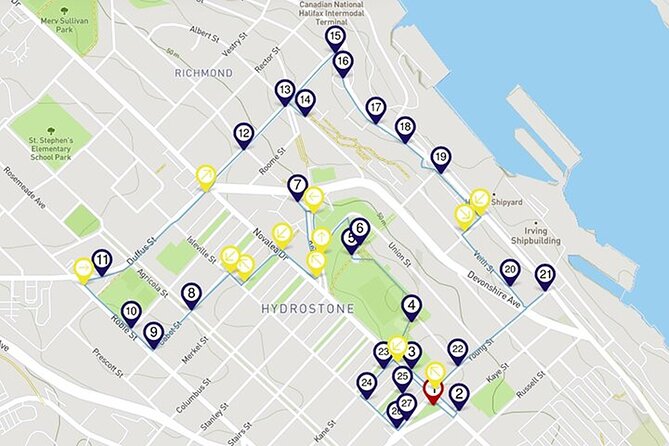
You begin at Hydrostone Park, at 5547 Young Street, across from the Hydrostone Market. This is a sensible starting point because the route introduces the disaster through the neighbourhood it helped create.
The tour is not just a march between plaques. Jeff explains how Halifax changed after the blast and how outside aid helped shape the rebuilt north end. The opening material prepares you for the theme running through the whole walk: this is a story about people who suffered, people who helped, and a city that had to rebuild quickly.
The first stop takes about five minutes, but the full walk lasts roughly 1 hour 30 minutes to 2 hours 20 minutes. That wide time range matters. If you move steadily and pause only briefly, you may finish near the shorter end. If you stop to look at memorials, read signs, take photographs, or replay sections, allow more time.
The route is open daily from 6:00 AM to 10:00 PM during the stated operating period. Still, daylight will make the outdoor memorials and street details easier to see. Bad weather can change the experience. The audio can be played later, even if rain or wind ruins the walking portion, but the physical route is the heart of the tour.
More Audio Walking Tours in Canada
- Halifax Churches, Gardens & Graveyards: a Smartphone Audio Walking Tour
★ 4.5 · 25 reviews - Halifax Boardwalk & Seaport: a Smartphone Audio Walking Tour
★ 4.0 · 19 reviews - Explore Halifax with 3 Unique Smartphone Audio Walking Tours
★ 4.0 · 16 reviews
The ships and the first shock of the blast

At the stop marked by the coordinates near MC72+M7, the story turns to the SS Mont-Blanc and SS Imo. Here you hear about the ships and the events that led to the explosion.
This is an important early stop because it gives the disaster a clear cause and setting. Instead of hearing only about damage, you get the chain of events involving the two vessels. The audio format works well here because you can pause beside the site and let the story build before moving on.
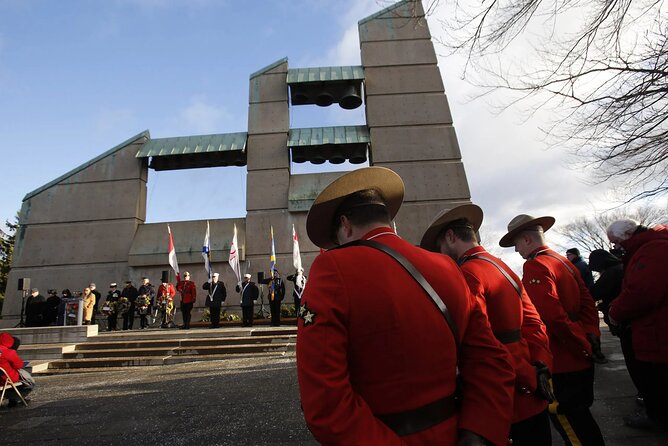
From there, the route reaches the Halifax Explosion Memorial Bell Tower in Fort Needham Memorial Park. The bell tower is one of the walk’s most important monuments, and the commentary explains its meaning for people in Halifax and Dartmouth who lived through the destruction.
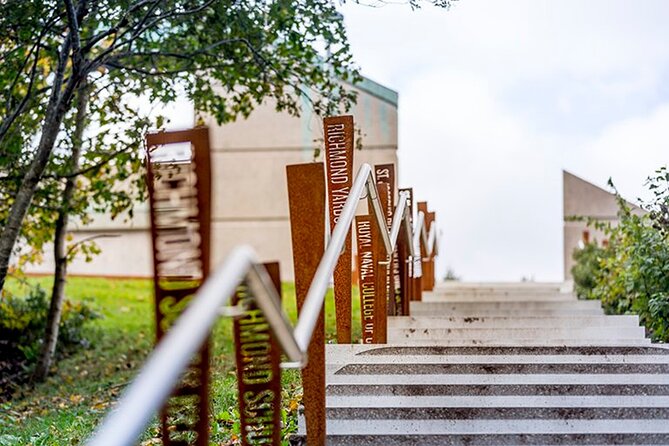
The Richmond Staircase adds another layer. Its symbolism and railings, including the names of businesses destroyed in the blast, connect the large event to ordinary working life. I find this sort of detail more useful than a simple date-and-death-toll presentation. It shows what a city actually lost.
The stairway also gives the tour a physical sense of height and movement. Later, the audio explains how the tsunami swept up the hillside. Standing in this area while hearing that account helps you picture the force of the water rather than treating it as an abstract fact.
Richmond School and the shape of a rebuilt neighbourhood
At Canada Family Court, you hear about Richmond School, a building constructed soon after the explosion. The story includes the tragedy of the Roome School, which gives this section a difficult but necessary focus on children and education.
The next stops explore details that are easy to miss without guidance. The Secret of the Trees concerns timber that became infamous in lumber mills from Canada to the southern United States. The supplied information does not spell out every part of that story in advance, so listen closely when the audio begins. This is one of the places where the automatic narration adds value: you might otherwise walk past without knowing why the trees matter.
At 3365 Robie Street, the focus shifts to Francis Mackey, the pilot aboard the Mont-Blanc. His life changed profoundly after the explosion, and his story gives the ship disaster a personal face.
The Robie Street water reservoir, built in 1913, is another practical detail with a larger role. You hear how it survived and why it received special designation. I like this stop because it moves beyond memorials and individual stories. Infrastructure can seem dull until you learn what remained standing and why that mattered.
Firefighters, weather, and the water rushing uphill
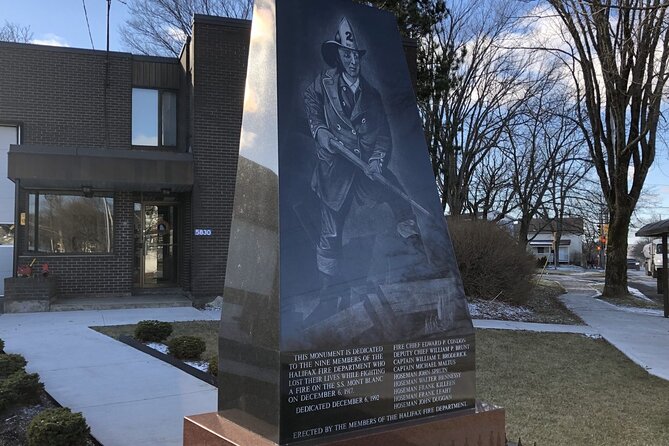
A monument to the Halifax firefighters who died in 1917 introduces Patricia and her crew. The stop also explains the Patricia, adding a maritime thread to the story of emergency response.
The walk then covers Fire and Ice and Black Rain. These phrases describe the harsh conditions survivors faced after the blast, when fire, cold, debris, and darkened skies made rescue even harder. The audio encourages you to consider the weather as part of the disaster, not just a backdrop.
The tsunami stop is especially effective in this stretch. You hear how the wave swept up the hillside and how high it would have reached if you had been standing there at the time. That kind of place-based narration is the best reason to choose this tour over a general Halifax history walk.
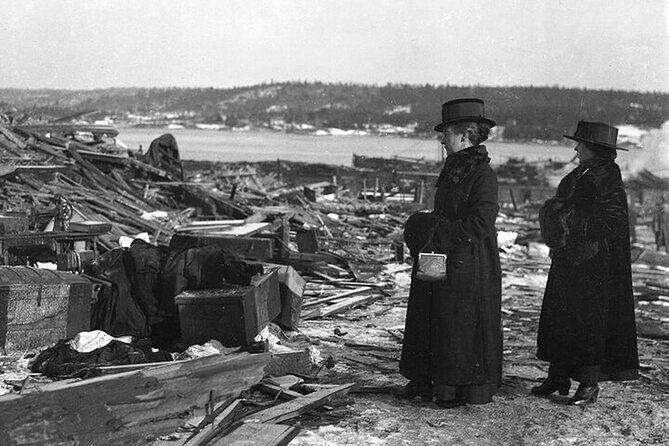
The next stop covers house holes and the razing of Richmond. Changes in the ground mark the places where homes once stood and people died. These ghostly traces can be harder to understand than a large monument, but they bring home how thoroughly the neighbourhood was altered.
More Smartphone Audio Tours in Canada
- Cabot Trail: a Smartphone Audio Driving Tour
★ 4.5 · 118 reviews - Icefields Parkway: a Smartphone Audio Driving Tour
★ 4.0 · 118 reviews - Smartphone Audio Driving Tour between Banff and Calgary
★ 4.0 · 25 reviews - Smartphone Audio Driving Tour between Lake Louise and Calgary
★ 4.0 · 15 reviews
Vincent Coleman and the people who bought others time
At Vincent Coleman’s stop, you hear why Haligonians remember him as a hero. He is credited with potentially saving hundreds of lives, and his story gives the tour one of its clearest examples of courage under pressure.
The route continues along Barrington Street and Duffus Street, once part of Campbell Road. It was a wide dirt road lined with shops and houses. This stop is useful because it restores the everyday setting. Before the disaster became a national event, this was a working neighbourhood with homes, stores, and familiar streets.
Then comes Ashpan Annie, one of the tour’s most memorable stories. The stop brings good news about a baby’s miraculous survival. After so much destruction, this small story provides relief without weakening the seriousness of the walk.
The Amazing Adventure of Billy Wells offers another change of pace. His story is described as extraordinary, and the audio uses it to show how people survived in ways that seem almost impossible. These individual accounts keep the tour from becoming a string of dates and buildings.
Memorials to children, sailors, and worldwide aid
At Irving Shipbuilding, the commentary explains the controversy surrounding the structure and why it was built there. This adds a later layer to the route, reminding you that the meaning of the explosion continued to affect decisions about the area.
Veith House brings the Halifax Protestant Orphanage into the story. A colourful memorial on the white picket fence was painted by children from Veith House. It is a quieter stop, but it connects the past to the children who live and work in the neighbourhood today.
Near the former Royal Navy College, you hear how the efficiency of the co-commander helped people survive. The college once stood across the road, and this stop widens the story beyond Halifax residents to the naval setting around the harbour.
The next stop, To the Rescue, covers the help Halifax received from around the world and a tradition that continues today. This is one of the tour’s more hopeful sections. It explains that the aftermath was not only local suffering. Aid, cooperation, and long-term remembrance also became part of the story.
Hydrostone District, planned after catastrophe
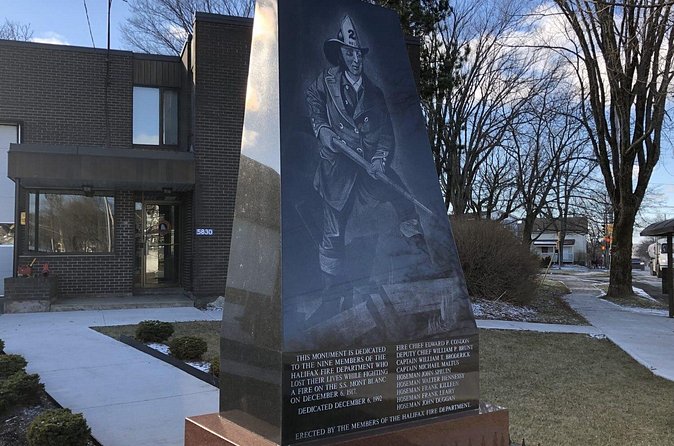
The Hydrostone District is the final major section of the walk. You hear about the town planner and the use of English garden-city ideas in rebuilding Halifax.
The district’s rowhouse cottages were constructed in the English Tudor Revival style for families who survived the explosion. Their design is not just decorative. It reflects an organized attempt to create new housing after an entire neighbourhood had been damaged or destroyed.
The back lanes provide another practical detail. The tour explains why they were designed for business use, giving you a reason to look behind the front facades. The Hydrostone is easy to appreciate as a pleasant shopping and residential area, but this commentary shows how its layout grew out of emergency planning and rebuilding.
The Halifax Relief Commission Building is the last major historical stop before the finish. The commission was formed to deal with the emergency, and the building is now a designated cultural historic site. This is a fitting point in the route because it brings together the response, administration, housing, and long recovery that followed the blast.
You finish at Hydrostone Market, close to where you started. The ending returns attention to the people who lived through the day and those who rushed to help. You can stop for refreshments at the market if it is open, but the tour itself does not include food or admission to an attraction.
How the GPS audio and trivia work

Before setting out, download the tour over Wi-Fi. Once it is on your device, you do not need a signal or mobile data during the walk. This is useful in an outdoor route where connectivity can vary, and it avoids unexpected data use.
A live GPS map shows your position and the next point. As you approach a stop, Jeff’s commentary should play automatically. The design aims to give you the freedom of a private walk without requiring you to read a long guide at every corner.
The optional trivia game adds a small interactive element. After the commentary, you look at the device and tap your answer. It will appeal most to families and people who like a bit of structure, but you can ignore it and focus on the history.
One practical weakness is that automatic audio requires you to stay aware of your position. If the commentary is hard to follow, check the map rather than walking ahead and hoping the next segment catches up. Bring a charged phone. The tour does not provide a smartphone, tablet, or headphones, and the audio can play through your device speaker.
You choose the number of devices when booking. That number is not simply a headcount for a group reservation. It is the number of phones or tablets to which you can download the tour.
Price, pace, and who gets the best value
At $8.96 per person, this is inexpensive for a private activity. A conventional guided walk can cost much more, and this option avoids a fixed group schedule. You can begin within the stated hours, pause for photographs, stop for food, or restart a section without holding up anyone else.
The value is strongest if you want a focused history walk and already have a phone. It is less attractive if you prefer a live guide who can answer questions, adjust the route, or explain a confusing point in person.
The tour is offered in English only. It requires a moderate level of physical fitness because you walk about 5 kilometres and use outdoor paths, streets, and stairs. Service animals are allowed, and the start is near public transportation.
The route is a private activity for your own group. That means no crowded cluster around a guide, but it also means no other person is there to clarify the directions if you lose your place. Downloading before you leave and keeping the map visible are the two most useful precautions.
Free cancellation is available if you cancel at least 24 hours before the scheduled start time. Inside that window, the amount paid is not refunded, and changes are not accepted.
Should you book the Halifax Explosion walk?
Book it if you want a low-cost, flexible way to understand the Halifax Explosion through specific places and personal stories. The route does more than point out monuments. It links the ships, the tsunami, firefighters, Vincent Coleman, Ashpan Annie, Billy Wells, relief work, and the Hydrostone rebuild.
I would choose it for an independent visitor, a history-minded family, or anyone who dislikes being pushed along in a group. I would be more cautious if you need a polished live presentation or have trouble following GPS audio. In that case, download the tour well ahead of time, use headphones if you have them, and allow extra time.
The strongest feature is the combination of local streets and automatic storytelling. The main limitation is that the experience depends on your device, your ability to follow the map, and decent walking weather. At this price, those are fair trade-offs for a thoughtful route through one of Halifax’s most important stories.
FAQ
How long is the Halifax Explosion Smartphone Audio Walking Tour?
The walk takes approximately 1 hour 30 minutes to 2 hours 20 minutes. The route is about 5 kilometres, and your time will depend on how often you stop, replay audio, or look around.
Where does the tour start and finish?
It starts at Hydrostone Park, at 5547 Young Street in Halifax. It finishes back at the starting point, near Hydrostone Market.
Do I need mobile data during the tour?
No. You should download the tour over Wi-Fi before starting. After that, the tour does not require a signal or mobile data.
Does the tour include a live guide?
No. It is a smartphone audio tour featuring commentary from guide Jeff. GPS triggers the audio near each point of interest.
What equipment do I need?
You need your own smartphone or tablet. Headphones are not included, and you can listen through your device speaker if you prefer.
Is the tour suitable for a private group?
Yes. This is a private activity for your group, and the number of devices available for download matches the number of travelers selected at booking.
Latest audio tours in Canada
- Fruit alcohol tasting + Velvet Orchards audio tour★ 5.0 · 2 reviews
- APP Self-Guided Tours Quebec with Audioguide★ 3.0 · 2 reviews
- Quebec City Self-Guided Driving Audio Tour★ 4.0 · 7 reviews
- Layers of Natural History: Picton Nature Self-Guided Audio Tour★ 5.0 · 4 reviews
- Smartphone Audio Driving Tour between Wasaga Beach and Toronto★ 4.5 · 3 reviews
- Niagara: Behind The Falls, Skylon Tower Ticket & Tesla Audio Tour★ 3.5 · 69 reviews
- Niagara Falls Pass: 5 Iconic Attractions, WEGO Bus & Audio Guide★ 5.0 · 7 reviews
- Niagara Peninsula: a Smartphone Audio Driving Tour★ 4.0 · 10 reviews
Audio Walking Tours, compared.

City Monuments Guided Walking Tour with Audio Guide
Read our review →

Self Guided Classic Freedom Trail Location Aware (GPS) Walking Audio Tour
Read our review →
Self-Guided Historical Walking Tour (Audio Guide)
Read our review →
Cape Cod & Provincetown Self-Guided Driving & Walking Audio Tour
Read our review →
Verona Walking Tour with Audio and Written Guide by a Local
Read our review →
Royal Walking Tour and Buckingham Palace Audio Tour
Read our review →
Bologna Walking Tour with Audio and Written Guide
Read our review →Browse the lists this tour appears in