
Reviewed · COLOGNE
Roman Cologne: A Self-Guided Audio Tour
Cologne’s Roman past is easy to miss beneath its modern streets, but this self-guided walk helps you spot it. In about an hour to an hour and a half, you’ll move from the cathedral area to the Ubii Monument while hearing how Roman roads, warehouses, temples, and palaces shaped the city you see today. I especially like the GPS-triggered narration and the chance to pause whenever you want. The main drawback is that the route works best in its planned direction, so starting somewhere else can be confusing.
I also like the offline access, which lets you download the audio, map, and location data before walking. At $11.99, the tour is a good-value introduction for independent visitors, though it is not a substitute for entering museums or paying for a live guide. The narration is in English only, and one low-rated experience found the storytelling a bit dull.
Key points about the Roman Cologne walk
- Follow Cologne’s Roman story in sequence: The route connects the cathedral area, Roman harbor road, palace remains, old market, and Ubii Monument.
- Use your phone hands-free: GPS activates the next recording as you reach each location, so you can put your phone away while listening.
- Download before you walk: The VoiceMap app stores the audio, map, images, and geodata for offline use.
- Expect a short urban walk: The full route takes about 60 to 90 minutes, depending on your pace and stops.
- See history without museum admission: You pass major sites and peer through a museum window, but entrance tickets are not included.
- Keep the route in order: The narrative is designed to run from the dedicated start to the Ubii Monument, not backward.
Why Roman Cologne works best as a walking story
Cologne is famous for its cathedral, but the city’s Roman layer is less obvious. You may walk over ancient roads, pass foundations hidden under later buildings, and look at medieval churches without realizing how much Roman material lies below or beneath them.
This tour gives those fragments a connecting thread. Instead of treating each site as a separate stop, the audio explains how Roman Cologne developed and how later buildings reused earlier spaces. That makes the walk useful on your first visit, but it also has something to offer if you already know the city. One person who had lived in Cologne for nearly 30 years still found new details about places such as Höherstraße and the Gürzenich.
The VoiceMap format is simple. You download the app on an Android or iOS phone, download the tour files, and begin at the designated starting point. As you walk, GPS triggers the next section of narration. You do not need to keep checking the screen, although you should still glance at the map if you become unsure of the route.
The tour has no time limit or expiry. You can pause for a coffee, stop to take photographs, or split the walk into sections. That flexibility is useful on a day when Cologne’s attractions are closed, such as New Year’s Day. It also lets you fit the route around cathedral visits, meals, or other plans.
More Self-Guided Audio Tours in Germany
- Lübeck Scavenger Hunt and Highlights Self Guided Audio Tour
★ 4.0 · 30 reviews - Freiburg Scavenger Hunt and Highlights Self Guided Audio Tour
★ 4.0 · 29 reviews - Heidelberg’s Altstadt: A Self-Guided Audio Tour
★ 4.0 · 26 reviews
Starting near the cathedral and the Kreuzblume
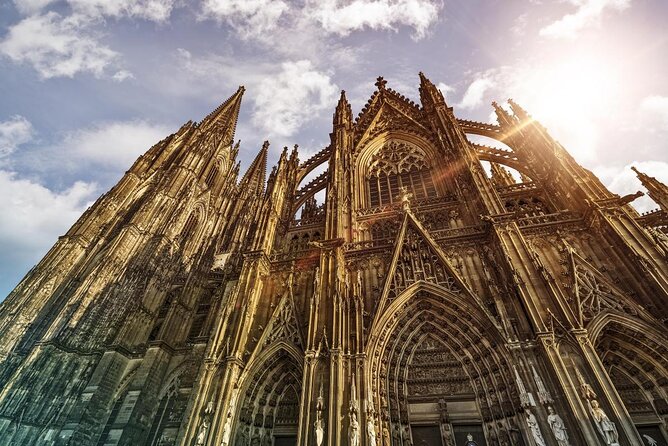
The walk begins in the cathedral area, in front of the Kreuzblume. The supplied meeting-point information gives Cologne Cathedral at Domkloster 4 as the start address, so use the app’s map and directions to get to the precise starting point before pressing play.
This is a practical place to begin. The cathedral is one of Cologne’s easiest landmarks to find, and the route quickly places the modern city in its Roman setting. You will not tour the cathedral interior as part of this experience. Instead, you pass by its exterior while the audio explains the setting and the layers beneath the surrounding streets.
Give yourself a few minutes to get oriented before starting. The tour’s narration follows a set order, and the app uses GPS to trigger the audio at the correct locations. Starting from the wrong place, or attempting to walk the route backward, can make the directions harder to follow.
The cathedral, Northern Gate, and Roman city limits
The cathedral is an impressive first sight, but the Roman Northern Gate gives the tour a more direct connection to antiquity. As you pass it, the narration describes the Romans’ northern entrance and helps you picture Cologne as a fortified settlement rather than simply the medieval and modern city around you.
This is one of the strengths of an audio walk. You are not just looking at a surviving object. You are being asked to think about how people entered the city, how its boundaries worked, and how much of the Roman plan remains visible in altered form.
The cathedral area can be busy, and the route does not provide a private guide to manage the crowd or point out details in person. If you want long explanations or plenty of time for questions, a live tour may suit you better. If you prefer to listen while setting your own pace, the audio format is more relaxed.
The Roman mosaic behind the museum window
One particularly useful stop comes at the Roman-Germanic Museum. The tour does not include museum admission, but you can look through a window to see one of the world’s largest and best-preserved Roman mosaics.
That detail matters because it keeps the experience inexpensive. You get a meaningful look at an important Roman object without adding an entrance fee, though the viewing experience is naturally more limited than visiting a museum exhibition. The audio supplies the context, while the window gives you something concrete to study.
If you are especially interested in Roman art, archaeology, or the museum’s full collection, treat this stop as an introduction rather than the complete experience. Tickets and attraction entry are not part of the $11.99 price.
Another self-paced route in Germany:
- Neuschwanstein Castle Skip-the-Line Ticket with Audio Guide
★ 4.4 · 1,388 reviews - Berlin: Solar Powered Sunset Catamaran Cruise & Audio Guide
★ 4.6 · 1,043 reviews - Berlin: Boat Sightseeing Cruise with Audioguide
★ 4.6 · 947 reviews - Füssen: Neuschwanstein Castle Express Ticket and Audio Guide
★ 3.9 · 788 reviews
Die Römische Hafenstraße and an imperfect reconstruction
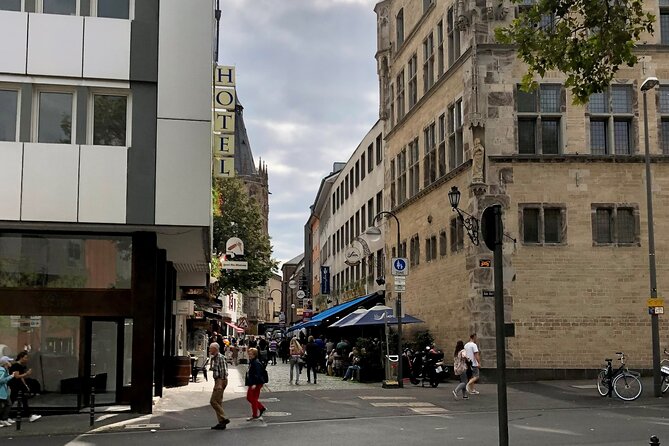
The walk continues along Die Römische Hafenstraße in Köln, the Roman harbor road. This stop is less about a perfect monument and more about how modern Cologne chooses to show its past.
You will hear why the Roman harbor road was imperfectly rebuilt in Kurt Hackenberg Platz. That imperfection is worth noting. Ancient remains in a modern city rarely survive as a complete, untouched scene. Roads get covered, buildings change, and later planners decide how much of the past to expose.
For me, this is the kind of stop that makes the tour useful beyond a list of famous sights. You learn to question what you are seeing. Is it original? Is it reconstructed? Has it been moved or interpreted? The audio helps you separate surviving Roman fabric from later presentation.
The Praetorium and Cologne’s Roman seat of power
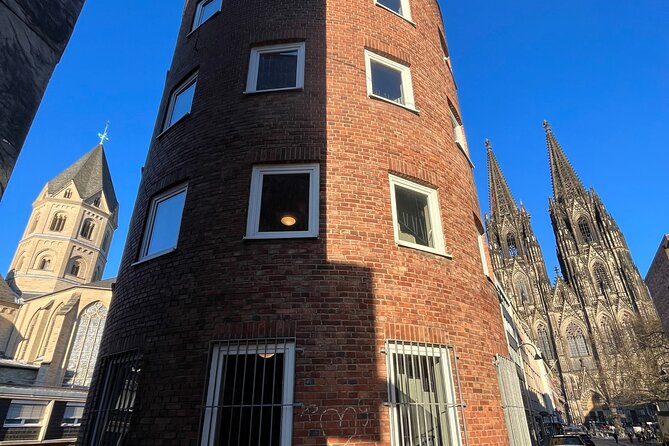
At the Römisches Praetorium, the tour reaches the largest Roman palace in the Rhineland. This was not an ordinary home. The scale of the site points to Cologne’s political importance within the Roman world.
The stop also helps balance the walk. You have already heard about gates, roads, and a harbor connection. Here, the focus shifts to authority and administration. Roman Cologne was not simply a trading settlement with scattered ruins. It was a major center with buildings suited to regional power.
You pass the site rather than entering it, and admission is not included. That keeps the route easy to join, but it means you should not expect a full archaeological visit. The value comes from seeing the location in sequence with the other sites and understanding how the palace fits into the city’s larger plan.
Alter Markt and Great St Martin Church
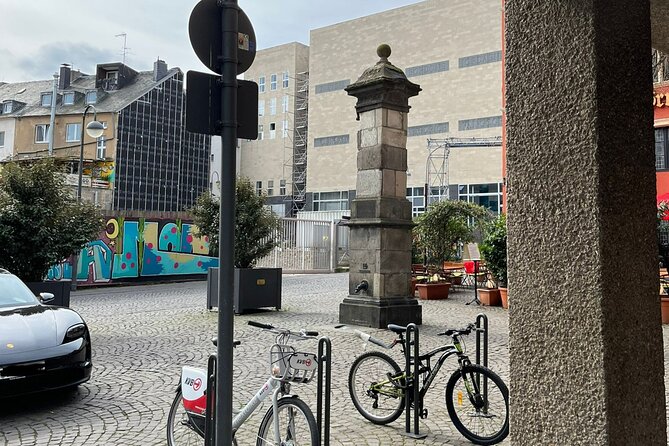
The route passes through the Alter Markt, Cologne’s old market. This gives you a change of scenery from the explicitly Roman remains, but the audio continues to connect the present street plan with earlier uses of the city.
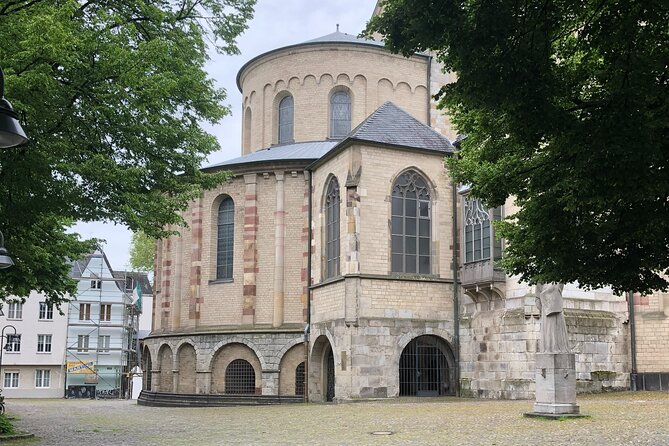
Great St Martin Church is another good example of Cologne’s layered past. The medieval church was built on the foundations of a Roman warehouse. You can look at the church as a medieval landmark while also considering the practical Roman structure that came before it.
This is one of the tour’s most appealing ideas: history is not arranged in neat periods. Roman, medieval, and modern Cologne overlap. A church can preserve the footprint of a warehouse. A market square can sit within a much older urban pattern. The walk keeps bringing your attention to those overlaps.
Schmitz Säule and the moon landing connection
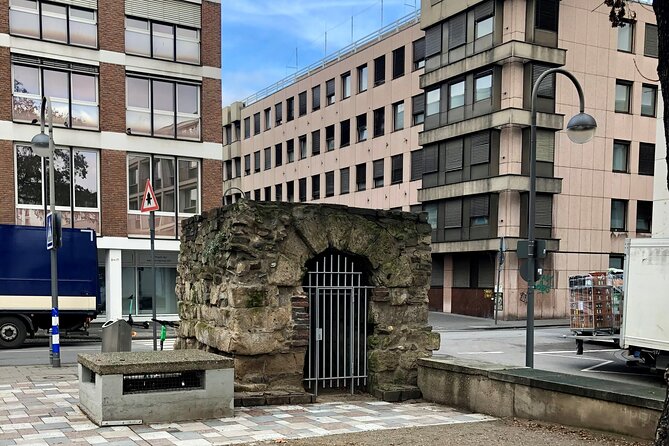
At Schmitz Säule, the audio turns to an unusual link between ancient Cologne and the 1969 moon landing. This is the sort of smaller story that can make a walking tour memorable, especially when you are already passing more famous landmarks.
The precise value of this stop is not its size. It is the surprise of finding a modern cultural reference tied into the story of Roman Cologne. You get a break from standard descriptions of emperors, roads, and ruins, and a reminder that ancient history is often kept alive through later symbols and stories.
If you prefer only major archaeological remains, this may feel like a side note. If you enjoy curious connections, it adds variety to the route.
Marsilius, Agrippa, and the Gürzenich facade
The walk then passes the Gürzenich Köln, whose imposing Gothic facade carries figures connected with Cologne’s Roman past. The audio tells you how to spot the celebrated Roman soldiers Marsilius and Agrippa.
This is exactly the kind of detail you might miss without guidance. You can admire the building’s Gothic appearance while also scanning its facade for people tied to the city’s ancient identity. The stop shows how later Cologne presented and remembered its Roman past, not just how Roman buildings once looked.
It also demonstrates why the app format can work well. You are free to stand back, look up, and take your time. The narration does not force you to move on with a group. You can pause the tour if you need more time to find the figures or photograph the building.
The former temple district and St Maria im Kapitol
The route passes through the former Roman temple district before reaching St Maria im Kapitol. The church belongs to a later period, but its location connects it with the religious life of ancient Cologne.
This stop widens the tour beyond roads and administration. Roman cities were shaped by worship as well as trade, government, and defense. Hearing about the former temple district while standing near a later church helps you picture how sacred places can change form while remaining important parts of the city.
The tour does not promise entry to St Maria im Kapitol or any other attraction. You see the exterior context and listen to the explanation. That is enough for a compact city walk, but you should plan separate visits if you want to explore interiors.
Ending at the Ubii Monument
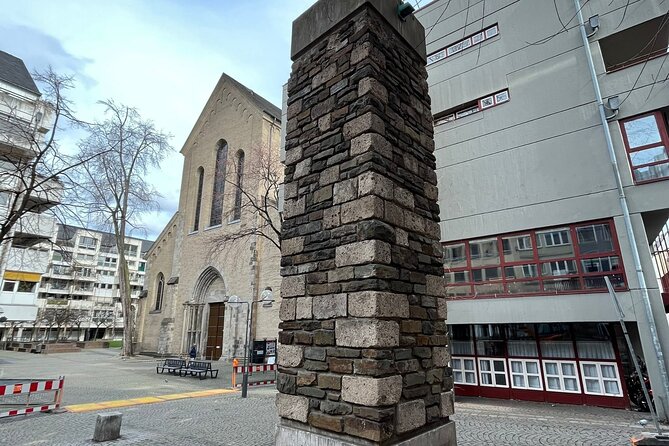
The final stop is near the Ubii Monument on Mühlenbach 35, 50676 Köln. The monument is described as the oldest stone tower in Germany, giving the walk a strong closing point.
Ending here makes sense as a piece of storytelling. The route has moved through public buildings, roads, religious sites, and later layers of Cologne. The Ubii Monument brings you back to the earliest physical traces in the story.
Because this is the endpoint rather than a return-to-start tour, plan what you will do next. The supplied information does not include transportation, and the tour does not provide a vehicle or escort. You finish near the monument, not back at the cathedral.
What $11.99 gets you
At $11.99 per person, the tour offers lifetime access to the English audio walk, plus the VoiceMap app and offline audio, maps, and geodata. The price is reasonable if you want a flexible introduction to Roman Cologne and do not need a live guide.
The cost is especially fair for people who like to revisit information. You can stop and start without a time limit, and the tour remains available after your first walk. That is different from a scheduled group tour, where missing a stop usually means missing it for good.
Still, keep the limits in mind. The price does not cover food, drinks, transport, museum entry, or a smartphone and headphones. The tour also provides no personal guide for questions. You are paying for a prepared audio route and research, not a guided conversation.
Who should choose this self-guided tour
I would choose this walk if you like exploring independently, want Roman context around the cathedral district, or need an activity that can run outside normal attraction schedules. It also suits people who prefer to pause for photos and listen without keeping up with a group.
Families and mixed-age groups may appreciate the flexible pace, though the supplied information does not give a specific child-focused format. The route is also a good option for repeat visitors. The Cologne resident who discovered unfamiliar details shows that local familiarity does not guarantee you have noticed every historical clue.
The experience is less suitable if you want dramatic storytelling, a live historian, or a route you can freely reverse. One low rating described it as boring, and that criticism is worth taking seriously. Audio quality and personal interest matter. If Roman infrastructure and layers of urban history do not appeal to you, the walk may feel like a series of explanations beside ordinary city streets.
The app is designed for the planned direction. One person began somewhere other than the cathedral and found it difficult to work backward. The provider explains that the GPS triggers audio by location, which is why the dedicated starting point matters.
Practical advice before pressing play
Download the VoiceMap app and the tour files before you arrive. The audio, map, images, and geodata are intended to work offline, so you do not need mobile data or international roaming while walking. You will need your own smartphone and headphones.
Start at the designated point near the Kreuzblume and cathedral area. Do not assume you can begin at the most convenient stop and hear the story in reverse. The app may let you skip a location, but the route is built around a forward-moving narrative.
Allow the full 60 to 90 minutes rather than treating the one-hour estimate as a strict appointment. You may stop at the cathedral, look for the mosaic, study the Gothic facade, or pause at any of the Roman sites. The tour operates as a private activity for your group, but since it is self-guided, there is no live guide present.
The experience is offered in English. Confirmation is provided at booking, and the stated operating window covers Monday through Sunday around the clock. The booking is non-refundable and cannot be changed, so make sure the date and phone setup work before paying.
Should you book Roman Cologne?
Book it if you want an inexpensive, flexible way to connect Cologne’s visible streets with its Roman foundations. The best parts are the GPS narration, offline use, and the range of stops, from the Northern Gate and harbor road to the Praetorium, temple district, and Ubii Monument.
Skip it if you need a live guide, want to enter several museums, or prefer a highly dramatic presentation. Start at the official point, download everything first, and keep the route in order. With those expectations, $11.99 buys a useful hour or so of historical context and a better way to read Cologne’s streets.
FAQ
How long does the Roman Cologne audio tour take?
The tour takes approximately one hour to one hour and 30 minutes, depending on your walking pace and how long you stop at the sites.
What language is the tour offered in?
The tour is offered in English.
Where does the tour start?
It starts in the cathedral area, in front of the Kreuzblume. The supplied meeting-point address is Cologne Cathedral, Domkloster 4, 50667 Köln, Germany.
Where does the tour end?
The tour ends near the Ubii Monument at Mühlenbach 35, 50676 Köln, Germany.
Can I use the tour without mobile internet?
Yes. Download the VoiceMap app and the tour files first. The audio, maps, images, and geodata are stored on your device for offline access.
Are museum tickets or attraction fees included?
No. Museum admission, other attraction tickets, food, drinks, and transportation are not included.
Do I need a smartphone and headphones?
Yes. You must provide your own smartphone and headphones. The tour uses the VoiceMap app on Android or iOS.
Latest audio tours in Germany
- Private audio book city rally around the Jahrhunderthalle in Bochum★ 5.0 · 12 reviews
- Private audio book city rally around the old town of Essen Kettwig★ 4.0 · 6 reviews
- Sanssouci Park: A Self-Guide Audio Tour of the Garden’s Landmarks★ 3.0 · 2 reviews
- Beautiful Baroque Potsdam: A Self-Guided Audio Tour★ 4.5 · 4 reviews
- Nuremberg Walking Tour with Audioguide on your Smartphone★ 5.0 · 3 reviews
- Nuremberg Scavenger Hunt and Highlights Self Guided Audio Tour★ 4.5 · 7 reviews
- Discover Nuremberg: Self-Guided Audio Tour★ 3.0 · 9 reviews
- Self Guided Tours Munich With 100 Captivating Audio Stories★ 5.0 · 3 reviews
Self-Guided Audio Tours, compared.
Acropolis Ticket & Optional Self-Guided Audio Tours
Read our review →


Ultimate Acadia National Park Self-Guided Driving Audio Tour
Read our review →

Akrotiri Ticket with Optional Self-Guided Audios
Read our review →
Browse the lists this tour appears in