Reviewed · USA
Chicago’s Storied Neighborhood: An Audio Tour
Chicago’s Hyde Park is best understood on foot, and this self-guided walk gives the neighborhood a personal voice: Bill Ayers, a local professor and activist, narrates the route through the University of Chicago area, Washington Park, and nearby landmarks. You set the pace, stop when you wish, and can listen without a live group trailing behind you.
I like the flexible format and the chance to hear personal stories from someone closely tied to the area. I also like the route’s mix of university buildings, Frank Lloyd Wright’s Robie House, the Nuclear Energy Sculpture, and the DuSable Museum of African American History. The main caution is the amount of quiet walking. The route covers about three miles, and some sections offer less commentary than you may expect.
Key points to know before you book
- Bill Ayers provides the narration, adding personal context to Hyde Park and the University of Chicago.
- The route takes about 40 minutes to one hour, but the full walk is roughly three miles, so allow extra time for stops and a slower pace.
- The University of Chicago and Robie House anchor the early part of the route.
- Washington Park and the DuSable Museum add a broader Chicago story, beyond university architecture.
- VoiceMap provides offline audio, maps, and location data, useful if you do not want to depend on mobile service.
- The walk is private and self-guided, but admissions, transport, food, drinks, a smartphone, and headphones are not included.
Hyde Park through a local voice
This tour works best as a neighborhood walk with commentary, not as a traditional guided sightseeing program. You do not meet a guide at the starting point or join a scheduled group. Instead, the VoiceMap app uses your location to begin the next section at the right place.
That setup gives you welcome freedom. You can pause for photographs, stop for a meal, take a break, or linger at a building without holding up anyone else. You can also repeat a section if you miss something.
Bill Ayers is the narrator, and his connection to Hyde Park gives the audio a personal angle. The appeal here is not simply a list of dates and architectural labels. You get an insider’s view of a neighborhood shaped by university life, civic debate, African American history, public art, and long-standing local institutions.
Still, you should set your expectations carefully. This is not wall-to-wall narration. Some parts of the route are quiet, and one important criticism is that the longer stretches between stops could use more explanation. If you want constant historical detail, a live guide or a more densely scripted tour may suit you better.
More Audio Tours in the USA
- Los Angeles: Hop-On Hop-Off Bus Tour with Audio Guide
★ 3.7 · 2,030 reviews - City Sightseeing Hop-On Hop-Off Bus Tour with Audio Guide
★ 3.0 · 1,083 reviews - Medieval Torture Museum Ticket with Audio Guide and Ghost Hunting
★ 5.0 · 962 reviews
Starting at the University of Chicago Laboratory Schools
The walk begins outside the University of Chicago Laboratory Schools at 1362 East 59th Street. This is a practical starting point for an introduction to the university district, but you should arrive ready to navigate with your own phone and headphones.
The opening section establishes the academic character of Hyde Park. The University of Chicago is not presented as a single attraction with one entrance and one viewing platform. Instead, the route takes you past a series of buildings and university faculties, letting you see how closely the campus and surrounding neighborhood are tied together.
I like this kind of beginning because it puts you in the setting before the tour reaches its better-known landmarks. You get a sense of Hyde Park as a lived-in district rather than a short list of postcard stops.
The limitation is equally clear. The walk passes university buildings, but it does not take you inside the original buildings. If you are hoping for interior architecture, campus access, or a formal university tour, this experience will not provide that.
Rockefeller Memorial Chapel and the university core
The route passes Rockefeller Memorial Chapel, one of the most recognizable university buildings included on the walk. From the outside, it gives the tour a strong architectural pause and helps show the formal character of the university area.
You may find that this part works best when you stop the audio and take a moment to look around. Because the experience is self-guided, you are not rushed past the building while trying to keep up with a group. The app lets you manage the timing yourself.
The tour also continues past other University of Chicago faculties and buildings. This broader section matters because it shows the campus as a collection of institutions rather than one isolated monument. Ayers’s commentary adds a human layer to the stone and academic formality.
At the same time, the route can feel thin if you expect a detailed explanation at every corner. Some walkers have found the quiet stretches too long, particularly around the university buildings. I would treat this section as a walking introduction, not a substitute for a dedicated campus architecture tour.
Frank Lloyd Wright’s Robie House
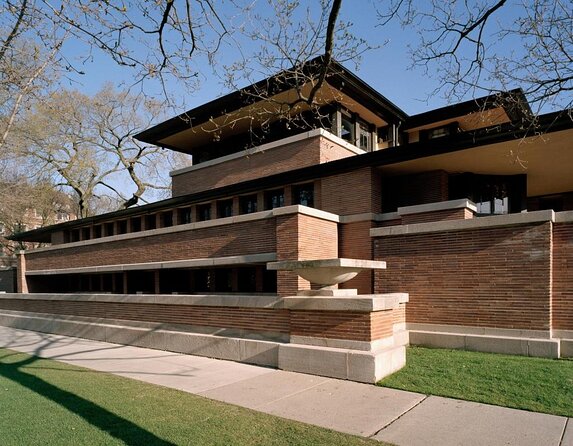
The passage by Frederick C. Robie House is one of the strongest architectural moments on the route. The building gives you a chance to connect Hyde Park with Frank Lloyd Wright and his Prairie School design.
The tour does not include admission to the house. That distinction matters. You pass the Robie House, but any interior visit or ticketed experience would be a separate expense and is not part of the audio walk.
Even from the route, the house gives the walk a clear focus. It is a famous work in a neighborhood otherwise shaped by university buildings and public institutions. If architecture is a major reason you are considering this experience, Robie House may be the point that makes the route worthwhile.
You should also allow time for your own look at the building rather than relying only on the narration. The audio can frame what you are seeing, but the format does not promise a long, detailed architectural lecture.
Another self-paced route in the USA:
- Gettysburg Battlefield Self-Guided Driving Audio Tour
★ 4.5 · 910 reviews - Joshua Tree National Park Self-Guided Driving Audio Tour
★ 4.5 · 762 reviews - San Francisco: Alcatraz, Ferry & Audio Tour w/ Night Option
★ 4.4 · 617 reviews - Ultimate Acadia National Park Self-Guided Driving Audio Tour
★ 4.0 · 521 reviews
The Nuclear Energy Sculpture and Hyde Park’s harder questions
The Nuclear Energy Sculpture adds a different mood. Instead of another grand university building, you encounter public art tied to the area’s scientific and political identity.
Its inclusion makes sense in a walk narrated by a professor and activist. The stop gives the route a chance to move beyond architecture and ask how science, public life, and political choices shape a place. The title alone points toward the weightier side of Hyde Park’s story.
This is also an example of why personal narration can be valuable. A standard sightseeing script might simply identify the sculpture. Ayers’s perspective can connect it to broader local questions, although the amount of detail depends on how much commentary you want during the walk.
The experience is not designed as a stop-by-stop museum program. You will need to look, listen, and decide how long to stay. That freedom suits curious walkers, but it may disappoint anyone seeking a tightly packed sequence of facts.
Washington Park and the changing shape of the route
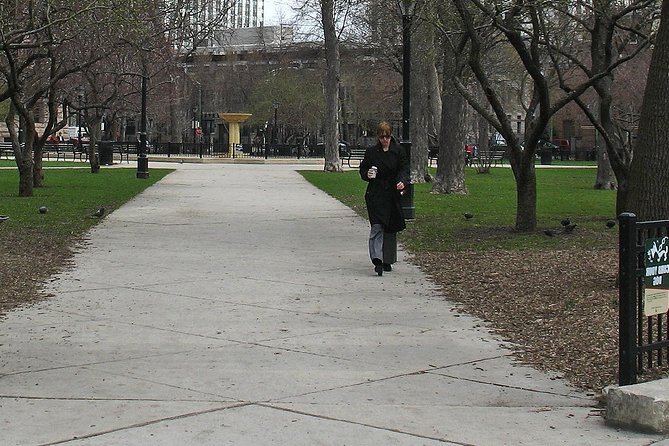
The route then passes through parts of Washington Park. This is where the experience shifts from the university district toward a broader view of Hyde Park and its surroundings.
Washington Park gives the walk more breathing room. The university section can feel formal and architectural, while the park section helps you experience the area as open public space. The transition also keeps the tour from becoming only a campus walk.
The drawback is distance. The complete route is about three miles, even though the stated audio time is only 40 minutes to one hour. That difference matters because listening time is not the same as walking time. Stops, photographs, pauses, navigation, and personal walking speed can make the outing considerably longer.
If you are 82 or have limited stamina, as one participant specifically noted, three miles may be too much. You should also avoid treating the short audio duration as proof that this is a quick stroll. Wear comfortable shoes and plan the route as a proper neighborhood walk.
The DuSable Museum of African American History
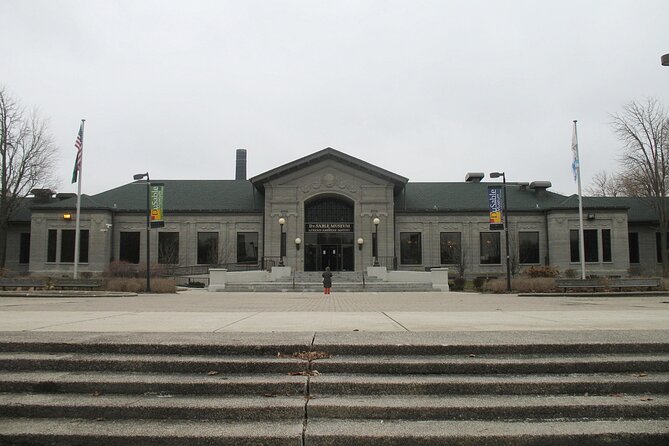
Passing the DuSable Museum of African American History gives the tour an important cultural and historical dimension. The museum broadens the route beyond the University of Chicago and its institutions, connecting Hyde Park with African American history in Chicago.
The audio walk does not include museum admission. If you want to visit inside, you will need to arrange and pay for that separately. The route simply brings the museum into the story as an important local landmark.
I value this stop because it prevents the walk from presenting Hyde Park only through the lens of the university. The neighborhood has more than academic prestige and architectural interest. The DuSable Museum points toward the people, movements, and cultural history that give the area its wider meaning.
If you have limited time, you may need to choose between continuing to the final stop and setting aside time for the museum. The tour itself is designed to pass by the institution, not to provide a full visit.
Finishing at 1101 East Hyde Park Boulevard
The walk ends outside the apartments at 1101 East Hyde Park Boulevard. The finish is practical rather than grand. You do not end at a major visitor attraction or a transportation hub identified in the tour details.
That means you should think about your next step before starting. The route is near public transportation, but no transportation is included. You may need to plan how you will leave the area, continue exploring, or return to your accommodation.
Ending at a residential address also reinforces the neighborhood nature of the experience. This is not a loop that returns you to the starting point. It is a one-way walk across several parts of Hyde Park, so the start and finish deserve equal attention when planning your day.
How the VoiceMap format affects the experience
VoiceMap is available for Android and iOS. Your booking includes lifetime access to the English tour, along with offline audio, maps, and geodata.
The offline option is useful because you can download what you need before beginning instead of relying on a strong connection throughout the walk. You still need your own smartphone and headphones, neither of which is supplied.
The location-based playback is one of the format’s better features. The audio is designed to begin at the proper point as you move along, so you spend less time searching through a track list. It also lets you stop and restart at your own pace.
There is a tradeoff. A self-guided app does not notice if you are tired, confused, or looking at the wrong building. You are responsible for following the map and handling your device. Most people can participate, and the route is near public transportation, but the experience has no live guide to adjust the outing for you.
Timing, group size, and practical value
The stated duration is about 40 minutes to one hour, while the route covers approximately three miles. I would budget more than an hour if you want to pause at the landmarks, take pictures, or walk at an easy pace.
The tour is private in the sense that only your group participates. You do not share the walk with a larger scheduled crowd, and the audio format lets you move independently. That can be a real advantage if your group prefers quiet stops or different walking speeds.
The value depends on what you want from the day. If you want a low-cost introduction to Hyde Park with personal narration, lifetime access, offline maps, and no fixed departure time, the format offers useful flexibility. You can also return to the tour later, which gives the purchase more value than a one-time scheduled talk.
If you mainly want detailed information with little silence, the value is less certain. The experience does not include admissions, food, drinks, transport, a phone, or headphones. Any museum visit or paid attraction must be added to your budget.
The mixed score of 2.8 from four ratings reflects this split. The strongest praise focuses on the personal stories and the app’s ability to start commentary in the right place. The clearest complaints focus on limited information, extended quiet sections, the absence of interior university visits, and the three-mile distance.
Who should choose this Hyde Park walk
I would recommend it most to independent walkers who enjoy setting their own rhythm. It fits someone curious about the University of Chicago, Robie House, Washington Park, public art, and the DuSable Museum, especially if personal commentary matters as much as a dense fact list.
It also suits a private group that wants to avoid a fixed schedule. You can begin any time during the stated operating period, stop for breaks, and continue when ready.
I would be more cautious if you have mobility concerns, dislike one-way walks, or want a guide speaking almost continuously. The route is not described as wheelchair inaccessible, but the supplied information does not provide detailed accessibility conditions. If three miles is difficult for you, this is a serious consideration.
Book only if you are comfortable with a walk that has both spoken sections and silent stretches. The short audio length can sound misleading if you do not account for the full distance.
Should you book Chicago’s Storied Neighborhood?
Book this audio tour if you want a flexible introduction to Hyde Park and like hearing a local academic and activist explain the area in a personal voice. The combination of the University of Chicago, Rockefeller Memorial Chapel, Robie House, the Nuclear Energy Sculpture, Washington Park, and the DuSable Museum gives you a wider view than a university-only walk.
Skip it if you need a highly detailed, continuously narrated tour or if three miles is beyond your comfortable range. The best reason to choose it is the freedom to explore at your own pace with Bill Ayers’s perspective. The main risk is paying for an experience that feels too quiet or too brief in its commentary.
Cancellation is free if you cancel at least 24 hours before the local start time. Cancellations made within 24 hours are not refunded, and late changes are not accepted.
FAQ
How long does the audio tour take?
The audio tour takes approximately 40 minutes to one hour. The complete walking route is about three miles, so you may need more time if you stop at landmarks or walk slowly.
What language is the tour offered in?
The tour is offered in English.
Who narrates the tour?
The tour is narrated by Bill Ayers, described as a local professor and activist.
Where does the tour begin?
It begins outside the University of Chicago Laboratory Schools at 1362 East 59th Street, Chicago, Illinois 60637.
Where does the tour end?
It ends outside 1101 East Hyde Park Boulevard Apartments at 1101 East Hyde Park Boulevard, Chicago, Illinois 60615.
Is this a group tour with a live guide?
No. It is a self-guided private activity, and only your group participates.
What landmarks does the route pass?
The route passes Rockefeller Memorial Chapel, Frederick C. Robie House, University of Chicago faculties and buildings, the Nuclear Energy Sculpture, parts of Washington Park, and the DuSable Museum of African American History.
Is museum or landmark admission included?
No. Personal expenses and admission fees are not included. The tour also does not include transportation, food, or drinks.
What do I need to bring?
You need your own smartphone and headphones. The VoiceMap app provides offline access to the audio, maps, and geodata for Android and iOS devices.
Latest audio tours in the USA
- Sequoia National Park Self-Guided Audio Tour★ 4.5 · 9 reviews
- Sequoia and Kings Canyon Audio Tour Self Guide National Park Tour★ 5.0 · 3 reviews
- Kings Canyon National Park Self-Guided Audio Tour★ 4.0 · 4 reviews
- Sedona, Arizona Self-Guided Audio Tour★ 4.0 · 36 reviews
- Sedona & Red Rock State Park Self-Guided Driving Audio Tour★ 3.0 · 30 reviews
- Haunted Savannah Self-Guided Walking Audio Tour★ 4.5 · 3 reviews
- Downtown Seattle Self-Guided Walking Audio Tour★ 4.5 · 6 reviews
- Uncover Seattle: Self-Guided Audio Tour★ 3.5 · 7 reviews
USA Audio Tours, compared.


City Sightseeing Hop-On Hop-Off Bus Tour with Audio Guide
Read our review →
Medieval Torture Museum Ticket with Audio Guide and Ghost Hunting
Read our review →



Ultimate Acadia National Park Self-Guided Driving Audio Tour
Read our review →