
Reviewed · CANADA
Discover Downtown Regina: a Smartphone Audio Walking Tour
Regina’s downtown is easy to overlook if you only see it from a car. This self-guided audio walk slows you down for old banks, churches, railway buildings, war memorials, political landmarks, and the sites tied to the 1935 Regina Riot. The commentary starts by location, so you can keep your phone in hand and let the route tell you what matters.
I like two things right away: you pay only $6.72 per person, and you can download the tour before leaving your hotel. I also like the private format. Your group can stop for coffee, linger in Victoria Park, or skip a building without waiting for a guide.
The main caution is route condition. Construction once blocked part of the path, causing one person to miss about five stops, and one section led through an area that felt uncomfortable. Check the route before you start, and keep the app open enough to reroute if needed.
Key points to know before you walk

- Automatic audio at each stop: Geolocation starts the commentary as you reach the site.
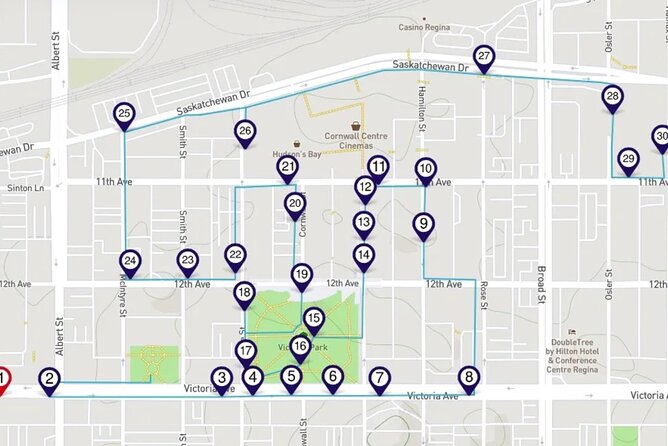
- Thirty downtown stops: The route includes City Hall, Hotel Saskatchewan, Union Station, churches, banks, public buildings, and more.
- Offline use: Download everything on Wi-Fi first, so you do not need mobile data during the walk.
- Private and flexible: Only your group participates, and you can take as long as you like.
- Optional trivia: Each location includes a question if you want a little extra play along the way.
- About 90 minutes to two hours: Walking time, stop lengths, and detours can affect the total.
A self-guided start at Regina City Hall
The tour begins at Queen Elizabeth II Court, at Regina City Hall on Victoria Avenue. You get the convenience of a central starting point, and admission to the sites is free because this is an outdoor walking route rather than a ticketed attraction tour.
The first few stops introduce Regina through its civic and commercial buildings. At the former Sherwood Department Store, the audio explains the role of this once-famous shop. The Balfour Apartments follow, a 1930 building described in the commentary as an ominous presence. These opening stops are brief, around five minutes each, so you get a quick sense of the city without being trapped in a long lecture.
The route then reaches First Baptist Church, just south of Victoria Park. Its size makes it an easy landmark to spot. At the Land Titles Building, you hear about the first public building commissioned by Saskatchewan’s new provincial government. That pairing gives you two useful views of Regina: religious life and the young province’s public administration.
More Audio Walking Tours in Canada
- Halifax Churches, Gardens & Graveyards: a Smartphone Audio Walking Tour
★ 4.5 · 25 reviews - Halifax Boardwalk & Seaport: a Smartphone Audio Walking Tour
★ 4.0 · 19 reviews - Explore Halifax with 3 Unique Smartphone Audio Walking Tours
★ 4.0 · 16 reviews
Victoria Park, Hotel Saskatchewan, and the federal quarter
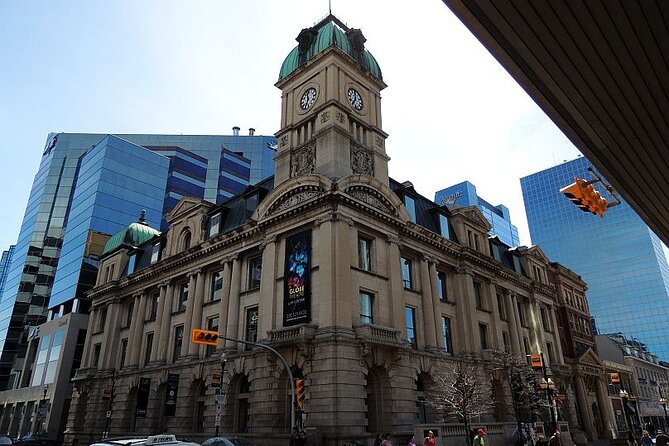
Hotel Saskatchewan is one of the route’s strongest early stops. Built in 1927 for the Canadian Pacific Railway, it is now a municipal heritage property. The audio helps you read the building as part of the railway era, when hotels and rail service shaped the growth of Canadian cities.
Across from Victoria Park, the Federal Building occupies a prominent corner at Victoria and Scarth. The location matters. You are not just looking at an isolated old structure, but at a group of government and commercial buildings arranged around a public park.
The Motherwell Building, at Victoria Avenue and Rose Street, adds an agricultural connection. It is a municipal heritage property named for William Richard Motherwell, and the commentary places it within Saskatchewan’s government story. The Leader Building shifts the focus to the press. Built in 1912, it was the fourth home of the Regina Leader newspaper.
You then reach Conexus Plaza, the home of Conexus Credit Union, followed by the Old Post Office. The post office is one of the oldest remaining structures in downtown Regina. These stops work best if you pay attention to the changing scale of the streets: older low-rise buildings sit beside newer towers, showing how the central business district grew in layers.
Old banks and Regina’s early commercial core
The Northern Crown Bank is a particularly useful stop for anyone interested in architecture. It is a provincial heritage building and the oldest commercial building in Regina’s central business district. The Willoughby and Duncan Building continues that theme. It remains part of the commercial core, where Regina has its largest concentration of early commercial architecture.
This section gives the walk its clearest sense of place. You can look at decorative façades, older storefront proportions, and the narrow gaps between historic buildings. The audio does the work of explaining what you are seeing, which is useful when a building’s importance is not obvious from the sidewalk.
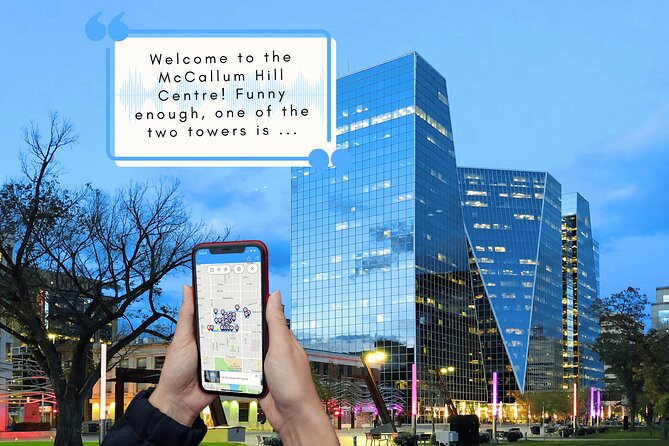
Next comes Hill Centre Tower I, one of Regina’s twin towers. The tower occupies the site of the original McCallum Hill building, once Regina’s tallest building and first skyscraper. This is a good reminder that the city’s vertical history did not begin with the modern office towers you see today.
The stop-by-stop format keeps the commentary short. Each listed stop is planned for about five minutes, though you should allow extra time for walking between them and for finding the exact location.
Memorials, churches, and civic memory

The Regina Cenotaph honors those who died in the First World War. From there, the route reaches a memorial to Sir John A. Macdonald, Canada’s first prime minister and a figure identified in the tour as the Father of Confederation.
Knox-Metropolitan United Church is another major architectural stop. It is home to two of Regina’s oldest congregations and remains important to the city’s heritage. The route also includes St. Paul’s Cathedral, constructed in 1894 to replace the first Saint Paul’s church.
These buildings show how much of Regina’s early public life was organized around churches, memorials, civic offices, and commercial institutions. You do not need to enter every building to get value from the walk. Much of the experience comes from standing outside, matching the audio to the façade, and noticing how each site fits into the surrounding streets.
The Dunlop Art Gallery adds a more modern cultural note. It has locations in the Central and Sherwood libraries and has been part of the Regina public library since the 1960s. This is a useful change of pace after several heritage buildings.
More Smartphone Audio Tours in Canada
- Icefields Parkway: a Smartphone Audio Driving Tour
★ 4.0 · 118 reviews - Cabot Trail: a Smartphone Audio Driving Tour
★ 4.5 · 118 reviews - Smartphone Audio Driving Tour between Banff and Calgary
★ 4.0 · 25 reviews - Smartphone Audio Driving Tour between Lake Louise and Calgary
★ 4.0 · 15 reviews
Victoria Park and Memorial Hall
Victoria Park is more than a green pause in the route. The land began as a two-block public reserve set aside in 1883 and later became a popular gathering and recreation area. If you need a break, this is the obvious place to take one.
The park also gives you a better view of how Regina planned its central public spaces. It sits beside churches, government buildings, hotels, and commercial blocks, making it a natural center for the walk.
Memorial Hall, connected with Royal Canadian Legion Branch 001, was built between 1947 and 1951. The Regina branch was the first in Canada to receive a Legion charter. The stop adds a postwar chapter to the route and connects local history with the wider story of veterans’ organizations.
Canada Life Assurance Company Building follows. Built in 1914, it once served as the Saskatchewan headquarters of the Ontario-based Canada Life Assurance Company. The Regina Telephone Exchange then shifts the story toward technology and communications. Its historical value comes from its connection with the development and expansion of telephone service in Saskatchewan.
Agriculture, sport, and provincial institutions

The Saskatchewan Revenue Building has an especially useful connection to the province’s agricultural economy. The building was constructed by the Saskatchewan Cooperative Elevator Company, one of the first major agricultural cooperatives in Saskatchewan.
That stop helps explain why Regina’s architecture is not only about government or banking. Agriculture shaped the province’s economy, and cooperative institutions helped organize business in the early twentieth century.
Mosaic Stadium brings you into the present-day sports world. It is home to the Saskatchewan Roughriders of the Canadian Football League. The audio includes a warning for anyone attending a Roughriders game, so expect a bit of local team spirit here rather than a dry architectural note.
The route also includes SGI, the Saskatchewan Government Insurance Company. SGI was created in 1945 as a provincial Crown corporation. Together, the Revenue Building and SGI show the long reach of provincial institutions in Regina.
Union Station and the Regina Riot

Union Station was built in 1911 by the Canadian Pacific Railway. It housed rail service and the railway’s divisional headquarters. This is one of the key stops for understanding why Regina developed where it did and how strongly the railway shaped its early growth.
Later, the route reaches the Regina Police Department on Quance Street. This location is tied to the 1935 Regina Riot. The event grew from the On-to-Ottawa Trek, when unemployed men protesting during the Great Depression clashed with police.
The tour does not treat downtown as a collection of pretty façades only. It includes labor conflict, government power, policing, and economic hardship. That wider range gives the walk more substance than a simple list of old buildings.
The Old No. 1 Fire Hall, completed in 1921, is another distinctive building. Its design gives you something visual to look for after several stops focused mainly on institutional history.
The final listed stop is the Municipal Justice Building. At the time of the recording, the building had been slated for destruction, while local people were trying to save it. This is an important practical warning: the site may have changed, and the building may not be accessible or present when you arrive.
Extra sights beyond the main downtown route
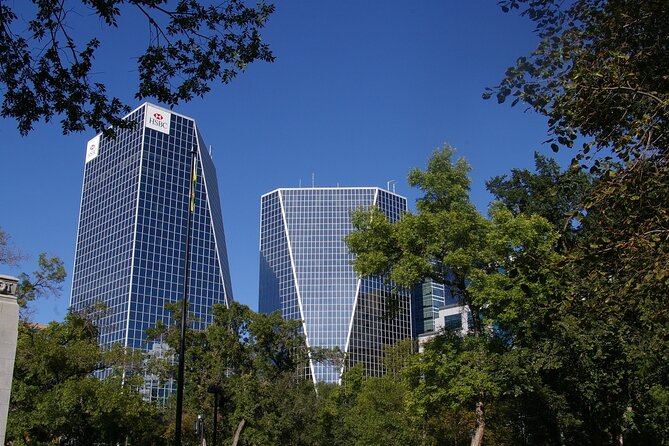
The experience also includes references to several nearby or related points of interest. These include an old stone castle, the Royal Canadian Mounted Police, the Saskatchewan museum, Wascana Centre, Wascana Lake, and the Saskatchewan Science Centre.
The RCMP material places the force in Canada’s story from its creation in 1873. The museum-related commentary points to Saskatchewan’s long-running effort to help people explore the province and the wider world through the past, present, and future.
Wascana Centre is described as a landscaped park around a 120-hectare lake in the heart of Regina. A point on the Wascana Lake Tour is also included. The Saskatchewan Science Centre offers experiments, stage shows, workshops, and the province’s only 3D IMAX Theatre.
These extra points may not function like the numbered downtown stops, so I would treat them as added context rather than assume every one is part of a single uninterrupted walk. If you want a short downtown outing, concentrate on the central route. If you have more time, use the Wascana and museum references to plan an additional stop.
How the audio format works in real use
You download the tour over Wi-Fi before setting out. Once it is on your phone, the walk does not require mobile data or a live connection. That is a real advantage if you are managing data use or dealing with weak service.
The geolocation feature is the star of the format. As you pass a site, the audio can begin automatically. You can walk down the street instead of repeatedly stopping to search for the next entry.
The trade-off is that a location-based route depends on the path being clear. Construction once forced a person off the intended street and led to several missed sites. I would open the map before starting, note the next few stops, and be ready to make a short detour.
You also need your own smartphone or tablet. Customer service is available by phone and email, but there is no live guide to point out a blocked sidewalk or explain a question on the spot. Service animals are allowed, public transportation is nearby, and most people can participate.
Is $6.72 a fair price?
At $6.72 per person, the price is low for a private activity lasting about an hour and a half to two hours. You are paying for recorded commentary, route technology, optional trivia, and the freedom to start within the stated operating period rather than for admission to attractions.
The value is strongest for two or more people who want to walk independently. A private group can pause without holding up strangers, and the tour can be kept for flexible use on Tripvia Tours. You can also take longer than the suggested duration because there is no fixed time limit.
The price is less attractive if you expect a detailed, personal conversation with a local guide. The commentary at each place is brief and designed to keep you moving. That suits a first look at downtown, but history fans who want long discussions may want another format as well.
Who should choose this Regina walk?
I would choose this for first-time visitors who want a clear introduction to central Regina, families who like optional quizzes, and independent walkers who do not want to join a scheduled group. It also works for people with a spare afternoon who prefer to set their own pace.
The route may appeal to architecture fans, but its subject range is wider than architecture. You get churches, banks, railway history, political memory, sports, public administration, labor conflict, and local culture.
I would be more cautious if you have limited mobility or need a perfectly predictable route. The tour is a walking activity with many outdoor stops, and construction or site changes can affect access. I would also avoid starting without checking current street conditions.
Cancellation is free up to 24 hours before the start time. Inside 24 hours, the booking is nonrefundable, and changes are not accepted.
Should you book Discover Downtown Regina?
Book it if you want an inexpensive, private introduction to Regina and like the idea of your phone guiding you from one landmark to the next. The automatic audio, offline access, and short commentary make it easy to use, while the route includes enough serious history to keep it from feeling like a simple sightseeing checklist.
Skip it if you want a live guide, long explanations, or guaranteed access to every listed site. For the best experience, download the tour on Wi-Fi, start at City Hall, allow two hours, and check for construction before you leave. At this price, it is a practical way to get your bearings and see the downtown buildings you might otherwise pass without noticing.
FAQ
How long does the Discover Downtown Regina tour take?
The estimated duration is about one hour and 30 minutes to two hours. You can take longer because the tour has no time limit.
Where does the tour start?
It starts at Regina City Hall, at 2476 Victoria Ave, Regina, Saskatchewan.
Where does the tour end?
The tour ends at 1550 11th Ave, just north of the Halifax Street and 11th Avenue corner.
Does the tour require mobile data or Wi-Fi while walking?
No. You should download the tour over Wi-Fi before starting. After that, no data or Wi-Fi is required along the route.
Is this a guided group tour?
No. It is a private, self-guided activity for your own group. There is no live guide listed for the experience.
What language is the tour offered in?
The tour is offered in English.
Are attraction tickets included?
No. Attraction tickets are not included. The listed outdoor stops have no admission charge, but recommended attractions may be closed or inaccessible.
Can I cancel for a full refund?
Yes, if you cancel at least 24 hours before the experience start time. Cancellations made less than 24 hours before the start time are not refunded.
Latest audio tours in Canada
- Fruit alcohol tasting + Velvet Orchards audio tour★ 5.0 · 2 reviews
- APP Self-Guided Tours Quebec with Audioguide★ 3.0 · 2 reviews
- Quebec City Self-Guided Driving Audio Tour★ 4.0 · 7 reviews
- Layers of Natural History: Picton Nature Self-Guided Audio Tour★ 5.0 · 4 reviews
- Smartphone Audio Driving Tour between Wasaga Beach and Toronto★ 4.5 · 3 reviews
- Niagara: Behind The Falls, Skylon Tower Ticket & Tesla Audio Tour★ 3.5 · 69 reviews
- Niagara Falls Pass: 5 Iconic Attractions, WEGO Bus & Audio Guide★ 5.0 · 7 reviews
- Niagara Peninsula: a Smartphone Audio Driving Tour★ 4.0 · 10 reviews
Audio Walking Tours, compared.
City Monuments Guided Walking Tour with Audio Guide
Read our review →
Self Guided Classic Freedom Trail Location Aware (GPS) Walking Audio Tour
Read our review →
Self-Guided Historical Walking Tour (Audio Guide)
Read our review →
Cape Cod & Provincetown Self-Guided Driving & Walking Audio Tour
Read our review →
Verona Walking Tour with Audio and Written Guide by a Local
Read our review →
Royal Walking Tour and Buckingham Palace Audio Tour
Read our review →
Bologna Walking Tour with Audio and Written Guide
Read our review →Browse the lists this tour appears in