
Reviewed · UK
Bath: Roman Baths Entry Ticket with Audio Guide
The Roman Baths are not just a pool with some old stones around it. Beneath modern Bath, you’ll find a working ancient religious and bathing complex, a temple dedicated to Sulis Minerva, and objects that show how ordinary people lived in Roman Britain. The Great Bath is the showpiece, but the museum and smaller bathing rooms give the site its real depth.
I like the freedom of the self-guided audio tour, which lets you stop, replay sections, or move on when a room is crowded. I also like the small details: the gilt bronze head of Sulis Minerva, projected scenes that help explain the ruins, and the chance to taste the thermal water at the end. The main drawback is that a handheld audio device can become tiring, and prebooked ticket holders may still face the main entry queue.
Key points at a glance
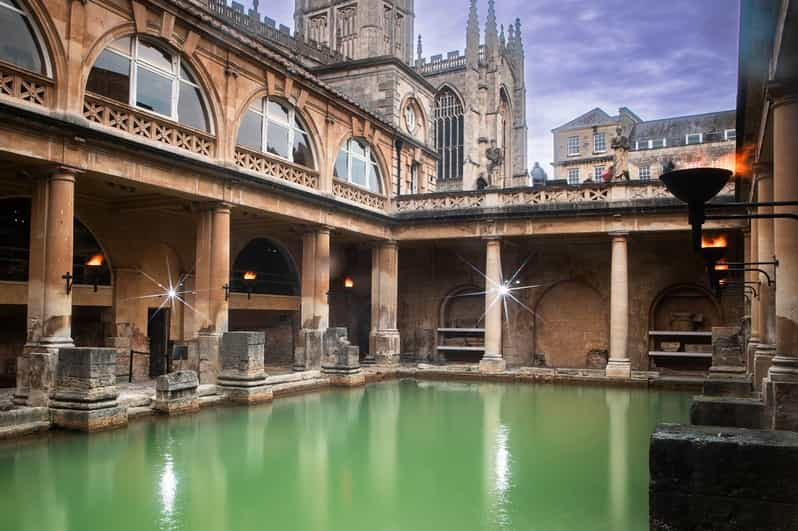
- The Great Bath: Walk around the open-air pool where hot spring water still gathers beneath Bath’s historic rooftops.
- Sulis Minerva’s temple: See the impressive gilt bronze head of the goddess and the famous Gorgon’s head from the temple pediment.
- Audio guide in 12 languages: Choose English, Dutch, French, German, Italian, Japanese, Chinese, Korean, Polish, Russian, Portuguese, or Spanish. A BSL video guide is also available.
- Several bathing areas: Explore heated rooms, massage facilities, a Roman gym, a sauna, plunge pools, and the Circular Bath.
- A taste of the spring: Try water containing more than 43 minerals from the dedicated drinking tap.
- Best timing: Go early if possible. The museum can fill quickly, and the Great Bath is easier to appreciate before the heaviest crowds.
Why the Roman Baths are more than an ancient swimming pool

Bath’s natural hot spring made this place special long before the city became a fashionable Georgian spa town. The Romans built a religious complex around the spring, combining bathing, worship, and social life. People came to seek healing and to honor Sulis Minerva, a local goddess linked with the Roman goddess Minerva.
That mix of faith and everyday life is what makes the site worth your time. You are not simply looking at a ruined building. You are following the route through a place where people washed, rested, prayed, received treatments, and left offerings.
The ticket is valid for one day, but this is not a quick 30-minute stop. I would allow around two hours, especially if you listen to most of the audio commentary. You can move at your own pace, sit at several points, and return to details that catch your eye.
At about $30.31 per person, the entry fee is not pocket change for a short attraction. The value improves if you use the audio guide fully and take time with the museum, rather than treating the site as a photo stop. You are paying for a substantial museum and archaeological visit, not only access to the Great Bath.
More Audio Tours in the UK
- London: Emirates Stadium Entry Ticket and Audio Guide
★ 4.7 · 5,513 reviews - Westminster Abbey Entrance Ticket Including Audio Guide
★ 4.0 · 661 reviews - London: British Museum Audio Tour & Priority Entrance Ticket
★ 4.5 · 631 reviews
Starting with the museum’s Roman objects
The visit begins with the museum, and that is the right order. The artifacts give meaning to the stonework you see later. Without them, the bathing rooms can look like a maze of walls and worn paving. With them, you start to picture the people who used this place.
The audio guide directs you around the displays and explains what various objects reveal about life in Roman Britain. It is detailed without forcing you into a fixed pace. Each point is marked, and arrows help you follow the route, so you do not need to keep checking a map.
One major highlight is the Gorgon’s head, once part of the temple pediment. It towered about 15 metres above people approaching the temple. Its fierce expression is familiar, but its exact identity remains open to interpretation. It may depict the mythical Gorgon, or it could represent a water god.
That uncertainty is worth pausing over. Ancient objects do not always come with neat labels explaining exactly what they meant. The museum lets you consider how Roman and local beliefs may have blended at this spring.
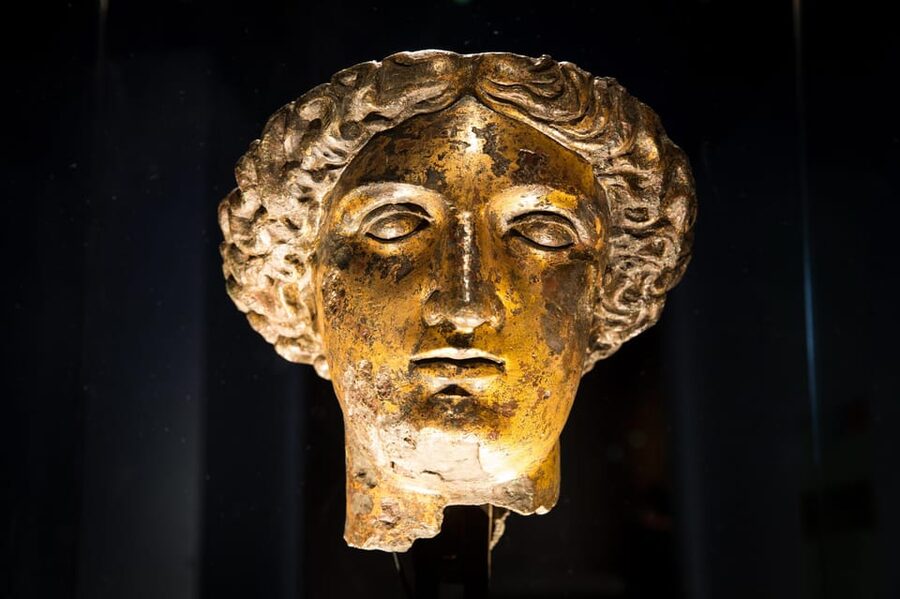
The gilt bronze head of Sulis Minerva is even more striking. This was part of the cult statue inside the temple and would have watched over the sacred space. The workmanship is fine, and the face has enough presence to make the object feel far more personal than a fragment of metal.
I find this part especially useful if you are visiting with children or anyone who likes stories more than bare ruins. The displays connect an object to a person, a belief, or a custom. A children’s audio version is available, and it offers a lighter way for younger visitors to follow the site.
The Great Bath beneath Bath’s rooftops
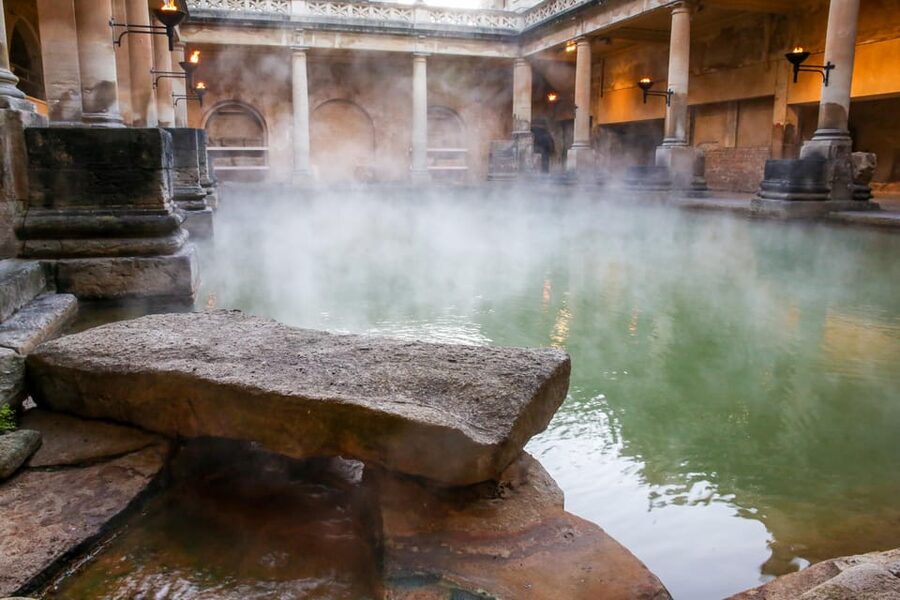
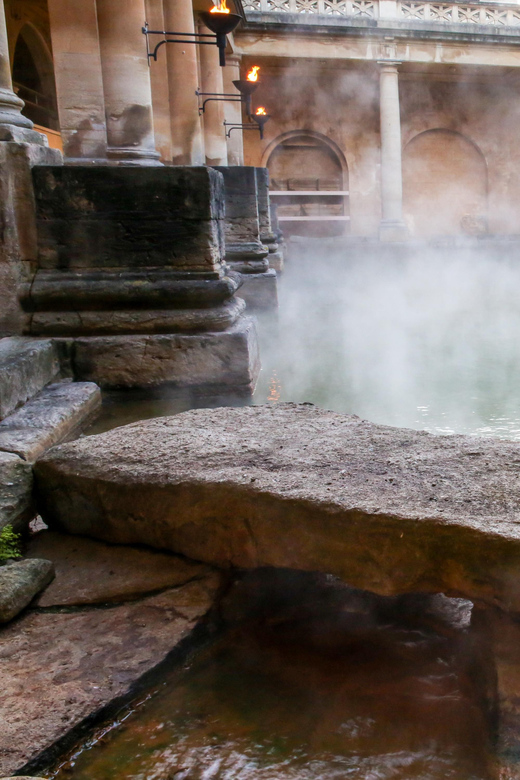
After the museum, you reach the Great Bath. This is the scene most people picture when they think of the Roman Baths: a broad pool of warm water, surrounded by a stone walkway, with Bath’s buildings visible above.
On a cold morning, steam may curl off the water. That gives the place a strong sense of atmosphere, but the view is not a reconstructed Roman fantasy. You are looking at an ancient pool in the middle of a modern city, with rooftops and sky framing it.
The walkway lets you see the pool from several angles. Take a little time here instead of rushing to the next room. The audio commentary helps explain how the pool fitted into the larger complex and what made the spring important.
The Great Bath is also the most crowded section. It is the easiest place for groups to gather, and the narrow route around the water can feel slow when busy. An early entry is the practical choice. The first part of the day is generally calmer, and you will have a better chance of standing at the rail without being pressed along.
You cannot bathe in the Great Bath. This is an archaeological site, not the modern Thermae Bath Spa. That distinction matters when planning your day. The visit shows you the ancient spring and its setting, while a separate spa experience would be needed for modern thermal bathing.
Heated rooms, massage areas, and the Roman sauna
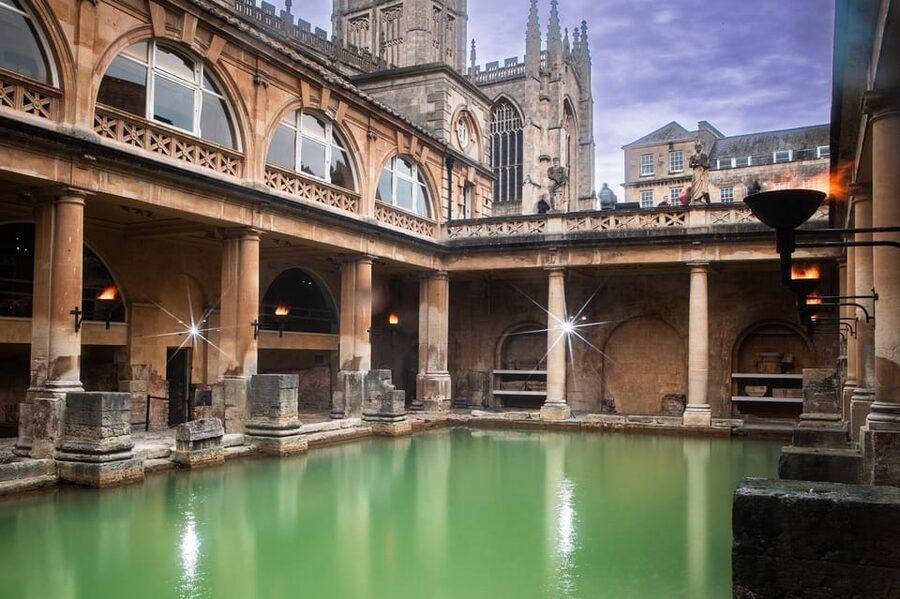
The Great Bath gets the attention, but the rest of the complex explains how elaborate Roman bathing could be. Continue into the East Baths, where you can see heated rooms and areas connected with massage.
These spaces help you understand that bathing was a process rather than a single dip. Different rooms had different temperatures and uses. The audio guide gives the ruins a practical framework, so you can better imagine how people moved through the building.
The Roman gym and ancient sauna, known as a laconicum, add another layer. They show that physical activity and bathing belonged together. The site was not only a place to get clean. It was also tied to exercise, treatment, conversation, and public life.
You will not find every wall standing at full height, and some rooms take imagination. That is where the audio guide earns its place. It provides the context that a bare outline of stones cannot.
The West Baths include plunge pools, offering a contrast to the hot spring water. The Circular Bath is another distinctive part of the route. Each area is smaller than the Great Bath, but together they show how much was built around the spring.
I like the way the visit moves between preserved ruins, museum objects, and visual explanations. Subtle video projections show how the Romans may have used certain spaces. They do not overwhelm the ancient setting, and they give you a clearer sense of scale and activity.
Another self-paced route in the UK:
- Golden Tours York Hop-on Hop-off Open Top Bus Tour with Audio Guide
★ 4.5 · 468 reviews - Canterbury Cathedral: Entry Ticket with Audio Guide
★ 4.6 · 266 reviews - London: Churchill War Rooms Ticket & Political London Audio
★ 4.6 · 224 reviews - Windsor Castle Tour from London with Transportation & Audio Guide
★ 3.5 · 222 reviews
Audio guide strengths and small annoyances

The audio guide is one of the strongest parts of the ticket. It is available in 12 languages, and a BSL video guide is offered as an alternative. The commentary covers the key rooms and objects, while the marked points and arrows make the route simple to follow.
You can listen in English, Dutch, French, German, Italian, Japanese, Chinese, Korean, Polish, Russian, Portuguese, or Spanish. That range makes the visit easier for international visitors and removes the need to read every information panel.
The commentary is detailed enough that you should not rush. You can stop the device while looking at an object, then continue when ready. The self-guided format also works well for mixed groups, since one person can pause while another spends longer at a display.
There is a practical downside. The audio equipment is handheld, so you may need to carry it through the entire visit. If you have shoulder or hand problems, this can become uncomfortable. Headphones are not part of the stated package, so bring your own only if the venue’s equipment permits their use.
The children’s version is worth considering for families. It gives younger visitors a different way into the subject, and you may find it useful even if you are an adult who wants a shorter, less formal explanation.
Costumed Romans and hands-on moments

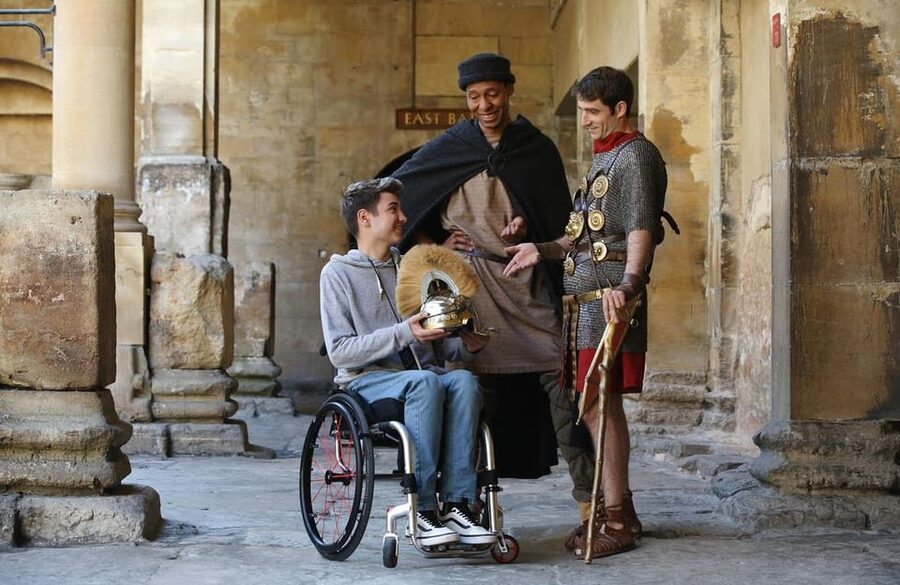
At times, costumed Roman characters are present in the baths. You can ask them questions about life in Roman Britain and pose for a photograph. This is not a guaranteed private performance, so treat it as an added encounter rather than the central reason to book.
For children, it can turn an archaeological visit into something more immediate. Instead of only hearing about Roman clothing, customs, or bathing, they may have a person in costume to speak with. Adults who enjoy historical interpretation will also find it a pleasant break from display cases.
The site’s visual projections serve a similar purpose. They help fill in missing walls and show how the Romans may have used the rooms without covering the original remains with heavy modern reconstruction.
Tasting the mineral-rich spa water

Near the end of the visit, you can try the spa water from a dedicated drinking tap. The water contains more than 43 minerals and has drawn people to Bath for centuries because of its supposed healing qualities.
This is a small part of the experience, but it gives the spring a physical presence. Until then, you have seen the water, steam, and ancient channels. Tasting it connects the modern visitor with the reason people kept returning to this place.
The flavor may not be to everyone’s taste. Mineral water can be an acquired taste, and you should not expect a refreshing bottle of ordinary drinking water. Still, I would try it. It is included with admission and gives the visit a memorable final note.
If you need a longer rest, plan ahead. There are seating areas along the route, but the visit is still a museum walk with several levels and stops. One person may take two and a half hours, while another may move through more quickly.
Timing, crowds, and practical limits
The Roman Baths are open for a one-day visit tied to your selected availability. Last entry is one hour before closing, so do not arrive at the final moment. You redeem your voucher at the Roman Baths themselves.
Prebooking can help you secure your planned visit, but it does not always mean you walk straight past every queue. The main entrance may still have one line for both ticket holders and people buying admission. If avoiding a queue is your top concern, check the current entry arrangements before you go.
Early morning is the best practical tip. The museum can become crowded quickly, and the Great Bath is easier to see before groups fill the route. A quiet visit also makes the audio commentary easier to follow.
Large bags and luggage are not allowed, and baby strollers and pets are also excluded. Plan to arrive with only what you need. The site is about 90 percent accessible to wheelchair users, with elevators available between levels, but not every part is fully accessible.
The activity is listed as a small group limited to six participants, although the main visit is self-guided rather than led by a guide. Think of the group limit as an admission arrangement, not as a personal guided tour. No guided tour or printed adult or children’s guidebook is included.
Who will get the most from this visit
I would recommend the Roman Baths to first-time visitors who want Bath’s main historic sight explained properly. It also suits families with children from roughly eight years old, especially if they use the children’s audio option and meet a costumed character.
It is a good choice for anyone interested in archaeology, Roman Britain, ancient religion, or the history of public bathing. The audio guide makes it accessible even if you arrive knowing little about the site.
You should think twice if you dislike handheld devices, crowded museums, or attractions where ruins require imagination. The entry price may also feel high if you plan only a brief look at the Great Bath. To get good value, give yourself enough time for the museum, the smaller bathing areas, and the audio commentary.
The shop at the exit adds a useful final stop. It carries books, prints, jewelry, homeware, games, bathing products, and items from local independent makers, including honey, botanical gin, and handmade soaps. You do not need to buy anything, but it offers more distinctive choices than a typical souvenir counter.
Should you book the Roman Baths ticket?
Book it if you want the key historic sight in Bath presented with enough explanation to make the ruins meaningful. The Great Bath is the visual highlight, but Sulis Minerva’s head, the Gorgon’s head, the heated rooms, and the spa-water tasting make the full visit much more satisfying.
Choose an early time if you can, and allow around two hours. Use the audio guide rather than treating it as optional. If you need a fully guided tour, a printed guidebook, or a totally queue-free entrance, this ticket may not match your expectations.
For most visitors spending a day or two in Bath, I would make room for it. Just arrive light, start early, and let the ancient spring tell the story at its own pace.
FAQ
How long is the Roman Baths ticket valid?
The ticket is valid for one day. Check the available starting times when booking, and remember that last entry is one hour before closing.
Is an audio guide included?
Yes. An audio guide is included in 12 languages: English, Dutch, French, German, Italian, Japanese, Chinese, Korean, Polish, Russian, Portuguese, and Spanish. A handheld BSL video guide is also available.
Is there a guided tour?
No. This ticket provides entry and a self-guided audio experience. A guided tour and printed adult or children’s guidebook are not included.
Can I taste the spa water?
Yes. Spa-water tasting from a dedicated drinking tap is included. The water contains more than 43 minerals.
Is the Roman Baths wheelchair accessible?
The Roman Baths are 90 percent accessible to wheelchair users, and elevators are available to help with different levels.
Can I bring a stroller, pet, or large bag?
No. Pets, baby strollers, luggage, and large bags are not allowed.
Where does the visit start and finish?
You start at the Roman Baths, where you redeem your voucher. The activity ends back at the meeting point.
Latest audio tours in the UK
- Stonehenge Private Immersive Audio Guide★ 4.5 · 15 reviews
- Discovering Cheltenham: A Self-Guided Audio Tour★ 4.5 · 23 reviews
- Oxford’s literary legends and landmarks: A Self-Guided Audio Tour★ 3.0 · 4 reviews
- A Guide to the City of Dreaming Spires: A Self-Guided Audio Tour of Oxford★ 5.0 · 2 reviews
- Hadrian’s Wall: A Self-Guided Audio Tour along the Ruins★ 3.5 · 4 reviews
- Whitby’s Historic East Side: An audio tour uncovering the east side’s tales★ 5.0 · 2 reviews
- Durham’s Landmarks and Legends: A Self-Guided Audio Tour★ 4.0 · 35 reviews
- Essential Whitby: Discover the town’s legends on a self-guided audio tour★ 5.0 · 47 reviews
UK Audio Tours, compared.

Emirates Stadium Entry Ticket and Audio Guide
Read our review →
Westminster Abbey Entrance Ticket Including Audio Guide
Read our review →
British Museum Audio Tour & Priority Entrance Ticket
Read our review →
Golden Tours York Hop-on Hop-off Open Top Bus Tour with Audio Guide
Read our review →
Canterbury Cathedral: Entry Ticket with Audio Guide
Read our review →
Churchill War Rooms Ticket & Political London Audio
Read our review →
Windsor Castle Tour from London with Transportation & Audio Guide
Read our review →
London Panoramic Open Top Bus Tour with Audio Guide
Read our review →Browse the lists this tour appears in