
Reviewed · BAR HARBOR
Acadia Mount Desert Island Self-Guided Driving Audio Tour
Acadia’s Mount Desert Island is best understood from behind the wheel, where rocky coves, small villages, forest roads, and ocean views keep unfolding around you. This self-guided tour turns that drive into a narrated route with more than 48 audio stories, including stops at Bass Harbor Head Lighthouse and the tide pools of Wonderland.
I like the freedom to stop whenever you want, especially since several recommended walks are short and easy to add. I also like the price: $14.99 covers everyone in a car of up to four people, not each person. The main drawback is that the commentary may feel too general if you want a deep, detailed guide to every corner of the park, and winter snow can hide the plants and shoreline features described by the audio.
Key points at a glance
- 57-mile island route: The tour links Mount Desert Island villages, beaches, trails, lakes, and Acadia sights in one driving loop.
- More than 48 audio stories: The app supplies background on geology, local history, wildlife, villages, and unusual tales.
- Short walks built into the route: Ship Harbor, Wonderland, Little Long Pond, and other stops let you stretch your legs.
- Offline and hands-free: Download the tour over strong Wi-Fi or cellular service, then let location-based stories play as you drive.
- Excellent group value: One purchase covers a private car group of up to four people.
- Use it on your own schedule: The access does not expire, so you can pause, skip stops, or return on another trip.
A narrated drive around Mount Desert Island
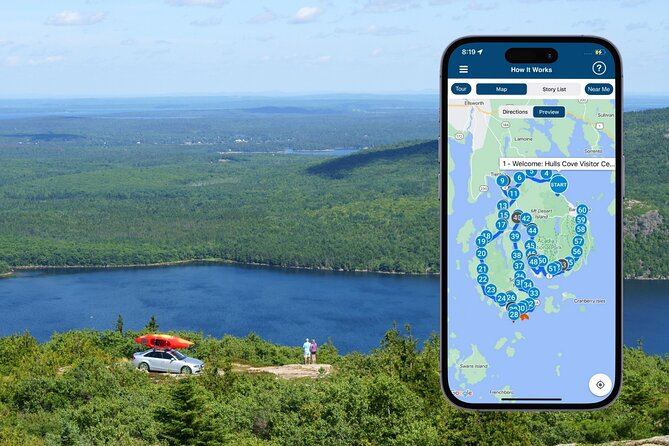
This is not a bus tour and not a private ride with a human guide waiting at each stop. You drive your own vehicle, open the Action Tour Guide app, and follow a route that begins at the Hulls Cove Visitor Center in Bar Harbor and ends beside the Boardwalk at 1 West Street.
The route covers more than 57 miles and takes about two to three hours if you keep moving. That timing does not include the walks, beach stops, snacks, photographs, or side trips you may add. In practice, you should treat the stated duration as the narration and driving time, not as a complete day in Acadia.
The app uses your phone’s location to trigger stories as you approach each point. This makes the experience easy to manage while driving, since you do not need to keep checking a screen. Connect your phone to the car by Bluetooth, USB, or AUX, and keep your attention on the road.
You need to download the app and the tour while you have a strong connection. After that, the route and audio work offline, which matters in a large national park where cellular service may not be dependable. Apple CarPlay is supported for audio playback. Android Auto support is listed as forthcoming, so Android users should plan to use the phone itself or another car connection.
More Self-Guided Audio Tours in the USA
- Gettysburg Battlefield Self-Guided Driving Audio Tour
★ 4.5 · 910 reviews - Joshua Tree National Park Self-Guided Driving Audio Tour
★ 4.5 · 762 reviews - Ultimate Acadia National Park Self-Guided Driving Audio Tour
★ 4.0 · 521 reviews
Bass Harbor Head Lighthouse and Bass Harbor

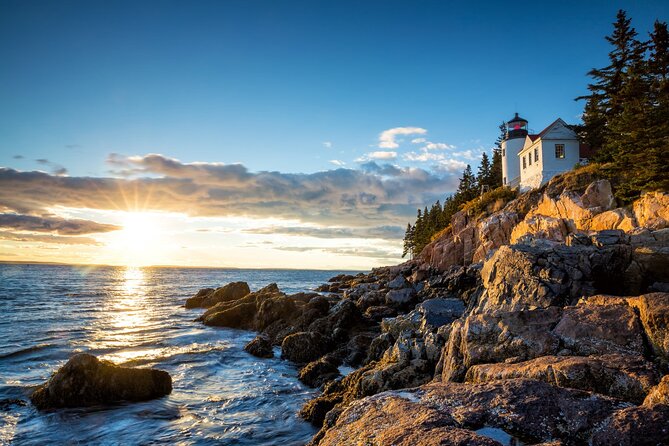
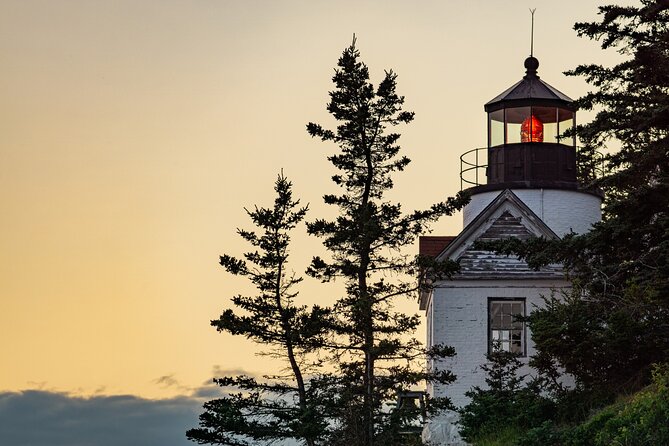
The route’s first major stop is Bass Harbor Head Lighthouse, one of Acadia’s three light stations and the most photographed on the main coast. Built in 1858, it has the classic appeal you expect from a Maine lighthouse, with a working setting rather than a museum-style attraction.
You cannot enter the tower or keeper’s house. That limitation is worth knowing before you arrive, especially if you are expecting an indoor visit. The audio adds a human touch by explaining that a more recent keeper, Robert Burchell, moved into the house with his family in 2004. Tourists were usually respectful, but some were curious enough to try opening the keeper’s door. Consider that a reminder to enjoy the view without treating a working home like a public exhibit.
A short drive brings you to Bass Harbor, a traditional fishing village once called McKinley. The story behind the name is amusing. When residents were asked what to call a nearby post office, they reportedly answered that officials could name it after the president if they cared to. The name changed back to Bass Harbor in 1966 after descendants pushed for the old name.
These two stops work well together. The lighthouse gives you a famous coastal view, while Bass Harbor adds local character and a reminder that Mount Desert Island is not only a park.
Ship Harbor and Wonderland, two easy coastal walks
Ship Harbor Nature Trail is a one-mile walk that follows the edge of a narrow cove. It should take about half an hour, though you will want extra time if you pause for the shore and the views.
The audio tells a grim shipwreck story connected to 1741. Two hundred people sailing from Ireland toward Philadelphia were caught in a storm and wrecked on the coast. The survivors reached land but waited without help. Some people tried to swim to the mainland and disappeared. Native people eventually found those who remained and carried word to English settlements.
The story gives this otherwise simple walk a strong sense of place. Still, the trail’s appeal does not depend on the tale. You get a gentle shoreline walk and a chance to see Acadia away from the car.
Wonderland Trail is another easy option, about 1.5 miles and less than an hour. It reaches the water’s edge and is especially useful if you want to combine a walk with birdwatching or tide-pool hunting.
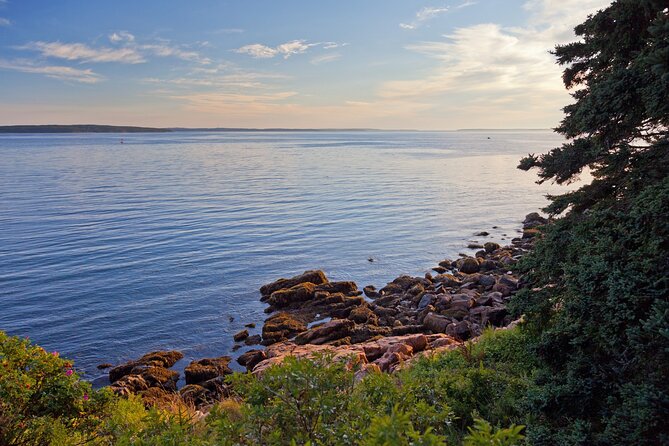
Tide pools are best visited near low tide. As the water pulls back, small pockets remain among the rocks, holding tiny marine ecosystems. Check the tide before you leave and move carefully along wet rocks. The tour also points out Pretty Marsh Picnic Area, where a stairway leads down to the shore. Near low tide, it can be a fine place for a quiet pause and some tide-pool watching.
Seawall, butterflies, and Echo Lake
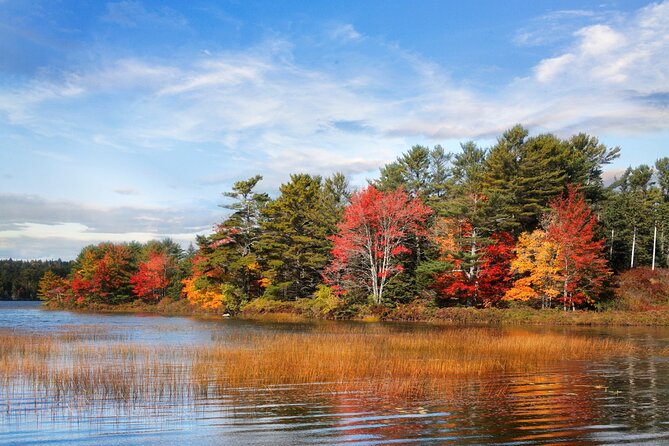
Acadia’s natural seawall is a good example of how the coast was shaped without human engineering. Waves carry stones up from the beach, and repeated tides sort the heavier rocks toward the top while lighter ones settle lower down. The result is a long wall of rounded stones made by the sea.
The stop is mainly about seeing and understanding the shoreline rather than visiting a formal attraction. It gives the narration a useful geological angle, which helps explain why Acadia feels so rocky and weathered.
Charlotte Rhoades Butterfly Park offers a change of pace. The property was given to Southwest Harbor in 1970 with a request that it remain a peaceful park for children and families. The town kept that promise, and the stop adds a small piece of local civic history to the route.
Echo Lake and Beach is the island’s most popular freshwater swimming spot. It also serves as a trail starting point. The Beech Cliff Trail is a fairly strenuous two-mile hike taking about two hours, with ladders leading through cliff formations. It does not continue all the way to the top of Beech Mountain, so do not confuse this with a simple stroll.
The tour works best when you use these descriptions to choose your stops. If you want a swim or a short break, Echo Lake fits the bill. If you want a more demanding outing, the Beech Cliff route requires extra time and comfort with ladders.
More Driving Audio Tours in the USA
- Ultimate Lake Tahoe Self-Guided Driving Audio Tour
★ 4.5 · 435 reviews - Scenic Newport, RI Self-Guided Driving Audio Tour
★ 4.5 · 325 reviews - Arches National Park Self-Guided Driving Audio Tour
★ 4.5 · 288 reviews - Yellowstone National Park Self-Guided Driving Audio Tour
★ 4.5 · 249 reviews
Little Long Pond and Seal Harbor Beach
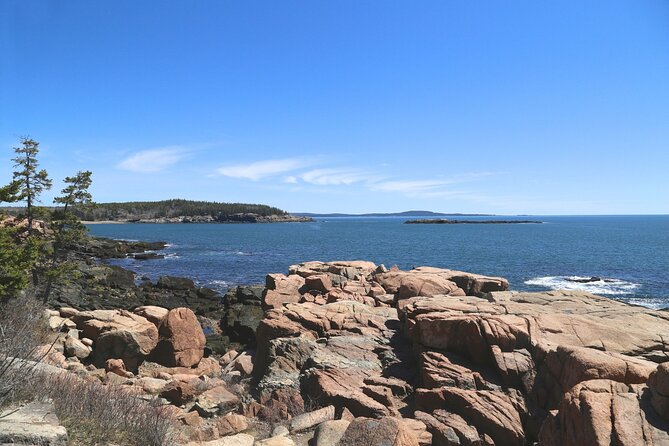
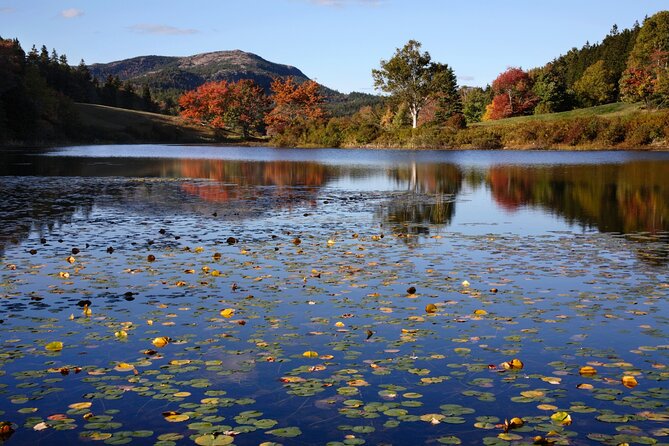
Little Long Pond offers an easy two-mile loop, usually taking less than an hour. The route follows old carriage roads through the woods and passes a field beside the pond. It is a useful choice when you want a walk with less emphasis on steep terrain or exposed coastal rock.
Seal Harbor Beach gives you a different shore experience from the more famous Sand Beach. It is made of sand and pebbles and is usually less crowded. There is a platform for jumping into the water, along with the chance to search the shore for sea glass.
The beach stop also shows why the flexible format matters. You may want only ten minutes for a photograph, or you may linger much longer. No bus is waiting, and no guide is counting heads. You can pause the narration and continue when you are ready.
Keep in mind that the audio gives suggested stop times of about ten minutes, but those times are not rules. They are simply a rough guide. A walk, swim, picnic, or low-tide search can turn this section into a much longer part of your day.
Seal Harbor, Otter Creek, and the island’s human side
Seal Harbor has long attracted wealthy summer residents. The audio points out roads leading toward private summer homes, including Skyland, a cottage Henry Ford built for his son in 1925. The property is now owned by Martha Stewart, who has held it since 1997.
You will not be touring those private homes. The value here is the context. Mount Desert Island is a working community, a national park, and a long-established summer retreat all at once. Seal Harbor makes that mix easy to see.
Otter Creek is a small village south of Bar Harbor, completely surrounded by Acadia National Park. That unusual arrangement makes it feel almost separate from the rest of the island, even though it is part of the same road network. The narration uses the village to explain how park boundaries and established communities overlap.
The Tarn comes next. Its name comes from an Old Norse word meaning a small mountain lake. Glacial weight pressed the ground down and helped form the pond. After several dry summers, it has become more marsh-like, a useful reminder that even familiar park features can change with weather over time.
Jackson Laboratory and the return to Bar Harbor
The Jackson Laboratory began operating in 1929 as one of the world’s first centers for studying cancer genetics. George Dorr donated the 13 acres used for the campus. Dorr also played a major role in Acadia’s creation, so this stop connects scientific work with the people who shaped the park.
The tour ends in Bar Harbor, the island’s largest community. It was first called the Town of Eden in 1796 and did not take the name Bar Harbor until 1918. The town has drawn summer visitors for more than two centuries, and today it is the natural place to finish with food, shops, or a walk near the waterfront.
The official end point is at 1 West Street beside the Boardwalk. Since the tour is self-guided, you can also pause before the end and spend time in town without losing access to the route.
What $14.99 really gets you
At $14.99 per group, the price is strong if you have two to four people in the car. A family of four pays less than four individual admission fees for many guided activities, while still getting narration for the entire route. Even a solo driver may find the cost reasonable if the stories add structure to a day of independent sightseeing.
You are paying for the route design, audio stories, offline map, and location-triggered playback. You are not paying for park admission, attraction tickets, reservations, transportation, or a person physically guiding you. Those costs and arrangements remain your responsibility.
The lifetime access is a major advantage. You can use the tour on another trip, repeat a section in a different season, or pause it for a long walk and return later. That flexibility also softens the one clearly reported weakness: in February, snow may cover plants and make some natural details hard to see. A later visit could give you a fuller view of the places the audio describes.
Who should book this Acadia audio tour?
I would choose this tour if you want a planned route but dislike fixed schedules. It suits couples, families, and small groups with their own car, especially those who like mixing short walks with scenic driving.
It is also a good fit if you want background while you drive but do not need a live guide. The narration covers geology, village names, local stories, lighthouses, parks, and trails, giving you enough context to make informed choices along the way.
I would be more cautious if you want detailed interpretation at every stop, long guided walks, or a specialist focused on birds, plants, geology, or photography. The tour gives you a broad introduction, not an expert-led field course.
Download everything before leaving Wi-Fi, start at the Hulls Cove Visitor Center, and keep the route’s speed limits in mind. If you plan to walk Ship Harbor, Wonderland, or Little Long Pond, allow much more than the basic two to three hours.
Should you book it?
Book it if you want an affordable, private way to get oriented around Mount Desert Island and choose your own stops. The combination of 48-plus stories, offline access, short coastal walks, and lifetime use makes $14.99 a sensible buy for a car group.
Skip it if you prefer spontaneous driving with no narration, or if your main goal is a deeply detailed naturalist guide. For most independent visitors, though, it offers a helpful middle ground between driving alone and joining a scheduled tour.
FAQ
How long does the Acadia audio tour take?
The driving route takes about two to three hours without allowing much time for walks, meals, swimming, photos, or side trips.
How long is the driving route?
The route is more than 57 miles long and includes over 48 audio stories.
Where does the tour begin?
It begins at the Hulls Cove Visitor Center, 25 Visitor Center Road, Bar Harbor, Maine.
Where does the tour end?
It ends at 1 West Street in Bar Harbor, beside the Boardwalk.
Is this a guided group tour?
No. This is a private, self-guided activity. No guide meets you at the starting point, and only your group participates.
Does the tour work without cell service?
Yes. Download the app, map, and tour while you have strong Wi-Fi or cellular service. The audio and route then work offline.
How do I hear the audio in the car?
You can connect your phone to the car stereo with Bluetooth, USB, or AUX. Audio playback is also compatible with Apple CarPlay.
Does one purchase cover everyone in the car?
Yes. The $14.99 price covers a group of up to four people in one car.
Can I use the tour more than once?
Yes. The tour provides lifetime access with no expiry, so you can pause it, return to it later, or use it again on another trip.
Latest audio tours in the USA
- Sequoia National Park Self-Guided Audio Tour★ 4.5 · 9 reviews
- Sequoia and Kings Canyon Audio Tour Self Guide National Park Tour★ 5.0 · 3 reviews
- Kings Canyon National Park Self-Guided Audio Tour★ 4.0 · 4 reviews
- Sedona, Arizona Self-Guided Audio Tour★ 4.0 · 36 reviews
- Sedona & Red Rock State Park Self-Guided Driving Audio Tour★ 3.0 · 30 reviews
- Haunted Savannah Self-Guided Walking Audio Tour★ 4.5 · 3 reviews
- Downtown Seattle Self-Guided Walking Audio Tour★ 4.5 · 6 reviews
- Uncover Seattle: Self-Guided Audio Tour★ 3.5 · 7 reviews
Driving Audio Tours, compared.



Ultimate Acadia National Park Self-Guided Driving Audio Tour
Read our review →



Browse the lists this tour appears in