
Reviewed · MOAB
Utah Mighty 5 National Parks Self-Guided Driving Audio Tours
The best thing about this Utah Mighty 5 tour is that it turns your own car into a rolling guidebook. As you approach a viewpoint, trailhead, or landmark, the Action app uses GPS to play the related story. You get the setting before you arrive, not ten minutes after you have already driven past it.
I like the one-price-per-car setup, which covers a group of up to four, and I like the offline access, since cellular service can be patchy in Utah’s parks. The stories also include useful details about hikes, geology, and history, rather than simply naming the next turn.
The main catch is that this is an app, not a person waiting at the gate. You must download the tours on strong Wi-Fi or cellular service, start from the correct point, and keep the app working in the background. A few technical problems have been reported, so prepare your phone before entering a park.
Key points to know before you go

- GPS-triggered stories play as you approach sights, so you can keep your eyes on the road.
- Five national parks are covered: Zion, Bryce Canyon, Capitol Reef, Arches, and Canyonlands, with extra content for the Needles District.
- Offline maps and audio are essential for areas with weak or missing phone service.
- One purchase covers up to four people in one car, making the $32.99 price especially attractive for a small group.
- You set the pace, taking breaks, skipping stops, or spreading the drives over several days.
- No park entry is included, and no guide meets you at the starting point.
What this Utah audio tour actually feels like

This is a private, self-guided driving experience. You do not join a bus, follow a guide, or need to match someone else’s schedule. Instead, you download Action’s separate tour app, enter the password sent by email and text, drive to the listed starting point, and let the GPS activate each story.
The app is designed for hands-free use. Connect your phone to the car with Bluetooth, USB, or AUX, then listen through the vehicle speakers. Apple CarPlay is supported for audio playback. Android Auto support is still being added, so Android users should plan to use the phone itself or another connection method.
The route works best when you follow the suggested direction and speed. If you start in the wrong place, reverse the route without selecting the matching version, or rush past a trigger point, the timing can become confusing. Zion offers two route choices, from the Springdale Visitor Center toward the East Entrance or the reverse direction, so choose the version that matches your plan.
The listed driving portions range from about one to three hours per park, but that does not mean you can see a park properly in that time. Those figures describe the narrated route, not the full visit with parking, walks, meals, shuttle arrangements, and photo stops. Plan extra time for the actual parks.
More Self-Guided Audio Tours in the USA
- Arches National Park Self-Guided Driving Audio Tour
★ 4.5 · 288 reviews - Arches and Canyonlands NP Self-Guided Driving Audio Bundle Tour
★ 4.5 · 68 reviews - Canyonlands National Park Self-Guided Driving Audio Tour
★ 4.5 · 54 reviews
Zion, from Springdale to the East Entrance
Zion is the most dramatic opening section of the package. The route introduces you to the park near Springdale, then carries you through the canyon toward the East Entrance. You hear about the surrounding peaks, natural pools, major viewpoints, and the area’s past as the road changes from town access to canyon scenery.
The route includes the Springdale Visitor Center, Zion Canyon Visitor Center, and Zion Human History Museum. These are useful orientation points, especially if this is your first visit. You can use the audio to get the general story while deciding which walks deserve your limited time.
Inside the canyon, the narration covers Canyon Junction Bridge, Court of the Patriarchs, Zion National Park Lodge, Emerald Pools, Angel’s Landing, the Grotto Picnic Area, Weeping Rock, Big Bend, and the Temple of Sinawava. These names cover several of Zion’s best-known stops, but they are not all equal in ease or access.
Angel’s Landing, for example, is a major attraction, but hearing about it does not mean the hike is automatically suitable for you. Use the tour for context, then check current park rules, trail conditions, and access requirements before setting out. The audio can tell you what you are approaching, but it does not replace official safety information.
The route then shifts toward the East Entrance. You pass East Temple, a scenic drive viewpoint, the Zion-Mount Carmel Tunnel, Canyon Overlook Trail, Altar of Sacrifice, Checkerboard Mesa, and the East Entrance Ranger Station. This section gives you a useful change of pace, from towering canyon walls to more open, textured rock.
Canyon Overlook Trail is one of the more practical additions because it tells you about a specific walk rather than just a photo stop. Keep in mind that the park road, parking, and traffic can affect how easily you reach each point. The audio cannot reserve a parking place or shorten a line.
If you enter from the east, select the reverse version. This small step matters. The app has two directions, and the correct starting point helps the GPS stories arrive in the right order.
Bryce Canyon and its rows of hoodoos
Bryce Canyon offers a very different kind of scenery. Instead of Zion’s narrow canyon walls, you get a high rim crowded with orange and cream-colored hoodoos, the tall rock spires formed by erosion. The route begins at the visitor center and moves through Fairyland Point, Sunrise Point, Bryce Amphitheater, Sunset Point, Inspiration Point, and Bryce Point.
The sequence is helpful because the viewpoints are easy to confuse when you are moving along the rim. The audio gives you a reason to pause and compare them rather than treating every overlook as the same orange view.
Sunrise Point and Sunset Point sit near the Bryce Amphitheater area, while Inspiration Point and Bryce Point offer different angles across the formations. If you plan to walk down into the amphitheater, pay attention to the time and effort involved. The drive may take about two hours, but a rim stop or trail can turn that into a half-day or longer.
Farther along, the tour reaches Paria View, Swamp Canyon Overlook, Farview Point, Natural Bridge, Agua Canyon, Ponderosa Canyon, Black Birch Canyon, and Rainbow Point. The southern viewpoints spread the scenery out and help you see how the rock formations change beyond the central amphitheater.
The route finishes with Red Canyon Arch, giving you another chance to keep listening outside the busiest core of the park. Bryce is a good test of how much you enjoy audio guidance. If you like learning what formed a view just before seeing it, this part should feel useful. If you prefer silence at every overlook, you can pause the narration at any time.
One practical warning comes from the app itself: performance may not be identical at every park. Download Bryce before you arrive, check that the route appears in the app, and test the audio with your car speakers.
Capitol Reef, history along the road

Capitol Reef is the most story-driven portion of this package. The route combines cliffs and domes with old orchards, buildings, petroglyphs, mining sites, and accounts of the Paiute people and Mormon settlers. It feels less like a string of famous photo stops and more like a narrated drive through a place shaped by people as well as rock.
Early points include Twin Rocks, Chimney Rock, Goosenecks Overlook, the Fluted Wall, and the Castle. These give you a quick introduction to the area’s unusual formations before the route moves toward the visitor center and Capitol Reef Formation.
The historic district includes Ripple Rock Nature Center, the Mail Tree, Gifford Homestead, Fruita Barn, and Fruita Schoolhouse. The Gifford Homestead and old agricultural sites add useful context to the orchards and settlement area. You get a clearer sense of how a remote desert community functioned.
The narration also covers Cohab Canyon, American Moses, Danish Hill, Oyler Mine, the Paiute and Mormon story, Slickrock Divide, the North Star, the Paiute Way, and Wovoka. These names may mean little on a map, but audio helps connect them to the people, routes, and rock features around you.
Several hiking options are included, such as Hickman Bridge Trail, Capitol Gorge, Grand Wash, and Cassidy Arch. The tour also points out the Capitol Dome, Behunin Cabin, Pioneer Register, and petroglyphs. This is valuable when you are deciding where to spend your daylight, but you should still check trail conditions and distances at the park.
Capitol Reef is where the ability to pause becomes especially useful. You can stop the narration while walking, restart it for the next drive, and take a longer break in Fruita without losing the route.
More Driving Audio Tours in Moab
- Full-Day Audio Driving Tour of Arches National Park
★ 4.5 · 27 reviews - Self Guided Audio Driving Tour in Arches National Park
★ 3.5 · 6 reviews - Goblin Valley Self Guided Driving Audio Tour
★ 4.0 · 4 reviews - Self Guided Audio Driving Tour of Canyonlands
★ 5.0 · 2 reviews
Arches, a concentrated day of major formations

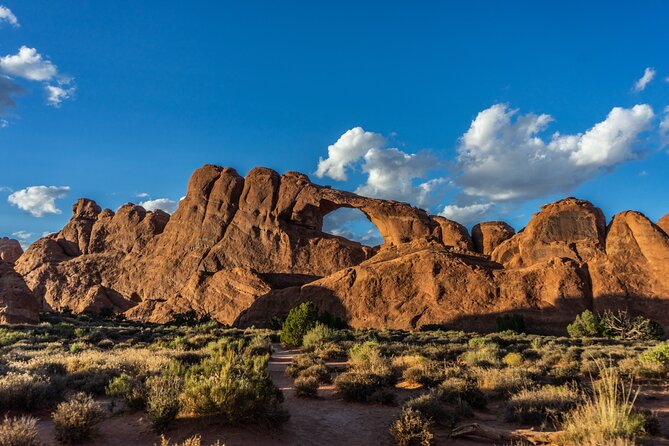
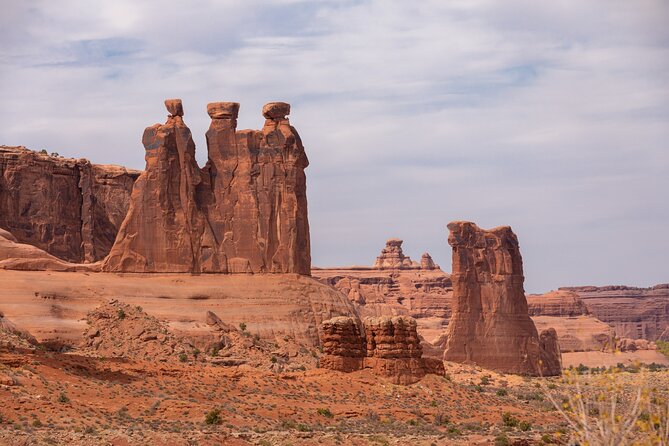
Arches packs a lot into a relatively compact drive, and the audio helps you understand how the formations relate to one another. The route begins at the visitor center and continues past Three Penguins, Moab Fault Overlook, North Park Avenue, La Sal Mountains Viewpoint, Three Gossips, and Courthouse Towers Viewpoint.
The early section gives you a strong introduction to the park’s rock shapes before reaching Petrified Dunes and Balanced Rock Trail. Garden of Eden and the Windows Road follow, leading toward Double Arch and Cove of Caves. These stops cover many of the formations that make Arches feel so different from the other four parks.
The route also includes Panorama Point, Delicate Arch, Salt Valley, Fiery Furnace, Sand Dune Arch, and Devil’s Garden Trailhead. You can expect the audio to explain what you are approaching and point out hikes or short stops worth considering. It does not include park admission, trail reservations, or a personal guide on the ground.
Arches is one place where timing matters. A narrated route of two to three hours can stretch much longer once you add walks and photo stops. The tour lets you start early, pause during the hottest part of the day, or return to a section later if you have access to it during the stated validity period.
The information provided describes the package as offering lifetime access with no expiry, while the Arches section also says the bundled tours can be used for one year. That is an important inconsistency. Check the current terms at booking so you know exactly how long your access lasts.
Canyonlands and the extra Needles route
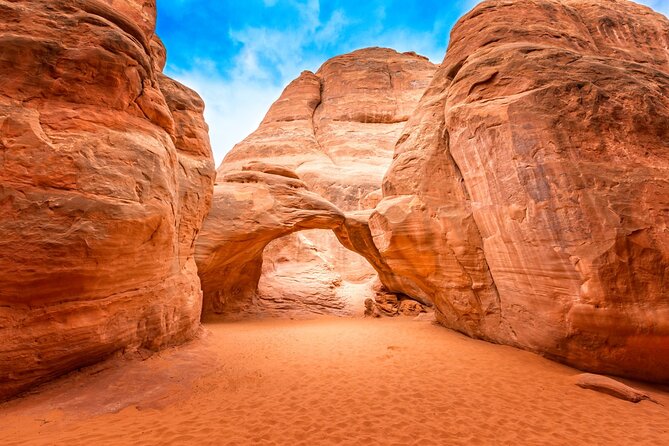
The main Canyonlands route focuses on the Island in the Sky area. It starts with formations such as Monitor and Merriamac Rock, then moves through Big Mesa Viewpoint, Plateau Viewpoint, White Rim, Basin Overlook Parking, and nearby Dead Horse Point State Park.
The Island in the Sky Visitor Center is a natural orientation point. From there, the audio leads you toward Shafer Canyon Overlook, the Neck, Lathrop Canyon, Mesa Arch, Green River Overlook, Aztec Butte, Whale Rock, and Upheaval Dome.
The route finishes with Candlestick Tower Overlook, Murphy Point Trail, Buck Canyon Overlook, White Rim Overlook Trail, Orange Cliffs Overlook, and Grand View Point Overlook. These broad viewpoints are a good match for GPS narration because the scale can be hard to grasp without some explanation.
Canyonlands is spread out, and the listed drive is only about an hour before you account for stops. Do not treat that figure as a full park itinerary. You will want extra time for overlooks, walks, parking, and the drive between sections.
The package also includes a separate Needles District route. It calls out Newspaper Rock, Pothole Point, and Wooden Shoe Overlook. This is useful if your plans include the southeastern part of the park, but you should select the correct tour version in the app rather than assuming the main Canyonlands route covers every district.
What the $32.99 price buys you

At $32.99 per group of up to four, this is inexpensive compared with a private guide or a paid vehicle tour. For four people, the cost works out to about $8.25 each. Even for one or two people, it can make sense if you use the audio in several parks.
The strongest value comes from flexibility. You can buy it before an Arches visit, use it for that park, then continue with Canyonlands, Bryce Canyon, Capitol Reef, and Zion on different days. You can also pause the tour for lunch or a walk and return to the narration later.
The value drops if you only want a short drive through one park, dislike listening while driving, or do not want to manage an app. You also need separate national park passes, and the tour does not include transportation, food, parking, or admission.
The product is most useful as a layer of explanation, not a replacement for park planning. Use official park information for closures, rules, trail conditions, and current access. Use this audio for timing, background, and reminders about what is coming next.
Download and setup tips that matter
Do the setup before you leave town. After booking, look for the email and text containing the password, then search for audio tour if you cannot find them quickly.
Download the separate Action Tour Guide app while you have strong Wi-Fi or cellular service. Open the app once, enter the password, and make sure the routes appear. Test the sound through your car before reaching the park entrance.
Bring a charged phone and connect it by Bluetooth, USB, or AUX. A tablet or iPad with GPS and cellular capability can also be used. The recommended devices are an iPhone with iOS 15 or later, an Android phone with version 9 or later, or a GPS-enabled tablet with cellular service.
If the audio does not trigger, first check that you are at the listed starting point and have selected the correct direction. Stay on the route and follow the speed limit. If the problem continues, use the provider’s support contact while you still have access to the booking details.
Free cancellation is available if you cancel at least 24 hours before the local start time. Changes or cancellations inside that window are not refundable.
Who should book this tour?
I would choose this package for a small group driving between several Utah parks, especially if you want useful background without paying for a private guide. It suits independent visitors who like to stop often, skip sights, and build their own day.
It is also a smart backup for a park where you already have a human guide. The audio can cover facts or viewpoints that a short guided visit misses, and you can use it on a later drive.
I would be cautious if you are uncomfortable with smartphone setup, have unreliable access to a charged device, or want a live person to answer questions beside you. The app has received a strong overall rating of 4.4 from 25 ratings, but technical complaints show why preparation matters.
Should you book the Utah Mighty 5 audio tour?
Book it if you are driving through several parks and want a low-cost narrator, offline access, and the freedom to set your own schedule. The best parts are the GPS timing, the broad coverage, and the way one purchase can serve a whole car.
Skip it if you expect a fully guided tour with personal attention. Download everything before your trip, confirm the access period, keep park passes separate, and treat the audio as a helpful companion to your own planning. Used that way, $32.99 buys a useful amount of context for a very large stretch of southern Utah.
FAQ
Does the tour include all five of Utah’s Mighty Five parks?
Yes. The package covers Zion, Bryce Canyon, Capitol Reef, Arches, and Canyonlands. It also includes a separate route for Canyonlands’ Needles District.
Is the tour guided by a person in the car?
No. This is a private, self-guided audio tour. No guide meets you at the starting point. Stories play through the Action app as you approach GPS-triggered points.
Can I use the tour without cell service?
Yes, after downloading the routes and audio in advance. You must complete the download while connected to strong Wi-Fi or cellular service. The maps and stories are designed to work offline afterward.
Does the $32.99 price include park admission?
No. National park passes are not included. The price covers the audio tour for a group of up to four people in one car.
How do I start the audio tour?
Download the Action Tour Guide app, enter the password sent by email and text, choose the correct route if more than one version is available, and drive to the first listed story point. The audio should begin automatically when you arrive.
Can I pause the tour and use it on different days?
Yes. You can start, pause, and resume the tour at your own pace. The supplied information describes lifetime access with no expiry, while the Arches details mention one year of use, so confirm the current access terms before booking.
More Self-Guided Audio Tours in Moab
- Self Guided Audio Tour in Arches and Canyonlands
★ 4.5 · 16 reviews - Utah Mighty 5 Adventure Bundle: 8 Self-Guided Audio Tours
★ 5.0 · 4 reviews - La Sal Mountain Loop Self-Guided Audio Tour
★ 3.5 · 4 reviews - Self Guided Audio Tour Bundle for Utah’s Mighty Five
★ 5.0 · 3 reviews
More National Park Audio Tours in Moab
- Canyonlands National Park Self-Guided Audio Tour
★ 4.0 · 5 reviews - Joshua Tree National Park Self-Guided Driving Audio Tour
★ 4.5 · 762 reviews - Ultimate Acadia National Park Self-Guided Driving Audio Tour
★ 4.0 · 521 reviews - Yellowstone National Park Self-Guided Driving Audio Tour
★ 4.5 · 249 reviews
Latest audio tours in Moab
- Utah Mighty 5 Adventure Bundle: 8 Self-Guided Audio Tours★ 5.0 · 4 reviews
- Goblin Valley Self Guided Driving Audio Tour★ 4.0 · 4 reviews
- Self Guided Audio Driving Tour of Canyonlands★ 5.0 · 2 reviews
- Self Guided Audio Tour Bundle for Utah’s Mighty Five★ 5.0 · 3 reviews
- Canyonlands National Park Self-Guided Audio Tour★ 4.0 · 5 reviews
- La Sal Mountain Loop Self-Guided Audio Tour★ 3.5 · 4 reviews
- Self Guided Audio Driving Tour in Arches National Park★ 3.5 · 6 reviews
- Delicate Arch Trail Self-Guided Audio Walking Tour★ 4.0 · 2 reviews
Driving Audio Tours, compared.


Ultimate Acadia National Park Self-Guided Driving Audio Tour
Read our review →


Browse the lists this tour appears in