
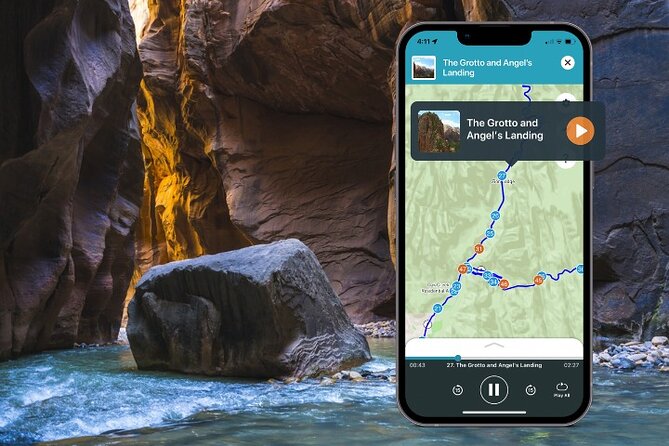
Reviewed · USA
Zion National Park Self-Guided Audio Tour
Zion’s big advantage is that this private GPS audio tour covers far more than the main canyon. In one flexible route, you can reach Kolob Canyons, a Mormon ghost town, high overlooks, famous hikes, and the road into East Zion without keeping up with a guide or bus group.
I like the $11.99 price for an entire vehicle of up to seven people, and I like that the narration starts automatically as you drive. You also get turn-by-turn directions, an offline map, and a tour that never expires.
The main drawback is the balance between music and information. Some listeners may enjoy the musical breaks, but if you want nonstop stories, history, and geology, parts of the commentary may feel light.
Key points to know before you go
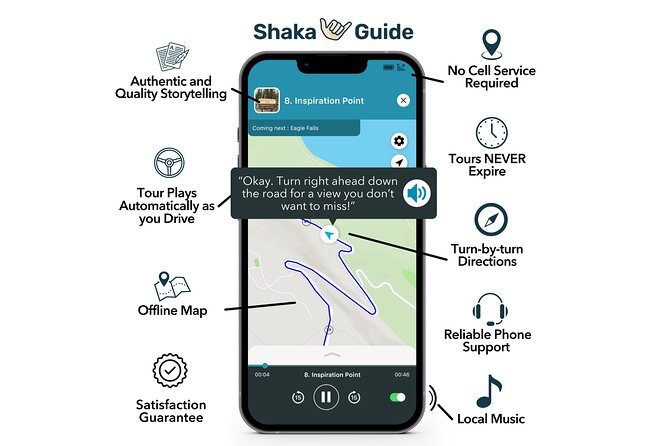
- One price covers your whole car: Up to seven people can use the tour for $11.99, with no per-person audio fee.
- The route reaches three sides of Zion: You can explore Kolob Canyons, Zion Canyon, and East Zion in one broad self-guided outing.
- Several stops are hikes, not just viewpoints: Timber Creek Overlook, Emerald Pools, Angel’s Landing, and Canyon Overlook each require different levels of effort.
- Offline use matters here: Download the tour on strong Wi-Fi before driving into areas with weak service.
- You choose the pace: Start, pause, skip, and resume stops as you like, even across several days.
- Permits remain your responsibility: Angel’s Landing and The Subway require separate permits that are not included.
A $11.99 tour that works best as your Zion road companion
This is not a traditional tour with a person in your vehicle. It is a self-guided audio route in the Shaka Guide app, designed to play stories, directions, tips, and music as your phone’s GPS tracks your position.
That setup gives you privacy and control. You can stop for a long hike, ignore a viewpoint, or pause the narration while you talk, take photos, or listen to a ranger. Since the fee covers the vehicle rather than each person, the value improves quickly when several people share the ride.
The listed duration is roughly eight to sixteen hours, but that does not mean you must complete it in one day. The tour never expires, and you can use it over multiple days if your Zion visit allows. That is important because the route includes enough driving and walking to overwhelm anyone trying to force every stop into one packed schedule.
You begin in Hurricane, Utah, with additional starting points near Mt. Carmel Junction and just north of Kanab. The route ends back at the meeting point. Park entry, parking, meals, refreshments, and private transportation are not included, so plan for those costs separately.
More Self-Guided Audio Tours in the USA
- Gettysburg Battlefield Self-Guided Driving Audio Tour
★ 4.5 · 910 reviews - Joshua Tree National Park Self-Guided Driving Audio Tour
★ 4.5 · 762 reviews - Ultimate Acadia National Park Self-Guided Driving Audio Tour
★ 4.0 · 521 reviews
Kolob Canyons starts the route with quiet, wide views
The northern Kolob Canyons section makes a fine opening because it feels removed from the busiest part of Zion. At the Kolob Canyons Visitor Center, you check in with your park pass, use the facilities, and get oriented before driving farther into the red-rock country.
Give yourself about 20 minutes here, though you may want longer if you need maps or current park information. The audio tour helps explain where you are, but the visitor center is still the right place to confirm road conditions and any changes affecting your day.
The best short walk in this section is Timber Creek Overlook Trail. It takes about 30 minutes and leads to broad views of Kolob Canyons, the Pine Valley Mountains, and Red Butte. The trail is described as short and easy, making it a strong choice if you want one quick hike rather than a major workout.
I would not skip this stop simply because it is outside Zion Canyon. It gives you a different view of the park, with open distance and layered ridges instead of the tight canyon walls found farther south.
La Verkin and Lava Point add useful high viewpoints
The route then moves toward La Verkin Overlook. A 15-minute round-trip drive on a gravel road brings you to views of Zion Canyon, the Virgin River Gorge, the Pine Valley Mountains, and La Verkin itself.
That gravel road is a small but important practical detail. If you are driving a vehicle you would rather keep on smooth pavement, check conditions before heading out. The stop itself is brief, but it gives you a wide regional view that helps connect the separate parts of the park.
The audio also points out The Subway, one of Zion’s best-known canyoneering areas. You can hear about the route and its two approaches, bottom-up and top-down, but do not confuse the audio explanation with permission to hike it. The Subway requires a wilderness permit through Zion’s lottery system. The bottom-up route is less technical and begins at the Left Fork trailhead, but the permit requirement still applies.
Lava Point Overlook is another worthwhile detour. From this high basalt cliff, you can look across a forested volcanic valley filled with pinyon, juniper, and white pine. On a clear day, the view reaches toward Bryce’s Paunsaugunt Plateau and the North Rim of the Grand Canyon.
There is no required hike at Lava Point, which makes it useful for a mixed group. You get a major viewpoint without asking everyone to walk far. The road is weather dependent, so the tour’s advice to continue only when conditions are safe matters here.
Grafton gives the drive a human story
Grafton Cemetery and Grafton Ghost Town provide a welcome change from cliffs and viewpoints. Grafton was an agricultural settlement, not a mining town, and that difference helps explain why its story feels distinct from many western ghost towns.
At the cemetery, plan around 40 minutes. The site is known for its old graves and its connection to the filming of the bicycle scene in Butch Cassidy and the Sundance Kid. The stop offers a direct link between the area’s settlement past and its later place in popular culture.
Grafton Ghost Town itself takes about 15 minutes in the suggested schedule. You can see abandoned houses and enter some buildings. Do not expect a large reconstructed historical park. The appeal is the preserved, quiet remains of a small settlement, with enough structures to make the place easy to picture as a working community.
I like this portion because it breaks up the geology-heavy route. It also rewards curious visitors who want more than scenic pullouts. Bring time for photos, but treat the old buildings with care and follow any posted access rules.
More National Park Audio Tours in the USA
- Arches National Park Self-Guided Driving Audio Tour
★ 4.5 · 288 reviews - Yellowstone National Park Self-Guided Driving Audio Tour
★ 4.5 · 249 reviews - Self-Guided GPS Audio E-Bike Tour Hawaii Volcanoes National Park
★ 4.5 · 131 reviews - Shenandoah National Park Self-Guided Driving Audio Tour
★ 4.5 · 109 reviews
Zion Canyon Visitor Center is your planning checkpoint
When you reach Zion Canyon, stop at the visitor center before beginning the main hikes. You can speak with rangers, pick up a map, use the restroom, refill water bottles, and ask about current trail conditions.
This is also where you can obtain a wilderness permit if you need one. Ranger talks and walks may be available, and the center has a bookstore and gift shop. I would handle practical needs here before heading deeper into the canyon.
During shuttle season, you will need to follow the current shuttle system. The tour suggests an alternate way to reach the shuttle at the Human History Museum: walk the paved Pa’rus Trail from the visitor center. It is about 1.7 miles, pleasant and suitable for bikes and dogs, but it is not a shortcut for everyone.
The Pa’rus Trail is the only Zion trail where bikes and dogs are allowed, according to the tour information. If you are carrying gear, traveling with children, or trying to save energy for a major hike, compare the walk with the shuttle line before choosing.
The museum and Court of the Patriarchs make easy stops
The Zion Human History Museum is a brief but useful stop. From its back patio, you can look toward the Towers of the Virgin formation. A ranger talk may also be offered, giving you a chance to hear park information in person instead of relying only on the app.
The museum stop takes about 10 minutes in the suggested schedule, but the ranger talk could make it longer. The view alone is worth the short pause if you are already nearby.
Next comes the Court of the Patriarchs, a formation named for Abraham, Isaac, and Jacob. The viewpoint is close to the road, so you can get out, take in the cliffs, and continue without giving up a large part of your day.
These two stops work well for visitors who want scenic rewards without another serious hike. They also give you breathing room between the longer walks ahead.
Emerald Pools is the most approachable major hike
The Lower Emerald Pools Trail is presented as the first must-see walk in the canyon. It covers about two miles and takes roughly an hour in the suggested plan.
You will pass beneath sandstone cliffs where water drips down toward hanging gardens and pools. The trail is described as family-friendly and starts across from Zion Lodge, making it one of the easier ways to experience the canyon’s water and plant life up close.
The word family-friendly should not be read as effortless. Trail conditions, heat, water, and the pace of your group still matter. Allow more than an hour if you want to stop for photos or take the walk slowly.
I would give Emerald Pools priority if you want a classic Zion experience but do not have the time or permits for more demanding routes. It offers a clear payoff without requiring a chain-assisted climb or a wilderness permit.
Angel’s Landing requires planning, strength, and a permit
The route directs you to The Grotto for Angel’s Landing. The full hike is about five miles round-trip, but the final half-mile to Angel’s Landing is the part that brings the narrow, chain-assisted climb and the most demanding exposure.
You now need a permit for Angel’s Landing. The permit is not included with park entry or the audio tour, so arrange that separately before treating this as a confirmed plan.
If you do not have a permit, do not want the final climb, or simply prefer a less exposed route, Scout’s Lookout provides a strong alternative. The audio makes that option clear, and it is useful advice because crowding and trail difficulty can add much more time than the mileage suggests.
Set aside at least two hours for the experience, and more if conditions are busy or you continue to the top. This is not a quick roadside attraction. The tour can guide you to the trailhead, but it cannot replace current ranger advice, proper preparation, or the required permit.
Weeping Rock and the Narrows point to Zion’s water story
The audio describes how water moved through Zion’s rock layers for more than 1,000 years before reaching the less-permeable Kayenta Formation. At Weeping Rock, that water travels sideways and emerges through softer limestone, creating the dripping effect.
The paved trail is about half a mile round-trip. It is a short stop with a useful geology lesson, though conditions and access can change in a national park. The stop adds meaning to what might otherwise look like simple dripping rock.
At the Temple of Sinawava, you reach the end of the canyon road and the starting point for The Narrows. The audio can introduce the route, but hiking The Narrows requires its own preparation and may involve permits depending on the route and conditions. Use the visitor center and ranger information before setting out.
East Zion finishes with overlooks and unusual rock patterns
The Great Arch is a blind arch, meaning it is not fully freestanding. You can see it from the road or from pullouts along the winding drive.
Canyon Overlook Trail is one of the most useful choices for anyone who wants a high viewpoint without attempting Angel’s Landing. The hike is about one mile and takes around 30 minutes in the suggested schedule. Its view looks across East Zion’s rugged terrain, making it a strong payoff for modest effort.
Checkerboard Mesa is best viewed from a pullout on the left before the ranger station. Its crossing lines formed through expansion and weathering, and the pattern becomes easier to see from farther away. Spend around 10 minutes here, but take care near the road and pullouts.
At the East Entrance Ranger Station, you can ask about longer routes. East Mesa Trail leads toward several options, including Observation Point, described as Zion’s highest lookout. The East Rim Trail is also the starting point for seeing the remains of the Cable Mountain Pulley system.
These trails connect and can take much longer than the short stops earlier in the day. Check with the ranger before leaving the road, especially if you are unfamiliar with the route or have limited daylight.
App setup matters more than the price
After booking, you receive confirmation and instructions by email. Download the Shaka Guide app, redeem the tour with the supplied code, and download the route over strong Wi-Fi before departure.
In the app, open the My Stuff tab, select the tour’s starting point, and follow the GPS directions. The narration, music, and instructions are meant to activate as you drive. The offline map means you do not need continuous Wi-Fi or mobile data once the tour is downloaded.
The tour works best when your phone is ready before you pull away. Do not wait until you reach a canyon road with weak service. Support is available by phone, chat, or email if you have trouble with the app.
Who should book this Zion audio tour?
I would recommend it to independent visitors who want structure without a fixed schedule. It is especially good for a family or group sharing one car, since $11.99 covers up to seven people.
It also suits visitors staying in the St. George, Hurricane, Mt. Carmel Junction, or Kanab area who want to combine major Zion sights with less obvious stops such as Grafton and Kolob Canyons. The route gives you ideas, but you remain free to skip long hikes or return on another day.
I would be more cautious if you want a detailed, nonstop history program. The audio includes musical interludes, and some sections may feel short on stories. If your priority is human guidance, long conversations with a local expert, or close help on demanding hikes, this format will not provide that.
Should you book it?
Book this tour if you want an affordable, flexible road guide that connects Zion’s major canyon with Kolob Canyons, Grafton, Lava Point, and East Zion. The offline directions and automatic narration are practical, and the car-wide price is hard to beat.
Skip it if you already have a detailed plan, prefer a live guide, or expect every minute of audio to be packed with history. For most self-directed visitors, it works best as a helpful companion rather than a complete replacement for ranger advice, trail research, and permits.
Cancellation is free up to 24 hours before the start time. Changes or cancellations inside that window are not refunded.
FAQ
How much does the Zion National Park Self-Guided Audio Tour cost?
The tour costs $11.99 per group, with up to seven people included in one vehicle.
How long does the tour take?
The suggested duration is approximately eight to sixteen hours. You can also pause the tour, resume it later, and use it across multiple days because tours never expire.
Where does the tour begin?
The main starting point is in Hurricane, Utah. Additional starting points are available at Mt. Carmel Junction and just north of Kanab.
What language is available?
The tour is offered in English.
Do I need Wi-Fi during the tour?
No. Download the tour and offline map over strong Wi-Fi before you begin. Continuous Wi-Fi or mobile data is not required after the download.
Is park admission included?
No. Entrance fees are not included. Parking fees, meals, refreshments, and private transportation are also separate.
Does the tour include a private vehicle?
No. Private transportation is not included. You use your own vehicle while the app provides audio and GPS directions.
Do I need a permit for Angel’s Landing?
Yes. Angel’s Landing requires a permit, and the permit is not included with the park entry fee or the audio tour.
Do I need a permit for The Subway?
Yes. The Subway requires a wilderness permit through Zion’s lottery system. The audio tour does not provide that permit.
Can I cancel for a full refund?
Yes. You can cancel at least 24 hours before the experience start time for a full refund. Cancellations made less than 24 hours before the start time are not refunded.
Latest audio tours in the USA
- St. Augustine City Self-Guided Walking Audio Tour★ 4.5 · 3 reviews
- St. Augustine’s Lost Souls: a Smartphone Audio Ghost Tour★ 4.0 · 7 reviews
- Historic St Augustine Audio Self Guided App GPS Tour★ 4.0 · 13 reviews
- Self-Guided Haunted Ghost Walking Audio Tour in St. Augustine★ 4.5 · 16 reviews
- Badlands National Park Self-Guided Audio Tour★ 4.0 · 3 reviews
- Badlands National Park Self-Guided Driving Audio Tour★ 4.5 · 61 reviews
- Badlands and Mount Rushmore Self-Guided Audio Tour Bundle★ 5.0 · 4 reviews
- Sequoia National Park Self-Guided Audio Tour★ 4.5 · 9 reviews
National Park Audio Tours, compared.

Ultimate Acadia National Park Self-Guided Driving Audio Tour
Read our review →
Vesuvius National Park Skip-The-Line Ticket and Audio Guide
Read our review →
Self-Guided GPS Audio E-Bike Tour Hawaii Volcanoes National Park
Read our review →
Browse the lists this tour appears in