
Reviewed · KRAKOW
Krakow Jewish Ghetto and Quarter Audio Guided Walking Tour
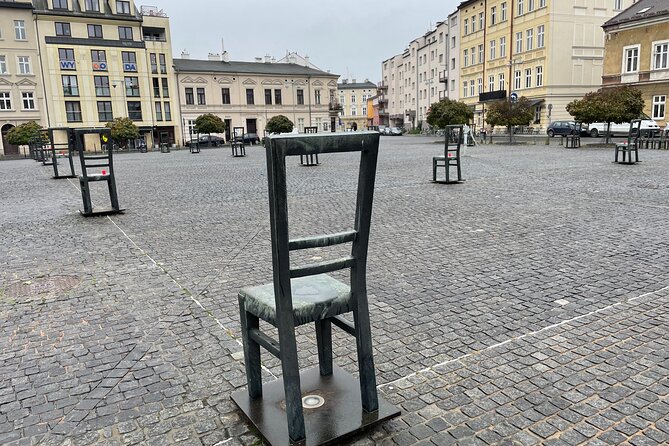
Krakow’s former Jewish ghetto is not a backdrop for a casual stroll. At Plac Bohaterów Getta, empty metal chairs mark the place where families were forced from their homes, and this audio tour uses that square to explain the ghetto, the murders, and the people who tried to survive. From there, you cross the Wisła River into Kazimierz, Krakow’s historic Jewish Quarter.
I like the low price of $9.99, especially since you can replay the tour and walk at your own pace. I also like the mix of Holocaust sites, film locations, murals, synagogues, and present-day community spaces. The main drawback is simple: there is no human guide, and the phone app can be a little glitchy when you download or operate it.
Key points to know
- Start at Plac Bohaterów Getta, the former ghetto square marked by its stark chair memorial.
- Hear the route in English through a GPS-aware smartphone app with narration, music, and sound effects.
- Cross Father Bernatek’s Bridge into Kazimierz, passing public art and the Wisła River.
- See Schindler’s List Passage, Tempel Synagogue, Szeroka Street, Jan Karski’s statue, and the Old Synagogue from outside.
- Plan 70 minutes to two hours, depending on your pace, stops, and how long you spend looking around.
- Finish near the Galicia Jewish Museum, where you can continue exploring on your own.
Starting at Plac Bohaterów Getta
The tour begins at Plac Bohaterów Getta, known in English as Ghetto Heroes Square. This is the right place to begin because the square gives you an immediate sense of what the Krakow ghetto meant in daily life. The metal chairs scattered across the plaza represent the belongings and furniture left behind when Jewish residents were expelled, deported, or killed.
You hear about the people trapped here, the violence inflicted on them, and the organized cruelty of the Nazi occupation. The audio presentation also includes stories of hope and the human connections formed in the square. That balance matters. The site is not reduced to dates and labels. You are asked to picture a neighborhood where ordinary life was ripped apart.
The route gives about ten minutes to the square, but I would not rush it. The app may move you along step by step, yet you control the pace. Pause the narration if you need time to look at the memorial or gather your thoughts.
The adjacent Jewish Ghetto Memorial is treated as the opening point for the story of the Holocaust in Krakow. You hear about the atrocities committed here and about the people who met in this place under impossible conditions. Since the square and memorial are open public spaces, there is no admission charge.
More Audio Walking Tours in Krakow
- Krakow: Old Town Audioguided walking Tour
★ 4.1 · 51 reviews - Krakow: Old Town Audio-Guided Walking Tour with Headset
★ 4.5 · 12 reviews - Krakow Walking Tour with Audioguide on Your Smartphone
★ 4.0 · 5 reviews
The pharmacy that offered a lifeline
The route stops outside the pharmacy connected with Tadeusz Pankiewicz, the Polish pharmacist who operated a business inside the Krakow ghetto. The audio explains how he and his staff helped Jewish residents, including efforts to provide medicine and assistance when the ghetto was under Nazi control.
You do not enter a museum or pharmacy as part of this walk. That is worth knowing before you book. The value comes from standing at the location while hearing the story, then deciding if you want to visit an indoor museum separately.
This stop helps connect the broad facts of persecution with one specific place and one person’s actions. It also gives the tour a needed change of scale. After the memorial and the large story of the ghetto, you focus on a pharmacy and the practical ways people tried to help.
Murals, myths, and the route toward the river
The next section uses public art to connect Krakow’s past with its present. At the Mayamural, you see the Robot Mural and hear how the work relates to the Krakow ghetto. The stop is short, about five minutes, but it adds visual interest to a route that deals with very heavy material.
You then see Blu’s Never Follow mural. The audio discusses why it was painted here, the targeting of Jewish people, and myths connected with the area. This is a useful reminder that Krakow’s Jewish Quarter is not only a set of old buildings. Modern artists also respond to the memory and meaning of these streets.
The route pauses at the statue of Juliusz Lea, an earlier mayor of Krakow. Here you hear about his part in the city’s development. This stop may feel less connected to the Holocaust than the surrounding sites, but it widens the story beyond one period. Krakow’s urban history did not begin or end with the wartime ghetto.
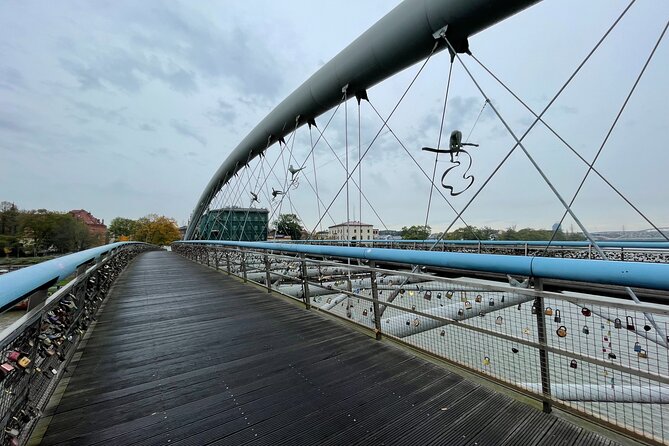
The walk then reaches Father Bernatek’s Bridge over the Wisła River. The bridge is known for the human figures suspended above the walkway. As you cross, the narration explains the bridge and the sculptures. This is one of the route’s welcome changes in mood: you leave the former ghetto area, get river views, and approach Kazimierz on foot.
Entering Kazimierz through Plac Wolnica
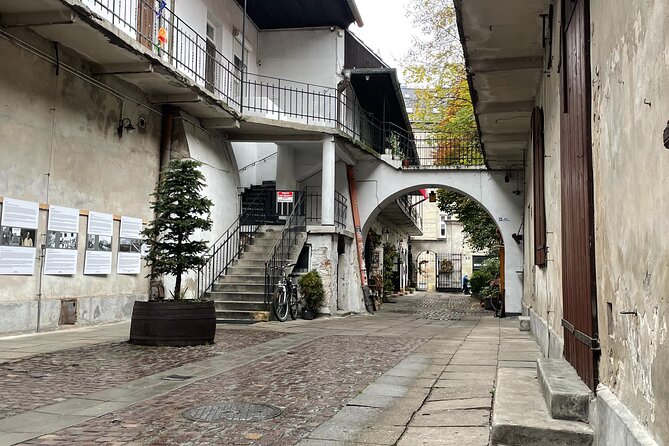
On the far side of the river, the tour reaches Plac Wolnica. The audio explains how the square was founded and how it developed. You are now entering the part of Krakow traditionally known as Kazimierz, the Jewish Quarter.
The route does not pretend that every stop is equally dramatic. Plac Wolnica is more about setting the scene and helping you understand the district’s layout. That makes it useful early in your walk through Kazimierz. You begin to see how public squares, religious buildings, residential streets, and market areas fit together.
The route then moves through the Jewish Quarter, pointing out both well-known sites and less obvious places. Since the tour is location-aware, your phone directs you step by step rather than asking you to follow a long written essay. Keep your phone charged, and use headphones if you want to hear the narration clearly in city traffic.
More Audio Tours in Krakow
- Krakow: Day or Night Vistula River Cruise with Audio Guide
★ 4.5 · 1,303 reviews - Krakow: Hop-On Hop-Off Bus Tour with Audio Guide
★ 3.6 · 703 reviews - Krakow: Wawel Hill Audioguide Tour
★ 4.3 · 582 reviews - Krakow: Sightseeing Cruise on Vistula River with Audio Guide
★ 4.4 · 480 reviews
Finding Schindler’s List Passage
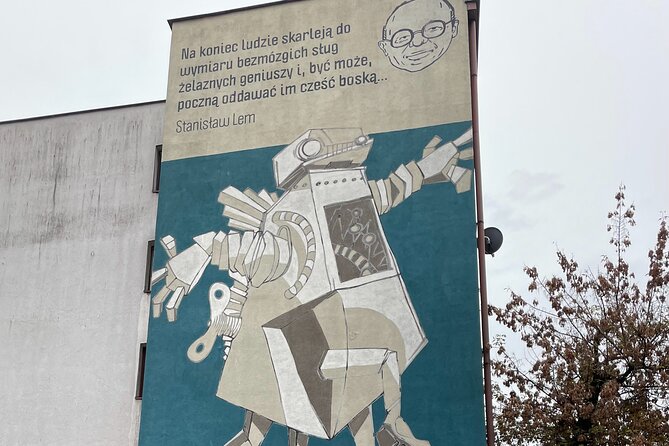
One of the most recognizable stops is Schindler’s List Passage, where scenes from Steven Spielberg’s film were shot. The audio covers the film’s locations and the story of Oskar Schindler, including how he protected and saved Jewish workers.
This stop works best if you have seen the film, but it does not require advance film knowledge. The narration gives the location a historical frame rather than treating it as just a movie photo opportunity. You hear how cinema brought international attention to Krakow and how the real story behind Schindler’s actions fits into the city’s wartime past.
Keep your expectations practical. You are viewing an outdoor passage, not entering a dedicated film attraction. The stop lasts about five minutes, so the app gives you a concise explanation rather than a full museum presentation.
Tempel Synagogue and the Jewish Community Centre
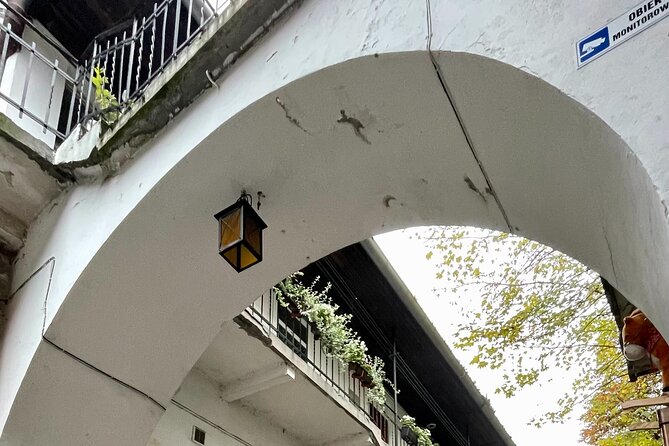
The walk continues past Tempel Synagogue. You hear the building’s story and its effect on the Jewish community, both in the past and today. The route stops outside, so an interior visit is not included.
You then reach the Jewish Community Centre of Krakow, known as JCC Krakow. The audio explains that it was founded by the current King of England and describes how the center brings people together and welcomes visitors.
This is one of the most useful parts of the route for anyone who wants more than a memorial walk. The Jewish Quarter is not only about a vanished community. Jewish life continues here, and the JCC gives you a present-day point of reference. The tour keeps the focus respectful by showing both loss and renewal.
The route’s short timing at each stop also makes the JCC easy to fit into the walk without turning the experience into a long indoor visit. If you want to understand the city’s current Jewish community in greater depth, you would need to explore the center separately.
Szeroka Street and the older Jewish Quarter
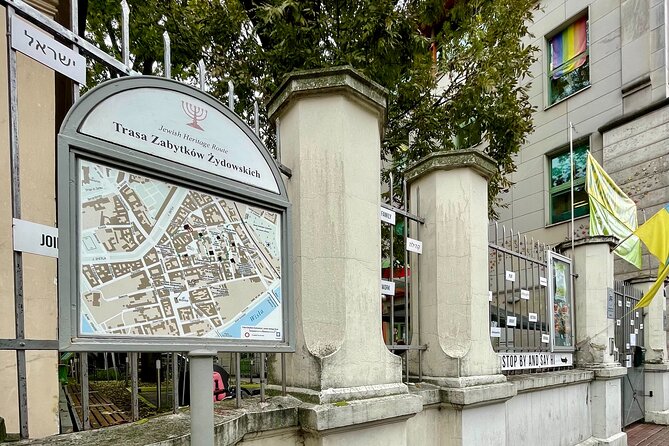
Szeroka Street receives about ten minutes, one of the longer stops on the route. This historic street brings together many of the themes introduced earlier: Jewish residents, synagogues, the mikveh, religious practice, and the development of Kazimierz.
This is where the audio tour feels most like a neighborhood walk. You are not simply moving from one monument to the next. You are looking at a street with religious buildings, old homes, restaurants, public spaces, and layers of memory.
The route explains the role of the mikveh and the synagogues, helping you see how Jewish life was organized in the district. You should allow extra time here if you want to examine the buildings from outside. The narrated portion is timed, but your walk does not need to be.
Reminders of war at the old cemetery
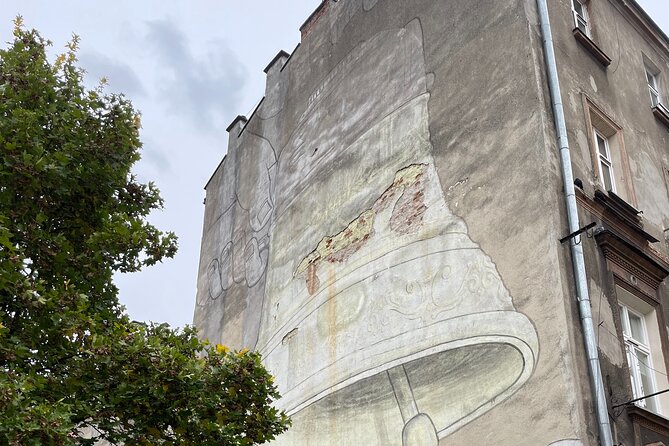
The tour stops outside one of the area’s oldest sites, more than 500 years old. The narration covers its age, what happened there during World War II, and what the Nazis did with Jewish headstones.
This is a difficult stop because it deals with the destruction of burial places and the misuse of memorial stones. The audio keeps the story tied to the physical site, which makes the subject harder to dismiss as an abstract wartime fact.
Again, the route remains outside. No entrance fee is included, and the tour does not provide a guided interior visit. If you want to spend more time at the cemetery or any synagogue, treat this audio walk as an introduction and plan separate visits.
Jan Karski and the Old Synagogue
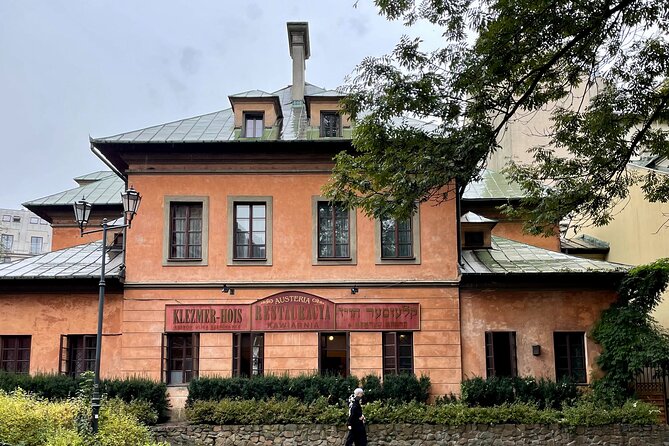
The statue of Jan Karski marks another important point. Karski was a spy who risked his life to report on the Nazis. The stop gives you a brief account of his work and the danger involved.
His story adds another angle to the tour. The walk has already covered victims, rescuers, community institutions, artists, and film history. Karski represents the perilous effort to carry information beyond the places where atrocities were happening.
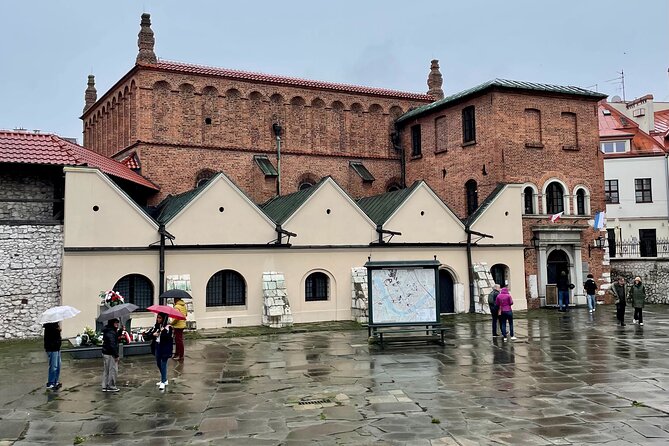
The final major stop is outside the Old Synagogue. The building was rebuilt in 1570 by the Italian architect Mateo Gucci. The audio notes that Gucci had no connection to the modern fashion name, a small touch of humor in an otherwise serious walk.
You also hear that the Old Synagogue is a rare surviving example of a Polish fortress synagogue. The narration covers its history and its less visible, sunken past. This is a strong place to finish the historical portion because it brings together the long life of Jewish Krakow, the damage of World War II, and the survival of an important building.
Finishing at the Galicia Jewish Museum
The route ends at the Galicia Jewish Museum on Dajwór Street. The stated endpoint also includes the museum’s bookstore and a striking mural, giving you a natural place to continue after the audio route ends.
The museum itself is not included as an admission stop. You can decide if you want to enter after the walk. That flexibility is useful because the route can take about 70 minutes at a brisk pace, or closer to two hours if you pause, look around, and let the stories settle.
The endpoint is also practical. You finish in Kazimierz rather than having to return to Plac Bohaterów Getta. Since the tour is self-guided, you can stop before the museum, return to a section later, or listen to the virtual tour after you have left the area.
What the $9.99 price really buys
At $9.99 per person, this is a low-cost way to add structure to an independent day in Krakow. You are paying for a professionally produced English narration, GPS directions, music, sound effects, and access that does not expire.
That last point matters. You can take the walk once, repeat part of it, or listen to the virtual material later. A human guide would offer more chances for questions and live explanation, but this app gives you privacy and control. Only your own group takes part, and you do not need to match a public group’s schedule.
The value is strongest if you already plan to walk between the ghetto and Kazimierz. The app turns that route into a connected story. It is less useful if you want long indoor visits, detailed discussion at each synagogue, or personal answers from a local guide.
The one technical warning comes from the app itself. Download and operation are generally manageable, but it can be a little glitchy. I would install it before reaching the starting square, check your phone battery, and use a reliable connection before setting off.
Who should choose this audio walk?
I would choose this tour if you want a flexible introduction to Krakow’s Jewish ghetto and Kazimierz, especially if you prefer walking alone or with your own group. It suits independent visitors who want clear directions and a serious historical thread without paying for a longer private guide.
It is also a good fit if you have limited time. The route covers major outdoor locations in roughly 70 minutes to two hours, and you can stop when a place catches your attention.
I would choose something else if you need a live guide, plan to enter several museums and synagogues during the walk, or want an extended discussion of Jewish religious history. The narration is useful, but the short stops cannot replace a full museum visit or a long conversation with a local expert.
Should you book the Krakow Jewish Ghetto and Quarter tour?
Book it if you want an inexpensive, self-paced route that connects the former ghetto with Kazimierz. The strongest features are the thoughtful sequence of memorials, public art, Schindler locations, community sites, Szeroka Street, Jan Karski’s statue, and the Old Synagogue.
Skip it if you dislike phone-guided tours or know you will want to ask questions as you walk. For everyone else, $9.99 buys a practical walking framework, replayable audio, and a meaningful introduction to two parts of Krakow that deserve more than a quick photo stop.
FAQ
Where does the tour begin?
The tour begins at Plac Bohaterów Getta in Krakow, Poland.
Where does the tour end?
It ends at the Galicia Jewish Museum at Dajwór 18 in Krakow. The endpoint also includes the museum bookstore and a mural.
How long does the walking tour take?
The approximate duration is 1 hour 10 minutes to 2 hours. Your timing depends on walking speed and how long you spend at each stop.
Is a human guide included?
No. The experience uses a smartphone app with GPS-aware, step-by-step audio guidance. It is a private activity for your group.
Is the tour available in English?
Yes. The tour is offered in English.
Can I cancel for a full refund?
Yes, if you cancel at least 24 hours before the experience start time. Cancellations made within 24 hours are not refunded, and changes within that period are not accepted.
Latest audio tours in Krakow
- Wawel Hill Audio-Guided Tour★ 3.5 · 19 reviews
- Krakow Walking Tour with Audioguide on Your Smartphone★ 4.0 · 5 reviews
- Krakow: Vodka Factory Museum – Entrance Ticket and Audioguide★ 5.0 · 3 reviews
- Wawel Hill Audio Guided Tour★ 3.0 · 2 reviews
- Krakow: Old Town Audio-Guided Walking Tour with Headset★ 4.5 · 12 reviews
- Krakow: Vodka Factory Museum Ticket & Audioguide and Tasting★ 4.3 · 38 reviews
- Krakow: Old Town Audioguided walking Tour★ 4.1 · 51 reviews
- Krakow: Vistula Night Cruise by Gondola w/ Audio Commentary★ 4.5 · 72 reviews
Audio Walking Tours, compared.
City Monuments Guided Walking Tour with Audio Guide
Read our review →
Self Guided Classic Freedom Trail Location Aware (GPS) Walking Audio Tour
Read our review →
Self-Guided Historical Walking Tour (Audio Guide)
Read our review →
Cape Cod & Provincetown Self-Guided Driving & Walking Audio Tour
Read our review →
Verona Walking Tour with Audio and Written Guide by a Local
Read our review →
Royal Walking Tour and Buckingham Palace Audio Tour
Read our review →
Bologna Walking Tour with Audio and Written Guide
Read our review →Browse the lists this tour appears in