
Reviewed · BELGIUM
Ghent Walking Tour with Audioguide on Your Smartphone
Ghent’s best sights sit close enough to link on foot, and this self-guided tour gives you the city’s medieval core without tying you to a guide’s schedule. You’ll cross St. Michael’s Bridge, pass old guild houses and market squares, then move through castles, churches, street art, and local neighborhoods. The offline map and GPS route are especially useful when you want to get your bearings fast.
I like the freedom to pause, skip a stop, or change the order. I also like the price: at $8.42, this is a low-cost way to add historical context to a walk you might make anyway. The tradeoff is simple: you are on your own. You must download and activate the app, bring headphones, and solve any route or technical issue without a human guide beside you.
Key details before you set out
- 31 audio recordings: The app adds spoken history and background to Ghent’s bridges, churches, squares, castle, and street art.
- About three hours on foot: The route links major sights with several 10 to 15 minute walks between stops.
- Start and finish at St. Michael’s Bridge: The route begins at Sint-Michielsplein and returns there.
- One year of access: You can use the tour at any time during that period, with the date and time chosen at checkout treated as approximate.
- English audio with an offline map: The app works on iPhone and Android and includes landmark illustrations.
- Bring your own equipment: A smartphone and headphones are required, and admission tickets, transport, food, and drinks cost extra.
How this Ghent audio walk works
This is not a scheduled walking tour with a person holding a sign. TouringBee supplies an app for iPhone and Android, an offline map, a GPS route, audio recordings, and illustrations to help you recognize each sight.
After booking, you download the app, activate your purchase, and follow the route from St. Michael’s Bridge. The audio is available at any time, so you are not locked into a particular departure. That matters in Ghent, where a rainy morning, a late train, or an unexpectedly good café can easily change your plans.
The route takes about three hours. Several transfers between sights are listed as 10 to 15 minutes of walking, with brief stops of about 10 minutes. In practice, your visit can take longer if you enter the castle, climb a tower, stop for food, or listen to every recording at a relaxed pace.
The app includes 31 recordings, which is more material than the named stops alone suggest. You can listen in English, use the map offline, and move at your own speed. One particularly useful feature is the ability to skip places that do not interest you and return later if you change your mind.
More Smartphone Audio Tours in Belgium
- Antwerp: City Walk with Audio Guide in 7 Languages on your Phone
★ 3.0 · 15 reviews - Bruges Walking Tour with Audioguide on Your Smartphone
★ 4.5 · 14 reviews - Bruges: City Walk with Audio Guide in 7 Languages on your Phone
★ 3.5 · 5 reviews
Starting with St. Michael’s Bridge and the Leie
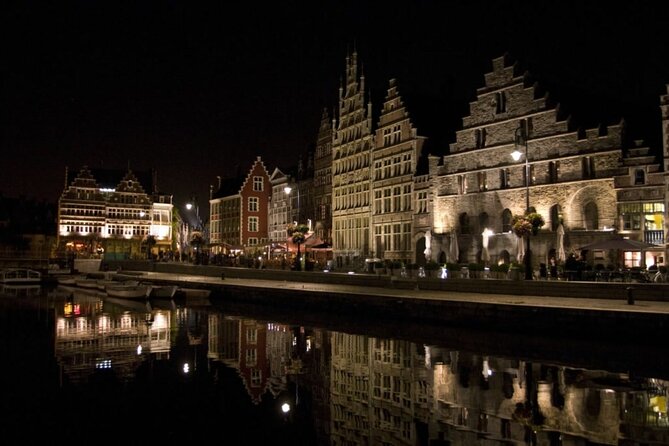
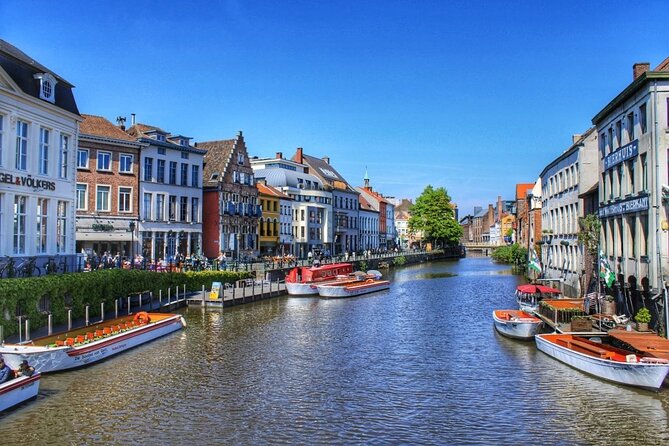
Begin at St. Michael’s Bridge, one of the finest places to see Ghent’s historic center at a glance. From here, you can admire the medieval skyline, the towers of St. Nicholas’ Church and St. Bavo’s Cathedral, and the Castle of the Counts farther along the water.
The bridge gives you an immediate sense of how compact the old center is. Water, stone facades, church towers, and busy pedestrian paths all meet in one view. It is a smart starting point because the audio introduction can give you a framework for the streets and buildings ahead.
The first stop is free, but the bridge can be a busy photo point. If you want a quieter look, pause for a moment after taking the obvious view. Since this is self-guided, you can wait for a clear sightline instead of moving along with a group.
From here, you walk roughly 10 to 15 minutes to Grasbrug Bridge.
Grasbrug, the Old Meat Market, and Groentenmarkt
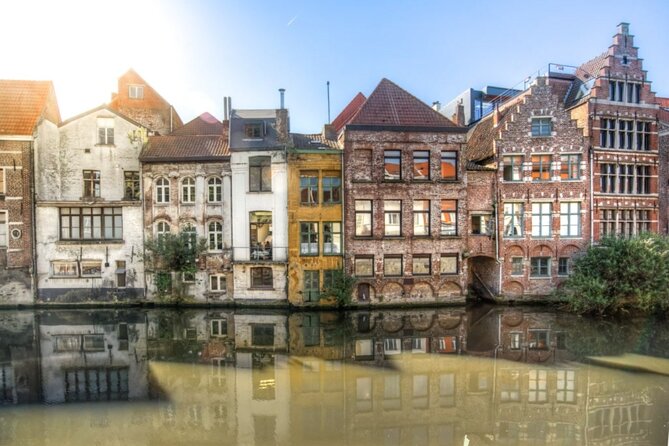
Grasbrug is a small drawbridge across the Leie, linking the Graslei and Korenlei waterfronts. Its appeal is less about a single grand monument and more about the relationship between the bridge, river, and old guild houses.
The audio stop helps you read this part of Ghent as a working medieval waterfront rather than just a pretty photograph. The bridge mechanism adds a touch of old engineering to the scene, while the embankments offer one of the city’s most recognizable urban views.
Next comes the Old Meat Market Hall. The building connects Ghent’s market past with its present use as a food and shopping spot. You can admire the medieval structure, then look inside for food stalls and artisanal shops.
This is one of the route’s more practical stops because it gives you a chance to pause indoors or consider a snack. Food and drinks are not included, so any purchase here is on your own account. The tour does not promise a meal, tasting, or reserved table.
Groentenmarkt follows. This old vegetable market is now a square with cafés, historic buildings, and a steady flow of local activity. It is a good place to notice how Ghent uses its old public spaces in everyday life. The square is not simply a preserved relic. It remains part of the city’s social rhythm.
The audio guide can supply background while you look around, but you should feel free to pause the recording. Listening while crossing streets or studying a building can make you miss the place itself.
Gravensteen Castle and Rabot’s medieval gatehouse
The route then includes Gravensteen, Ghent’s Castle of the Counts. This is the dramatic centerpiece of the walk, with thick medieval walls, battlements, dungeons, and views over the city.
The description allows for exploring the fortress, but entrance tickets are not included. That distinction matters. You can see the castle from outside as part of the walking route, but if you want to enter, climb the battlements, or see the interior displays, you need to buy admission separately.
I would plan extra time here if medieval fortifications are high on your list. The audio recording may explain the castle’s role in power and government, while the physical visit gives you the scale of the walls and the chance to look across Ghent from above. If you are trying to finish in exactly three hours, an interior visit could make the schedule tight.
Rabot offers a different view of the city’s defenses. This medieval gatehouse once served as a toll gate and now marks a meeting point between old Ghent and a modern neighborhood. It is less famous than the castle, but it adds useful context. Ghent was not only a collection of attractive churches and merchant houses. It was also a fortified city with controlled entrances and fees.
Because the route includes both the grand castle and a gatehouse, you get two versions of medieval Ghent: the seat of power and the practical edge of the city.
More Audio Walking Tours in Belgium
- Brussels: City Walk with Audioguide in 7 Languages on your Phone
★ 3.5 · 4 reviews - Ghent: City Walk with Audio Guide in 7 Languages on your Phone
★ 4.5 · 3 reviews - Leuven: City Walk with Audio Guide in 7 Languages on your Phone
★ 3.0 · 3 reviews - Brussels Audioguided walking tour 2h40 and 25 reviews
★ 5.0 · 3 reviews
Patershol and Friday Market Square
Patershol is one of the most atmospheric sections of the walk. Its cobbled streets, old houses, small shops, and eateries create a close-up view of the city’s older residential fabric.
The district was once associated with artisans. Today, its narrow streets lead you through a mix of historic character and contemporary places to eat. This is a stop where you should slow down rather than simply tick off the audio prompt. The route description also points to small squares and gardens, although the exact amount of time you spend exploring is yours to decide.
Next comes Vrijdagmarkt, or Friday Market Square. This broad public space has cafés, guild houses, and views toward the Belfry and St. Nicholas’ Church. Its name recalls the market tradition that helped shape city life here.
The square is useful for understanding Ghent at a larger scale. Patershol shows tight lanes and small buildings. Vrijdagmarkt opens the view and gives you a sense of civic space. The audio guide can connect those pieces while you take a seat or inspect the surrounding facades.
The main drawback is that the route has many stops packed into a limited period. If you stop for a full drink, meal, or extended shopping break, you may need to shorten another section. The app makes that easy, since you can skip a recording and return to it later.
Graffiti Street adds a modern turn
Werregarenstraat, better known as Graffiti Street, changes the mood of the walk. Here, walls serve as an ever-changing public gallery for local and international street artists.
This stop keeps the tour from becoming a procession of old stone buildings. Ghent’s identity includes modern art and informal creative space, not only medieval architecture. The painted surfaces change over time, so the street may look different on a return visit.
I like this part of the route because it gives you a useful contrast. After churches, bridges, and market halls, Graffiti Street shows a city that still makes room for new voices. It is also a quick stop to fit into a walking day, though you may want to pause and examine the details rather than rush through.
The route then turns back toward the major religious and civic landmarks.
St. Bavo’s Cathedral and Ghent’s central towers
St. Bavo’s Cathedral is one of the major stops, with Gothic architecture and the famous Mystic Lamb altarpiece by Hubert and Jan van Eyck. The tour gives you a reason to look beyond the exterior and consider Ghent’s place in European art and religious history.
An entrance ticket is not included, so check the cost and visiting arrangements if you want to see the interior or artwork. The supplied information also refers to ascending the tower for city views, but any tower access would be separate from the audio tour price.
Ghent’s Belfry is the city’s great civic tower and a UNESCO-listed landmark. Its dragon weathervane, carillon, and high views all add a different angle to the cathedral visit. The tower has about 300 steps, so climbing it is an optional physical challenge rather than a casual add-on.
You do not need to climb every tower to appreciate this section. From street level, the Belfry helps explain the old city’s skyline and the role of civic independence. If you do want the view, allow extra time and budget for the entrance fee.
St. Nicholas’ Church comes next. Its Gothic facade and interior sit close to Ghent’s central streets, making it easy to combine with the Belfry and St. Bavo’s. The church offers a quieter pause among the city’s major sights.
The supplied route calls this stop Esglesia de Sant Nicolau, but the familiar English name is St. Nicholas’ Church. If you are using the app map, matching the landmark image with the building will help avoid confusion.
St. Michael’s Church brings the loop back
The final named church is St. Michael’s Church, near the starting point. Inside, you can look for stained glass, an elegant altar, and a calmer setting away from the busiest streets.
Ending near where you began makes the tour easy to fit into a larger day. You can continue to another part of Ghent, return to your hotel, or stop for food without arranging a separate pickup. The activity finishes back at St. Michael’s Bridge.
The return also gives the route a pleasing shape. You begin with the view from St. Michael’s Bridge, walk through the old center and surrounding districts, then come back to the same waterfront area with a better sense of what you have seen.
Is $8.42 good value?
At $8.42 per person, this is inexpensive for a three-hour sightseeing route with 31 audio recordings, an offline map, GPS navigation, landmark illustrations, and one year of access.
The value is strongest if you already like walking independently. A human guide can answer questions and adjust the pace, but that service costs more and follows a fixed timetable. Here, you are paying mainly for structure and background. The app turns a loose city walk into a planned route.
The price does not cover transport, food, drinks, a smartphone, headphones, or entrance tickets. Those exclusions are reasonable for an audio walk, but they affect your real budget. Add castle, cathedral, or Belfry admission if you plan to go inside.
At the same time, you avoid the pressure to pay for sights you do not want. You can admire Gravensteen from outside, skip a church interior, or spend longer at Graffiti Street. That flexibility is a large part of the value.
What can go wrong, and how to avoid it
The main practical risk is app setup. One booking had trouble downloading the tour, while the provider’s response indicated that support can help with installation and code-entry problems. Do not wait until you are standing in the square to discover that the audio is not ready.
Download the app and activate the purchase before setting out. Bring charged devices and your own headphones. The tour is designed for iPhone and Android, but the experience depends on your phone working properly.
The map is intended for offline use, which is helpful, but you still need to follow the route yourself. There is no human guide to point out a missed turn, explain a question, or keep the group together. The maximum group size is listed as 20, but this format is still fundamentally self-guided rather than a conventional group walk.
The tour is offered in English. The information also notes a preferred language during purchase, but the listed offering is English, so confirm the language you need before booking.
Free cancellation is available if you cancel at least 24 hours before the local start time. Cancellations inside that window are not refunded, and changes are not accepted.
Who should book this Ghent walking tour?
I would choose this for an independent visitor who wants a useful route but does not want to join a scheduled group. It suits solo visitors, couples, and small groups who enjoy stopping for photos, changing the order, or skipping a sight.
It is also a good first audio-guide experience. The route map is clear, the speaker is described as easy to understand, and the app keeps the walk moving without requiring you to read a guidebook at every corner.
Families and groups with different interests may appreciate the flexibility. One person can spend more time at the castle while another skips ahead to the market square. Just remember that everyone needs access to the app and, ideally, personal headphones.
I would choose a human-led tour instead if you want lively conversation, detailed answers, or help interpreting every building on the spot. I would also avoid booking this as your only plan if you dislike phone-based navigation or have unreliable mobile equipment.
Should you book it?
Book this tour if you want a low-cost, flexible introduction to Ghent that covers far more than the postcard waterfront. The route connects bridges, markets, a fortress, old neighborhoods, street art, churches, the cathedral, and the Belfry, giving you a broad look at the city.
Skip it if you need a guide beside you or want entrance tickets bundled into one price. For everyone else, the combination of self-paced walking, useful audio context, and a one-year access period makes $8.42 a sensible way to organize your first day in Ghent. Download everything before you arrive, bring headphones, and leave room in your schedule for the stops you decide deserve extra time.
FAQ
Where does the Ghent audio tour start?
It starts at St. Michael’s Bridge, at Sint-Michielsplein, 9000 Gent, Belgium.
Where does the tour finish?
The activity ends back at the starting point near St. Michael’s Bridge.
How long does the tour take?
The walking tour takes approximately three hours. Several transfers between stops take about 10 to 15 minutes on foot.
Is this a guided tour with a person?
No. This is a self-guided experience using a mobile app, audio recordings, an offline map, and GPS navigation.
What do I need to bring?
Bring your own smartphone and headphones. Neither is included with the tour.
Are entrance tickets included?
No. Entrance fees and tickets are not included. Transportation, food, and drinks are also separate.
Can I use the tour at any time?
Yes. The audio guide is available at any time, and the date and time selected during checkout are approximate. You receive access for one year in your preferred language.
Latest audio tours in Belgium
- Lost Lanes and Secret Gardens Self Guided Audio Tour★ 5.0 · 3 reviews
- Liege Scavenger Hunt and Highlights Self Guided Audio Tour★ 4.0 · 9 reviews
- Hidden Ghent: A Self-Guided Audio Tour Of The Flemish City★ 5.0 · 2 reviews
- Ghent: City Walk with Audio Guide in 7 Languages on your Phone★ 4.5 · 3 reviews
- Ghent Scavenger Hunt and Highlights Self Guided Audio Tour★ 3.5 · 3 reviews
- Brussels: City Walk with Audioguide in 7 Languages on your Phone★ 3.5 · 4 reviews
- Leuven: City Walk with Audio Guide in 7 Languages on your Phone★ 3.0 · 3 reviews
- Brussels Scavenger Hunt and Highlights Self Guided Audio Tour★ 5.0 · 4 reviews
Audio Walking Tours, compared.

City Monuments Guided Walking Tour with Audio Guide
Read our review →

Self Guided Classic Freedom Trail Location Aware (GPS) Walking Audio Tour
Read our review →
Self-Guided Historical Walking Tour (Audio Guide)
Read our review →
Cape Cod & Provincetown Self-Guided Driving & Walking Audio Tour
Read our review →
Verona Walking Tour with Audio and Written Guide by a Local
Read our review →
Royal Walking Tour and Buckingham Palace Audio Tour
Read our review →
Bologna Walking Tour with Audio and Written Guide
Read our review →Browse the lists this tour appears in