

Reviewed · PORTUGAL
Coimbra Walking Tour with Audioguide on Your Smartphone
Coimbra’s story unfolds uphill, from the Mondego River toward its ancient university. This self-guided walk connects medieval towers, Roman remains, grand churches, and academic landmarks for just $8.45, letting you stop for coffee or linger over a view without keeping pace with a group.
I like the 23 professional audio recordings and the one-year access, which gives you room to split the route or repeat a favorite section. I also like that the guide takes you beyond the obvious sights. The catch is navigation: one review found the route description unclear in places, so keep the offline map open and allow extra time.
Key points to know before you book

- Start at Largo da Portagem: The central meeting point makes the walk easy to reach by public transport.
- Hear 23 narrated stops: A professional historian provides the commentary through an iPhone or Android app.
- See Coimbra’s layers: The route links Torre de Anto, Sé Velha, the Machado de Castro Museum, Sé Nova, and the university area.
- Bring your own kit: You need a charged smartphone and headphones. Entry tickets are separate.
- Plan for uphill walking: The route heads from the lower city toward Coimbra’s historic high ground.
- Keep the map handy: The offline GPS route helps, but the walking directions may not always feel perfectly clear.
A low-cost way to meet Coimbra’s old town
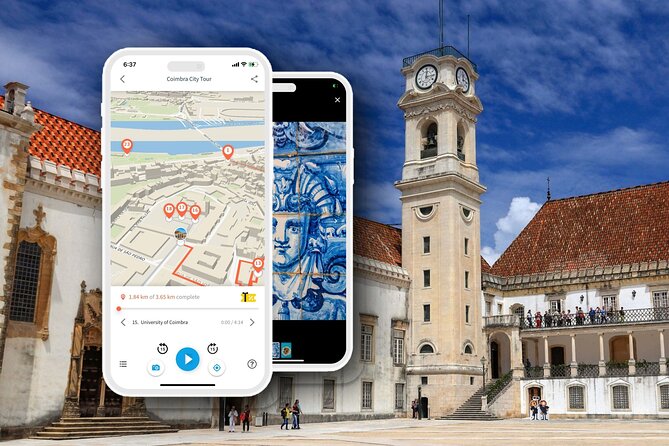
At $8.45 per person, this is priced as a digital orientation rather than a full guided tour. You are paying for access to the app, 23 audio segments, landmark illustrations, and a route map, not for a guide who walks beside you or for admission to the sights.
That distinction matters in Coimbra. The city’s historic center is compact enough to explore on foot, but its steep streets and dense old lanes can make it hard to know which turn matters. An audio route gives you a thread to follow while leaving you free to pause for coffee, take photographs, or spend longer inside a church.
The tour lasts about two hours, including walking and time at the stops. The listed stop times are brief, often only five or ten minutes, so treat the schedule as a framework rather than a strict timetable. If you decide to enter the cathedral, museum, or university, your visit will take longer because admission time is not included in the estimate.
The app remains available for one year. That is useful if you arrive late, want to divide the walk over two days, or would like to replay sections after seeing the city from a different angle.
More Smartphone Audio Tours in Portugal
- Lisbon: São Jorge Castle E-Ticket and Audio Guide
★ 4.3 · 2,182 reviews - Quinta da Regaleira: Skip-The-Booth E-Ticket and Audio Guide
★ 4.2 · 2,067 reviews - Lisbon: Jerónimos Monastery E-Ticket and Audio Guide
★ 3.7 · 660 reviews
Starting at Largo da Portagem
The walk begins at Largo da Portagem, 3000-337 Coimbra, a practical location in the lower part of the city. From here, the route leads upward into the old center, where Coimbra’s streets become older, narrower, and more layered.
Before leaving, download or open the app and check the offline map. You will need your own smartphone and headphones. Since there is no human guide, your phone is your map, ticket to the commentary, and timing tool all at once.
The offline feature is one of the most useful parts of the package. Mobile service can vary in old stone buildings and narrow lanes, so having the route stored on your phone reduces dependence on a live connection. Still, keep the route visible when moving between stops. Clear audio does not always mean clear street directions.
One review praised the guide for reaching beautiful places that might otherwise be missed, while also noting that the walking route was occasionally hard to follow. I would take that as a simple planning warning, not a reason to avoid the tour. Give yourself a little patience at turns, and do not rush away from a landmark merely because the recording has finished.
Torre de Anto and Coimbra’s medieval character

The first listed stop is Torre de Anto, a medieval tower in Coimbra’s old center. The tower is linked with a 16th-century poet’s residence and now includes a small museum focused on local crafts and history.
This is a good opening stop because it sets the tone for the walk. Coimbra is not just a university town. Its identity is built from old stone, religious power, royal connections, poetry, and everyday craft. Torre de Anto gives you a small-scale introduction before the route reaches the city’s larger monuments.
The listed visit lasts about ten minutes, and admission is not included. From the upper levels, you can expect views across Coimbra’s rooftops. Those views help you understand the city’s shape, especially the climb from the lower streets toward the university district.
The tower is also a reminder that Coimbra’s most appealing sights are not always enormous. A compact museum and a high viewpoint can explain the city better than a long list of grand façades. Let the recording provide the background, then look closely at the building itself.
Sé Velha, a fortress-like cathedral

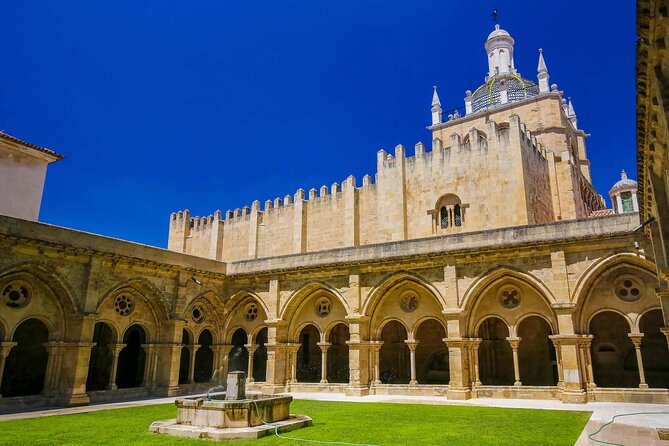
The Old Cathedral of Saint Mary, known as Sé Velha, is one of the route’s essential stops. Built in the 12th century, it has a defensive Romanesque exterior that feels almost like a fortress.
Inside, the mood changes. The golden stone and religious decoration create a quieter, softer space than the exterior suggests. The cathedral also includes a Gothic cloister, which gives you a chance to see how medieval worship, architecture, and daily religious life were connected.
The listed stop lasts five minutes, but that is enough only for an introduction. Admission is separate, so decide in advance if you want to go inside. If you do, allow more time than the audio schedule suggests.
I like this stop because it provides a sharp contrast with the later Baroque New Cathedral. You see two different periods of Portuguese sacred architecture within the same city, and the difference is easy to grasp without an art-history background. Sé Velha feels sturdy and restrained. Its design speaks through thick walls, arches, and stone rather than through display.
The commentary also places the building within Coimbra’s role as an early Portuguese capital, as well as its royal ceremonies and medieval processions. That context gives the cathedral more meaning than a quick photograph from the street.
Another self-paced route in Portugal:
- Quinta da Regaleira Skip-the-Ticket-Line Entry & Audioguide
★ 4.2 · 3,316 reviews - Pinhão: 2-Hour Rabelo Boat Tour with Audio Guide
★ 4.3 · 1,224 reviews - Lisbon: Tram 28 Entry Ticket & Audio Guide with 24-Hour Pass
★ 4.0 · 930 reviews - Sintra: Castle of the Moors & Quinta Entry with Audio Guides
★ 4.3 · 252 reviews
The Machado de Castro Museum and Roman underground remains
The route also takes you to the National Museum Machado de Castro, housed in a former bishop’s palace. It is named for Joaquim Machado de Castro, a major Portuguese sculptor, and its collections include sculpture, painting, and decorative arts.
The museum’s most unusual feature is below ground: the Roman Cryptoporticus, an underground gallery dating from the first century. This gives the walk another time layer. Within a few streets, you move from Roman construction to medieval worship and then toward the university’s centuries of academic life.
No admission price or specific visit length is included in the tour information, so treat the museum as an optional paid extension rather than part of the basic $8.45 experience. If art and archaeology are central to your interests, you may want to schedule extra time here and buy entry separately.
The museum is especially valuable because it broadens the route beyond churches and viewpoints. You are not simply moving from one impressive building to another. You are seeing how Roman, religious, artistic, and civic history overlap in Coimbra.
Sé Nova and the change to Baroque style

The New Cathedral of the Holy Name of Jesus, or Sé Nova, sits near the university. Built in the 16th century, it became Coimbra’s main cathedral in 1772.
Its architecture offers a clear counterpoint to Sé Velha. The New Cathedral uses Baroque and Jesuit ideas, with a grander façade, ornate woodwork, golden chapels, impressive altars, and organs. Where the Old Cathedral feels defensive and medieval, the New Cathedral is more theatrical and ordered for a later age.
The planned audio stop is only five minutes, and admission is not included. That is enough to identify the building and understand its importance, but not enough for a relaxed interior visit. If you enjoy sacred art, plan to stay longer and account for the separate ticket.
This pairing of the two cathedrals is one of the best reasons to choose the route. You can compare them while the differences are fresh in your mind. The walk turns architectural change into something you can see, not just something you read about.
The University of Coimbra and its grand academic setting

The University of Coimbra is the route’s most famous destination. Founded in 1290, it is one of Europe’s oldest academic institutions and part of Coimbra’s UNESCO World Heritage setting.
The university area gathers much of the city’s identity in one place. The route points you toward centuries-old halls, the ornate Joanina Library, and the University Tower, whose height offers views over Coimbra and the Mondego River.
The basic tour does not include entrance tickets. That is important here because the university complex is more than a building you can quickly glance at from the street. If you want the full interior experience, especially the library and tower, plan for separate admission and extra time.
The audio commentary is useful even if you do not enter everything. It can help you understand why the university dominates Coimbra’s upper town and why student tradition remains so closely tied to the city’s character. The university is not simply another monument on a route. It explains why Coimbra feels like an academic city as much as a historic one.
Because the walk climbs toward this area, comfortable footwear matters. The experience is not described as difficult, and most people can participate, but the route’s uphill direction is worth remembering when planning your day.
The Clock Tower and the final views

The Clock Tower is another emblem of the university area. Its design and chimes connect the modern streets around it with centuries of academic and civic timekeeping.
The attraction is simple but effective. You get a recognizable place for photographs and another way to read the city’s history through sound and architecture. The tower helps tie together the final part of the walk, especially after the larger university buildings and church interiors.
The tour ends back at the starting point. Since the route includes walking time as well as stops, you should not expect an uninterrupted sequence of audio tracks. The experience works best when you treat it as a flexible loop rather than a race from one landmark to the next.
What the app does well, and where it falls short
The app includes 23 audio recordings narrated by a professional historian. That is a solid amount of content for a two-hour route, especially at this price. The landmark illustrations can also help you identify the correct building when several old façades look similar.
I particularly like the freedom of an audio tour. You can pause for a coffee, replay a section, or move at your own speed. One person specifically enjoyed taking a coffee break along the way, which is exactly how this kind of tour should work.
The one-year access period adds practical value. You are not tied to the exact two-hour window, and you can return to the route later. It may also suit you if you want a quick introduction on one day and a slower visit to selected sights afterward.
The main weakness is route clarity. One review praised the clear explanations and the extra places discovered along the way, but also found some walking directions difficult. That is a fair limitation of self-guided touring. A human guide can point, wait, and correct you. An app cannot.
Use the offline map, watch the landmark illustrations, and leave room for wrong turns. The map is included to make GPS navigation easier, but no app removes the need to pay attention in old streets.
Who will get the most from this Coimbra walk
This tour suits you if you like learning while moving, prefer not to follow a fixed group, and want a low-cost introduction to Coimbra’s central sights. It also works well for independent visitors who enjoy choosing when to stop.
It is a good match for:
- First-time visitors wanting a broad introduction to the old center
- History and architecture fans who want context at several landmarks
- People who prefer audio commentary to reading long panels
- Couples or small groups who want their own pace
- Anyone comfortable using a smartphone for directions
It is less suitable if you want a personal guide, a carefully timed group experience, or included entry to the cathedral, museum, and university. It also may frustrate you if you dislike following GPS routes or do not want to bring headphones.
The maximum group size is listed as 20, but because this is a digital tour with no human guide, you should think of it as an individual experience rather than a conventional group excursion.
Price, practical details, and cancellation
At $8.45, the experience offers good value if you use the audio content and visit several of the listed areas. The price is less attractive if you only want a short walk to see the exteriors, since the major entry fees are extra.
Confirmation is provided at booking. The activity is near public transportation, most people can participate, and it begins and ends at Largo da Portagem. Transportation during the walk is not included, though the route itself is designed for walking.
You receive free cancellation if you cancel at least 24 hours before the local start time. Cancellations within 24 hours are not refunded, and late changes are not accepted. That policy is worth noting if your Coimbra plans are still shifting.
Should you book the Coimbra smartphone tour?
Book it if you want an inexpensive, flexible introduction to Coimbra with enough commentary to connect the Roman, medieval, religious, and university parts of the city. The clear narration, extra locations, offline map, and one-year access make it more useful than a simple audio download.
Skip it if you want a human guide, included admission, or perfect turn-by-turn directions. If you choose it, bring headphones, charge your phone, download the route, and allow more than two hours if you plan to enter the paid sights. Used that way, this is a sensible first look at Coimbra, with enough freedom to make the city feel like your own discovery.
FAQ
How long does the Coimbra walking tour take?
The tour takes approximately two hours, including time spent walking between the stops and visiting the listed locations.
Where does the tour start and end?
It starts at Largo da Portagem, 3000-337 Coimbra, Portugal, and ends back at the same meeting point.
Is a human guide included?
No. This is a self-guided experience using an audio guide app on your iPhone or Android smartphone.
What is included with the booking?
You receive 23 audio recordings narrated by a professional historian, an audio guide app, landmark illustrations, an offline route map with GPS navigation, and one year of access in your preferred language.
Are entrance tickets included?
No. Admission fees for locations such as Torre de Anto, the Old Cathedral, the New Cathedral, the Machado de Castro Museum, and the University of Coimbra are not included.
Can I cancel for a refund?
Yes. You can receive a full refund if you cancel at least 24 hours before the experience start time. Cancellations made within 24 hours are not refunded.
More Audio Walking Tours in Portugal
- Lisbon Walking Tour with Audioguide on Your Smartphone
★ 4.5 · 4 reviews - Audio Guide City Walk Lisbon for Cruise Guests
★ 4.9 · 4 reviews - Porto Walking Tour with Audioguide on Your Smartphone
★ 4.5 · 2 reviews - Sofia: City Monuments Guided Walking Tour with Audio Guide
★ 4.5 · 825 reviews
Latest audio tours in Portugal
- Porto Walking Tour with Audioguide on Your Smartphone★ 4.5 · 2 reviews
- Douro Valley: Rabelo Boat Tour with Audio Guide★ 4.0 · 9 reviews
- Douro Valley: Rabelo Boat Tour with Port Wine & Audio Guide★ 4.5 · 10 reviews
- Prazeres Cemetery: A Self-Guided Audio Tour in Lisbon★ 3.0 · 2 reviews
- Lisbon: E-ticket to St. George Castle & Audio Tour on Your Phone★ 3.0 · 18 reviews
- National Palace and Gardens of Queluz: E-ticket with Audio Guide★ 3.5 · 6 reviews
- Riverside Ride Audio Adventure Lisbon to Belem★ 5.0 · 8 reviews
- Lisbon Walking Tour with Audioguide on Your Smartphone★ 4.5 · 4 reviews
Audio Walking Tours, compared.

City Monuments Guided Walking Tour with Audio Guide
Read our review →

Self Guided Classic Freedom Trail Location Aware (GPS) Walking Audio Tour
Read our review →
Self-Guided Historical Walking Tour (Audio Guide)
Read our review →
Cape Cod & Provincetown Self-Guided Driving & Walking Audio Tour
Read our review →
Verona Walking Tour with Audio and Written Guide by a Local
Read our review →
Royal Walking Tour and Buckingham Palace Audio Tour
Read our review →
Bologna Walking Tour with Audio and Written Guide
Read our review →Browse the lists this tour appears in